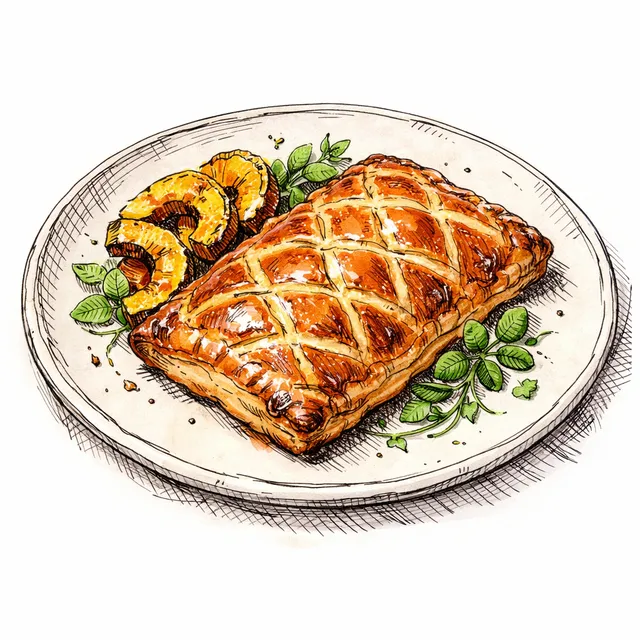
Aged Gruyere, Delicata Squash and Dijon Rough-Puff Dartois
We are not suffering for brunch. When I crave the lacy, buttery drama of a classic French pastry on a Tuesday night, I lean on rough-puff. This Dartois is my answer to the savory side of baking. The inspiration hit me during a chilly autumn in my Paris kitchen, staring at a surplus of sweet delicata squash and a block of sharp Gruyere. Delicata is the lazy baker's dream because the skin is tender and edible—no peeling required. We slice it thin, roast it fast, and sandwich it between buttery pastry tracks spiked with tangy Dijon. Why it works: folding cold butter into flour just enough times creates distinct layers without the three-day commitment of traditional lamination. The fridge is your friend here; let time do the work. Slice this golden slab into sleek fingers and serve it warm. Butter is not a garnish. Don't skip the flaky salt on top just before it hits the oven.
Featured Recipe
Aged Gruyère, Delicata Squash & Dijon Rough-Puff Dartois
A shatteringly crisp café pastry slab layered with sharp Dijon, caramelized delicata squash, and a molten blanket of nutty aged Gruyère. Sliced into sleek fingers, this delivers all the lacy, laminated drama of classic French pastry with a streamlined weeknight rough-puff method.
Save a copy to your collection for editing
Timeline
Ingredients
- 240 g all-purpose flour(about 2 cups, chilled for 15 minutes if your kitchen runs warm)
- 225 g unsalted cultured butter(1 cup (2 sticks), straight from the fridge and cut into 1/2-inch cubes)
- 1 tsp fine sea salt(divided)
- 120 ml ice water(1/2 cup, ice cubes removed before measuring)
- 1 tsp apple cider vinegar(relaxes gluten to keep the pastry flaky, not rubbery)
- 1 medium delicata squash(about 300g, halved lengthwise, seeded, and cut into 1/4-inch half-moons (no peeling required))
- 1 tbsp extra-virgin olive oil
- 0.5 tsp freshly ground black pepper
- 2 tbsp Dijon mustard(traditional French sharp style)
- 170 g aged Gruyère cheese(about 1 3/4 cups coarsely grated, divided; choose an alpine Gruyère aged at least 10 months)
- 1 tbsp fresh sage leaves(finely chopped)
- 1 large egg(beaten with 1 tsp cold water for egg wash)
- 0.5 tsp flaky sea salt(such as Maldon)
- 30 g aged Gruyère cheese(Mentioned in Step 6, but only 140g was listed in Step 5. Assuming a total of 170g.)
Instructions
- 1
Preheat your oven to 400°F (205°C). Toss 1 medium delicata squash slices on a baking sheet with 1 tbsp extra-virgin olive oil, 0.5 tsp fine sea salt, and 0.5 tsp freshly ground black pepper. Spread into a single layer and roast for 18 to 20 minutes until tender with caramelized edges. Let cool completely on the sheet pan.
20 min
Tip: Leave the skin on! Delicata skin is paper-thin and softens completely in the heat, adding texture and skipping fussy peeling.
- 2
In a wide mixing bowl, whisk together 240 g all-purpose flour and the remaining 0.5 tsp fine sea salt. Toss in 225 g unsalted cultured butter. Using your fingers or a pastry blender, press the cubes flat into thin walnut-sized sheets—do not rub them down into fine meal. Stir 1 tsp apple cider vinegar into 120 ml ice water, then drizzle it over the flour. Use a flexible bench scraper to fold the mixture together until a shaggy, ragged dough just clings together.
8 min
Tip: Big, visible shingles of butter are the secret. As that trapped moisture turns to steam in the oven, it lifts the dough into airy, lacy sheets.
- 3
Tip the shaggy mass onto a lightly floured surface. Press it into a rough 6x10-inch rectangle. Roll gently into a 8x15-inch strip. Fold the top third down and the bottom third up, just like a business letter (un tour simple, or a single letter fold). Turn the dough 90 degrees, roll out to 8x15 inches again, and repeat the letter fold once more. Flatten into a compact 5x7-inch block, wrap tightly in parchment, and chill in the refrigerator for 25 minutes.
7 min
Tip: If the butter ever feels soft or smears greasy instead of rolling, slide the board straight into the freezer for 5 minutes. Cold butter equals flake; warm butter equals dense dough.
- 4
Keep the pastry dough chilling in the coldest part of your refrigerator so the gluten relaxes completely and the butter firms up.
25 min
Tip: Let time do the work. Resting here guarantees your dough won't shrink or turn tight like a bad alibi when baked.
- 5
Line a large sheet pan with parchment. Unwrap the chilled pastry, cut it in half, and roll one piece into a 5x14-inch rectangle about 1/8-inch thick; transfer to the pan. Spread 2 tbsp Dijon mustard down the center, leaving a 1/2-inch border bare along all sides. Shingle the cooled squash slices over the mustard, then scatter 1 tbsp fresh sage leaves and 140 g aged Gruyère cheese on top. Roll the second piece of dough to the exact same dimension and drape it over the filling. Press the outer edges firmly to seal, then trim with a sharp knife to neaten.
12 min
Tip: Make sure your squash is completely cool before building, or it will melt the pastry butter prematurely.
- 6
Brush the top surface evenly with the 1 large egg wash. Use the back of a paring knife to score diagonal crosshatch marks across the top crust, cutting lightly into the surface without piercing through the dough. Cut 4 small vent slits along the top. Sprinkle the remaining 30 g aged Gruyère cheese and 0.5 tsp flaky sea salt directly over the pastry. Chill the assembled pastry in the freezer for 10 minutes to set the lamination.
10 min
Tip: Freezing the fully assembled tart right before baking shocks the butter layers, giving you an explosive oven-spring.
- 7
Slide the chilled dartois into the 400°F (205°C) oven. Bake for 24 to 26 minutes, until the pastry is deep bronze, puffed high with visible layered ridges along the edges, and the Gruyère filling is aggressively bubbling through the vents.
26 min
Tip: Don't pull it out at pale gold. You want a deep café-grade chestnut color—that's where true caramelized depth and shatter live.
- 8
Let the dartois settle on the baking sheet for 5 minutes. Transfer to a cutting board and slice crosswise with a large serrated knife into 8 finger bars.
5 min
Tip: Saw through the pastry in swift, confident strokes with a serrated bread knife instead of pressing down, keeping those crisp layers pristine.
Chef's Notes
A dartois is classic Parisian café vernacular: a long, laminated puff-pastry rectangle scored with neat diagonals and cut into snackable fingers. Why it works: High-fat alpine Gruyère brings intense savory funk without excess moisture, keeping the bottom crust crisp instead of soggy. Don't skip this: cultured butter has higher fat and lower water content than standard supermarket butter, which translates directly to crispness and sheer lamination. Butter is not a garnish, so buy the good stuff.

Camille Roux
Café-level bakes, weeknight methods, zero compromise.
Camille “Cami” Roux was born in Paris with flour in her hair and a healthy skepticism of culinary dogma. She grew up around neighborhood boulangeries that treated crust and crumb like religion—but what stuck with her wasn’t rigid tradition. It was the quiet precision: good butter that actually tastes like milk, patient fermentation that builds flavor for free, and desserts that know when to stop before they get cloying. After moving to the Bay Area, Cami trained in a bread-and-pastry scene obsessed with texture, naturally leavened doughs, and seasonal fruit—Tartine energy, minus the martyrdom. She became known for loaves that sing when they cool, jammy tarts with clean edges, and “how is this so good?” weeknight pastries made with a few smart shortcuts. Her motto is high impact, low fuss: splurge where it counts (butter, salt, time), streamline the rest (sheet pans, one bowl, cold-proofing). If it doesn’t improve flavor or structure, it doesn’t earn a step.