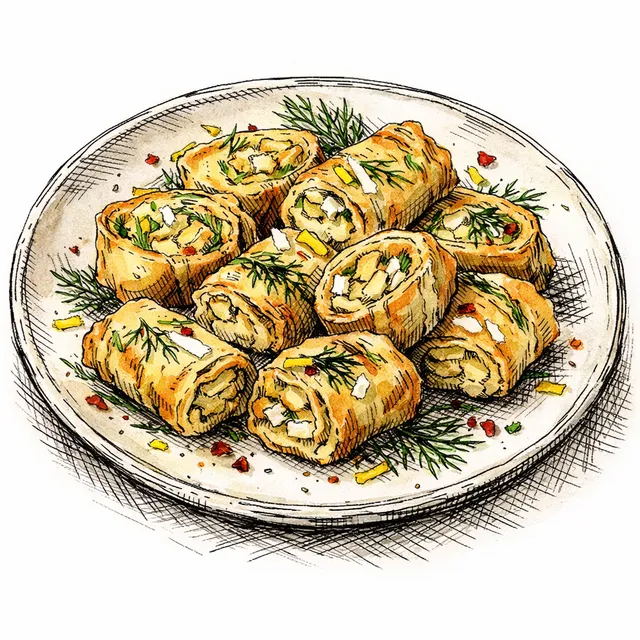
Artichoke–Feta Phyllo Roulettes: My 4 p.m. Café-Case Fix
These Artichoke–Feta Phyllo “Roulettes” are the savory café-case bites I always want at 4 p.m.—when the day goes a little soft at the edges and I need something crackly, salty, and sharp.
The inspiration is half Paris, half Bay Area. In Paris, I’d linger at the bakery counter and choose whatever looked like it would shatter—feuilleté (flaky pastry) energy, even when it wasn’t puff. In California, I fell hard for briny artichokes, citrus, and herbs that taste alive. Put them together and you get a tight spiral with a tangy center and real crunch.
My memory: assembling trays of these in a tiny kitchen before friends arrived, buttering phyllo like it was my job (it is), then hearing that first loud crackle as someone took a bite. Instant mood lift.
Why it’s special: it’s elegant without suffering. The shaping is clean—roll, slice, bake. No pastry drama.
Make it yours: swap dill for mint or parsley, add chopped olives, or use za’atar instead of Aleppo. Keep the lemon zest. It wakes everything up.
Cami’s shortcut note: freeze the sliced spirals raw on a sheet pan, then bake from frozen.
Don’t skip this: generous butter between the sheets. Butter is not a garnish.
Featured Recipe
Artichoke–Feta Phyllo “Roulettes” (Lemon Zest, Dill, Aleppo)
These are the savory café-case bites I always want at 4 p.m.: crackly phyllo, a tangy artichoke–feta center, and tight little spirals that shatter when you bite. They’re make-ahead friendly, freezer-happy, and the shaping is clean and confident—no pastry drama. Butter is not a garnish here; it’s the whole point.
Save a copy to your collection for editing
Ingredients
- 2 cans (14 oz/400 g each) Canned artichoke hearts, well-drained(Packed in water or brine; not oil-marinated)
- 170 g Feta cheese(Crumbled (about 6 oz))
- 60 g Cream cheese(Softened (about 2 oz); helps bind without making it heavy)
- 30 g Parmigiano-Reggiano(Finely grated (about 1/3 cup), optional but excellent)
- 1 Lemon(Zest + 1 Tbsp juice)
- 2 Tbsp Fresh dill(Finely chopped (or 1 Tbsp chives))
- 1 clove Garlic(Microplaned or very finely grated)
- 1 tsp Aleppo pepper(Or 1/2 tsp red pepper flakes)
- 1/2 tsp Black pepper
- 1 package (16 oz/450 g) Phyllo dough(Thawed overnight in the fridge, then kept covered while you work)
- 113 g Unsalted butter(Melted (1 stick); plus a little extra if you’re generous (you should be))
- 1 Tbsp Extra-virgin olive oil(Mixed with the butter for better browning without scorching)
- 1 Egg(Beaten with 1 tsp water for egg wash)
- 2 tsp Sesame seeds(Optional, for the top)
- 1/2 tsp Flaky salt(To finish (optional but very café))
Instructions
- 1
Heat the oven to 400°F / 205°C. Line a sheet pan with parchment.
5 min
Tip: Phyllo likes a hot oven—this is how you get that crisp, elegant shatter instead of a sad chew.
- 2
Dry the 2 cans (14 oz/400 g each) Canned artichoke hearts, well-drained like you mean it: drain, then press firmly in a clean towel to squeeze out as much liquid as possible. Rough-chop into 1/4-inch pieces.
8 min
Tip: Don’t skip this. Wet artichokes = tight like a bad alibi, and your phyllo steams instead of flakes.
- 3
Make the filling: in a bowl, mash together 170 g Feta cheese and 60 g Cream cheese until mostly smooth. Fold in chopped artichokes, 30 g Parmigiano-Reggiano (if using), 1 Lemon zest, 1 Lemon juice, 2 Tbsp Fresh dill, 1 clove Garlic, 1 tsp Aleppo pepper, and 1/2 tsp Black pepper.
6 min
Tip: You’re aiming for a spreadable paste with visible artichoke pieces—cohesive, not runny.
- 4
Set up your 1 package (16 oz/450 g) Phyllo dough station: keep the stack covered with a barely damp towel. Mix 113 g Unsalted butter melted with 1 Tbsp Extra-virgin olive oil in a small bowl and keep a pastry brush nearby.
3 min
Tip: The olive oil raises butter’s smoke point a touch. Why it works: you get deeper color without burning the milk solids.
- 5
Build one roulette log (tight shaping): lay 1 sheet of phyllo on the counter, brush lightly with Unsalted butter. Top with a 1 sheet of phyllo, butter again. Add a 1 sheet of phyllo, butter again.
6 min
Tip: Light brushing is enough—phyllo should look glossed, not drenched.
- 6
Spread filling in a thin strip along the long edge closest to you (about 1 1/2 inches wide), leaving 1 inch bare on both short ends. Tuck in the short ends, then roll up tightly into a long log.
5 min
Tip: Tight roll = clean spiral = maximum crust-to-crumb ratio. If it loosens, you’ll get gaps and leaks.
- 7
Repeat to make 3 more logs (you’ll use about 12 sheets total). Transfer logs to the fridge for 15 minutes to firm up.
20 min
Tip: This chill is the safe shortcut. It makes slicing clean and keeps butter where it belongs: between layers.
- 8
Slice each log into 6 pieces (about 1-inch thick). Place cut-side up on the sheet pan with space between. Brush tops with 1 Egg wash, then a tiny slick of remaining Unsalted butter around the edges. Sprinkle 2 tsp Sesame seeds if using.
10 min
Tip: If your knife drags, wipe it clean and use a gentle sawing motion—don’t squash the spirals.
- 9
Bake until deeply golden and audibly crisp, 18–22 minutes. Rotate the pan at minute 12.
22 min
Tip: Visual cue: the centers should look set (no creamy wobble) and the edges should be bronzed, not blond.
- 10
Cool 5 minutes, then finish with 1/2 tsp Flaky salt and a little extra Lemon zest if you want them to taste ‘awake.’ Serve warm or room temp.
6 min
Tip: They’re best within 6 hours for max shatter, but they re-crisp beautifully.
Chef's Notes
This one is personal: Paris café vitrines (display cases) taught me that savory bakes should look tidy and eat loud—crisp first, then tang. The hero here is canned artichoke hearts, but only if you treat them like fresh: drain hard, chop clean, season bright. Cami’s shortcut note: Assemble and slice the roulettes, freeze them raw on a tray, then bag. Bake from frozen at 400°F, adding 4–6 minutes—no thaw. You’ll look like you run a café. Don’t skip this: squeezing the artichokes dry and chilling the logs before slicing. That’s the difference between flaky spirals and soggy pinwheels. Troubleshooting: If they’re pale, your oven runs cool—go 425°F for the last 3 minutes. If the bottoms brown too fast, double-pan (stack another sheet pan underneath) and keep baking until the tops catch up.

Camille Roux
Café-level bakes, weeknight methods, zero compromise.
Camille “Cami” Roux was born in Paris with flour in her hair and a healthy skepticism of culinary dogma. She grew up around neighborhood boulangeries that treated crust and crumb like religion—but what stuck with her wasn’t rigid tradition. It was the quiet precision: good butter that actually tastes like milk, patient fermentation that builds flavor for free, and desserts that know when to stop before they get cloying. After moving to the Bay Area, Cami trained in a bread-and-pastry scene obsessed with texture, naturally leavened doughs, and seasonal fruit—Tartine energy, minus the martyrdom. She became known for loaves that sing when they cool, jammy tarts with clean edges, and “how is this so good?” weeknight pastries made with a few smart shortcuts. Her motto is high impact, low fuss: splurge where it counts (butter, salt, time), streamline the rest (sheet pans, one bowl, cold-proofing). If it doesn’t improve flavor or structure, it doesn’t earn a step.