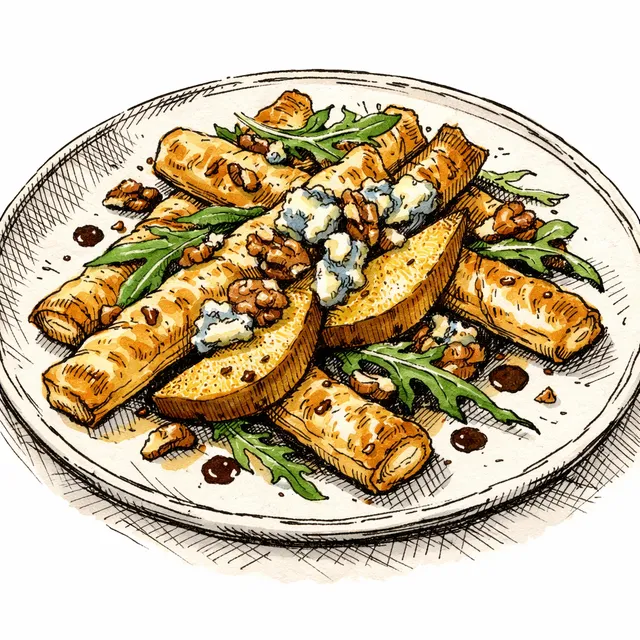
Bleu d'Auvergne, Seared Pear & Walnut Rough-Puff Allumettes
When I want savory pastry that looks like it took all day but actually respects my schedule, I make these allumettes—matchsticks of pastry, if we are translating. The inspiration comes from cold Parisian afternoons in my tiny kitchen, pairing whatever sharp cheese was left in the fridge with autumn fruit and whatever nuts I could toast in a dry pan. We are not suffering for brunch here. Butter is not a garnish, and our rough-puff dough delivers lacy, shatteringly crisp layers without the laminated panic. You sear the pears just enough to drive off excess moisture so your crust stays crisp, not soggy. The sharp funk of Bleu d'Auvergne melts into the sweet fruit, anchored by earthy walnuts. Let time do the work on the chilling, but keep your active effort minimal. Cami's shortcut note: store-bought puff pastry works in a pinch, but my quick-method dough takes ten minutes and tastes infinitely better. Don't skip the flaky salt right at the end. Make it your own by swapping the pear for thin apple slices when the season turns.
Featured Recipe
Bleu d'Auvergne, Seared Pear & Walnut Rough-Puff Allumettes
Crisp, flaky pastry battens layered with sharp Bleu d'Auvergne, tender seared pear, and toasted walnuts. Built on a zero-fuss rough-puff dough, these savory matchsticks deliver bakery-case drama in under an hour of active effort.
Save a copy to your collection for editing
Timeline
Ingredients
- 250 g all-purpose flour(unbleached, high protein preferred)
- 1 tsp fine sea salt
- 200 g unsalted European-style cultured butter(minimum 82% fat, very cold, cut into 1/2-inch cubes)
- 110 ml ice water(with ice cubes removed)
- 2 firm-ripe Bosc or Anjou pears(peeled, cored, and sliced 1/8-inch thick)
- 1 tbsp olive oil(for searing pears)
- 140 g Bleu d'Auvergne(crumbled (Roquefort or Gorgonzola Piccante also work))
- 50 g raw walnut halves(roughly chopped)
- 1.5 tsp fresh thyme leaves(stemmed)
- 1 egg(whisked with 1 tsp cold water for egg wash)
- 0.5 tsp flaky sea salt(Maldon or Fleur de Sel)
- 0.5 tsp freshly cracked black pepper
Instructions
- 1
In a wide mixing bowl, whisk together 250 g all-purpose flour and 1 tsp fine sea salt. Toss in 200 g unsalted European-style cultured butter. Using your thumbs and fingertips, flatten each cube into a thin pebble—do not rub into sand. The butter must remain visibly layered and flat. Drizzle in 110 ml ice water and toss lightly with a bench scraper until a shaggy, dry-looking dough forms with dry pockets of flour.
10 min
Tip: Visible butter leaves equal shattered pastry sheets later. If the butter starts warming up under your fingers, throw the bowl in the freezer for 5 minutes.
- 2
Tip the shaggy mass onto a lightly floured counter. Press into a rough rectangle, roll to roughly 8x16 inches, and give it a classic letter fold (fold the top third down and bottom third up, like business mail). Rotate 90 degrees and repeat the roll and letter fold once more. Wrap tightly in parchment and transfer to the freezer to chill rapidly.
10 min
Tip: That's two quick turns done in under five minutes. Don't worry if the dough looks slightly rough; lamination smooths out during resting.
- 3
While the pastry rests, heat a dry skillet over medium heat. Toast 50 g raw walnut halves until fragrant and golden, about 3 to 4 minutes, then tip onto a board. Wipe the skillet, add 1 tbsp olive oil, and increase heat to medium-high. Lay in 2 firm-ripe Bosc or Anjou pears in a single layer. Sear without moving for 2 minutes until caramelized at the edges, then flip for 30 seconds. Remove from the heat immediately to cool.
10 min
Tip: You want charred edges with firm centers, not mush. Overcooked pears will weep moisture onto your puff pastry.
- 4
Preheat your oven to 400°F (205°C) and line a large baking sheet with parchment paper. Pull the dough from the freezer. Roll it out on a lightly floured surface into a 10x14-inch rectangle, about 1/8-inch thick. Trim 1/4-inch off all four edges with a sharp chef's knife or pizza wheel to expose the laminated butter layers. Cut the rectangle down the center lengthwise, then crosswise into 12 even fingers (allumettes) measuring roughly 2x5 inches each.
10 min
Tip: Always cut straight down with a sharp blade; dragging or sawing pinches the laminated edges shut and prevents maximum puff.
- 5
Transfer the pastry fingers onto the prepared sheet, leaving an inch between each. Brush the surface lightly with 1 egg whisked with water. Distribute 140 g Bleu d'Auvergne evenly down the center stripe of each allumette, leaving a 1/4-inch border bare. Lay 2 to 3 seared pear slices over the cheese. Scatter the toasted walnuts, 1.5 tsp fresh thyme leaves, 0.5 tsp freshly cracked black pepper, and 0.5 tsp flaky sea salt over top.
10 min
Tip: Keeping the outer edges clear allows the uncovered pastry perimeter to puff sky-high around the savory core.
- 6
Bake at 400°F (205°C) for 22 to 25 minutes, rotating the pan at minute 15, until the pastry edges are deeply browned, flaky, and dry to the touch, and the cheese is bubbling with toasted specks. Cool on the sheet pan for 5 minutes before transferring to a wire rack. Serve warm or room temperature.
25 min
Tip: Look for deep chestnut color on the pastry edges. Pale rough-puff is soggy rough-puff.
Chef's Notes
Allumettes—literally 'matchsticks'—are a French café standby that deserve everyday status. We skip full tourage for a rapid rough-puff: big flattened shards of butter and two fast turns give you 80% of classic feuilletage flake with 20% of the sweat. Cami’s shortcut note: If you're planning an afternoon apéro, mix and fold the dough the night before and stash it in the fridge; roll and bake straight from the chill. Don't skip this: Searing the pear slices hot and fast before assembling evaporates excess surface moisture that would otherwise waterlog your crumb. Butter is not a garnish, and soggy pastry is tight like a bad alibi. Give them color and bake until deeply bronzed.

Camille Roux
Café-level bakes, weeknight methods, zero compromise.
Camille “Cami” Roux was born in Paris with flour in her hair and a healthy skepticism of culinary dogma. She grew up around neighborhood boulangeries that treated crust and crumb like religion—but what stuck with her wasn’t rigid tradition. It was the quiet precision: good butter that actually tastes like milk, patient fermentation that builds flavor for free, and desserts that know when to stop before they get cloying. After moving to the Bay Area, Cami trained in a bread-and-pastry scene obsessed with texture, naturally leavened doughs, and seasonal fruit—Tartine energy, minus the martyrdom. She became known for loaves that sing when they cool, jammy tarts with clean edges, and “how is this so good?” weeknight pastries made with a few smart shortcuts. Her motto is high impact, low fuss: splurge where it counts (butter, salt, time), streamline the rest (sheet pans, one bowl, cold-proofing). If it doesn’t improve flavor or structure, it doesn’t earn a step.