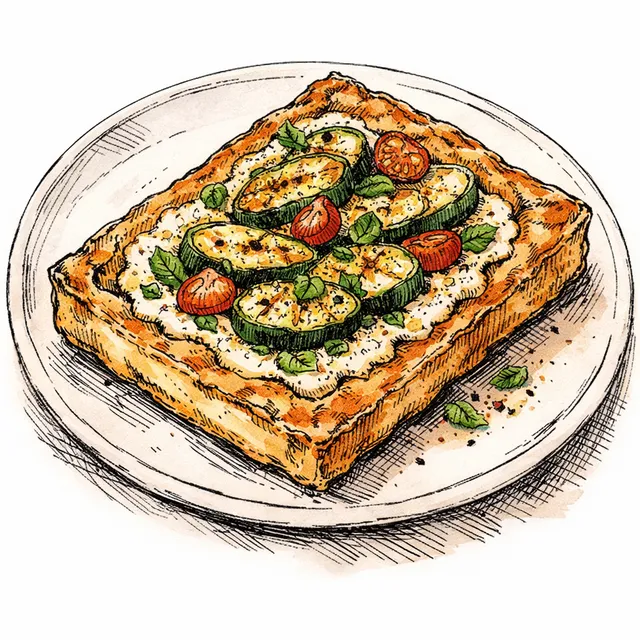
Blistered Zucchini & Whipped Ricotta Slab Quiche
Summer in the Bay Area gives us mountains of zucchini, but my Parisian upbringing taught me a harsh truth: zucchini is mostly water, and water is the enemy of crisp pastry. A soggy pâte brisée (shortcrust) is tight like a bad alibi, and we’re not suffering for brunch. I remember standing in my tiny kitchen years ago, furiously grating squash and wringing it out in tea towels. It was too much work. The shortcut? Blister it hard in a hot skillet. The high heat drives off moisture and caramelizes the edges, building deep flavor before it ever touches our lemon-scented whipped ricotta and Gruyère custard. This slab quiche is my weeknight savior because it scales beautifully. Baked in a quarter-sheet pan, you get the absolute maximum crust-to-custard ratio. The shortcrust must be strictly blind-baked until deeply golden—don't skip this. You want a crust that shatters. To make it your own, swap the zucchini for blistered cherry tomatoes or roasted fennel. Just remember: keep the moisture low and the butter cold. Butter is not a garnish. Cami’s shortcut note: Pulse your dough in a food processor, but leave the butter in walnut-sized shards, then chill it overnight. Let time do the work.
Featured Recipe
Blistered Zucchini & Whipped Ricotta Slab Quiche
Zucchini is mostly water, and water is the enemy of crisp pastry. We solve this by blistering it hard in a skillet before it ever touches this rich, lemon-scented ricotta and Gruyère custard. Baked in a quarter-sheet pan on a flaky, strictly blind-baked shortcrust, this is how you deliver café-level brunch without the fuss.
Save a copy to your collection for editing
Timeline
Ingredients
- 2 cups all-purpose flour(Plus extra for dusting)
- 1.5 tsp kosher salt(Divided (1 tsp for crust, 1/2 tsp for custard))
- 12 tbsp cold cultured butter(Cubed; butter is not a garnish, use the good stuff)
- 4 tbsp ice water(Very cold)
- 2 medium zucchini(Sliced into 1/4-inch coins)
- 1 tbsp olive oil
- 1 cup whole milk ricotta(Drained if particularly wet)
- 4 large eggs
- 1/2 cup heavy cream
- 1 cup grated Gruyère cheese
- 1 tbsp fresh thyme leaves
- 1 lemon(Zested)
- 1/2 tsp black pepper(Freshly ground)
- 1 each lemon zest(from 1 lemon)
Instructions
- 1
In a food processor, pulse 2 cups all-purpose flour and 1 tsp kosher salt. Scatter in the cubed 12 tbsp cold cultured butter. Pulse until it looks like coarse almond meal with a few pea-sized butter chunks left. Drizzle in 4 tbsp ice water and pulse just until the dough holds when pinched.
10 min
Tip: Visible butter chunks equal a lacy, flaky crust. If it looks perfectly uniform, you've gone too far.
- 2
Dump the dough onto a counter, bring it together into a rough rectangle, and wrap it tightly in plastic. Throw it in the fridge for 30 minutes. Let time do the work to hydrate the flour and relax the gluten.
30 min
Tip: A warm crust will shrink like a cheap sweater in the oven. Chill it.
- 3
While the dough chills, deal with the vegetables. Heat 1 tbsp olive oil in a large skillet over high heat. Add the sliced 2 medium zucchini in a single layer. Sear undisturbed for 2-3 minutes per side until aggressively browned and blistered. Transfer to a paper-towel-lined plate.
15 min
Tip: Do this in batches if you have to. If you crowd the pan, they will steam. We want scorch marks, not mush.
- 4
In a medium bowl, whisk together 1 cup whole milk ricotta, 4 large eggs, 1/2 cup heavy cream, 1 cup grated Gruyère cheese, 1 tbsp fresh thyme leaves, the zest of 1 lemon, 1/2 tsp kosher salt, and 1/2 tsp black pepper.
5 min
Tip: The mixture should be thick and cohesive. The ricotta provides body so the custard won't seep into the crust.
- 5
Preheat your oven to 400°F (200°C). On a lightly floured surface, roll the chilled dough into a 10x14-inch rectangle. Lay it into a 9x13-inch quarter sheet pan, pressing firmly into the corners. Trim any wild overhang and prick the bottom all over with a fork. Freeze the pan for 10 minutes.
10 min
Tip: Docking the dough allows steam to escape so the bottom stays flat.
- 6
Line the frozen crust with crumpled parchment paper and fill it to the brim with pie weights (or dried beans). Bake for 20 minutes.
20 min
Tip: Blind baking isn't a suggestion; it's the difference between a crisp base and a tight, soggy nightmare.
- 7
Carefully remove the parchment and weights. Bake for another 5 minutes until the bottom looks dry and lightly golden. Immediately turn the oven down to 350°F (175°C).
5 min
Tip: The crust should look matte, not shiny or damp.
- 8
Pour the ricotta custard directly into the hot, pre-baked crust. Shingle the blistered zucchini across the top in an overlapping pattern.
5 min
Tip: Pouring cold custard into a hot crust creates a seal that guarantees a crisp bottom.
- 9
Bake at 350°F (175°C) for 25-30 minutes, until the edges are puffed and golden, and the center has a slight wobble but isn't liquid.
25 min
Tip: Look for the jiggle. If it waves like a waterbed, it needs more time. If it's rigid, it's overbaked.
- 10
Let it cool in the pan for at least 15 minutes before slicing into squares.
15 min
Tip: We're not suffering for brunch, but if you cut this boiling hot, it will weep and collapse. Have patience.
Chef's Notes
Cami's shortcut note: If you are dreading the food processor, use your hands to make the crust. Smush the cold butter into flat shards with your thumbs. It actually creates a flakier pâte brisée anyway. Whatever you do, don't skip the blind bake, unless you prefer eating damp flour. You don't.

Camille Roux
Café-level bakes, weeknight methods, zero compromise.
Camille “Cami” Roux was born in Paris with flour in her hair and a healthy skepticism of culinary dogma. She grew up around neighborhood boulangeries that treated crust and crumb like religion—but what stuck with her wasn’t rigid tradition. It was the quiet precision: good butter that actually tastes like milk, patient fermentation that builds flavor for free, and desserts that know when to stop before they get cloying. After moving to the Bay Area, Cami trained in a bread-and-pastry scene obsessed with texture, naturally leavened doughs, and seasonal fruit—Tartine energy, minus the martyrdom. She became known for loaves that sing when they cool, jammy tarts with clean edges, and “how is this so good?” weeknight pastries made with a few smart shortcuts. Her motto is high impact, low fuss: splurge where it counts (butter, salt, time), streamline the rest (sheet pans, one bowl, cold-proofing). If it doesn’t improve flavor or structure, it doesn’t earn a step.