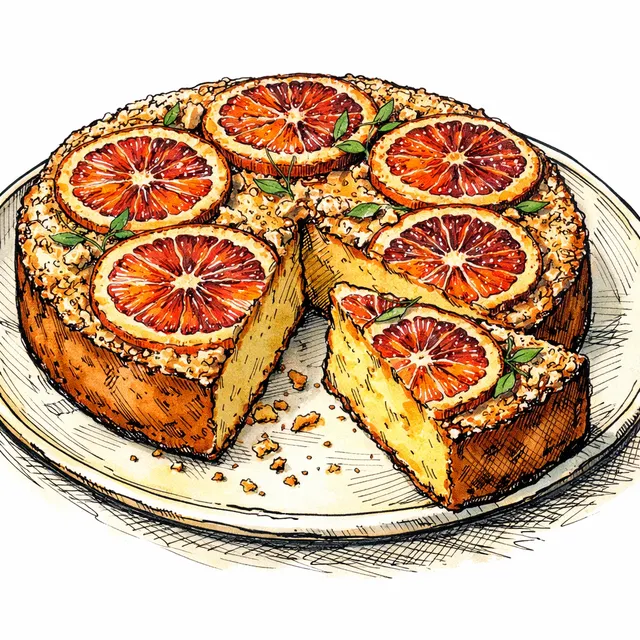
Blood Orange & Olive Oil Gâteau au Yaourt (Crackly Coriander-Sugar Crust)
Growing up in Paris, gâteau au yaourt (yogurt cake) is the first thing you learn to bake. You measure everything using the empty yogurt tub. It is completely foolproof, but honestly? A bit tame.I wanted that weeknight ease but rebuilt for a grown-up café case. We keep the whole milk yogurt for a lacy, tender crumb—the acidity breaks down the gluten, keeping things insanely soft—but we swap the usual neutral oil for a grassy, aggressive extra-virgin olive oil. Then, we lean hard into the late-winter bitterness of fresh blood oranges.The real magic is the finish. A heavy coating of toasted coriander-sugar before baking gives you a shattered, glass-like crust. We do not do boring tops around here.Make it yours. Swap blood orange for Meyer lemon, or trade the coriander for cardamom. Just do not mess with the fat content. We are not suffering for brunch.Cami's shortcut note: Mix wet, fold dry, bake. One bowl. Absolutely no stand mixer required.Don't skip this: Use full-fat, whole milk yogurt. Low-fat will make the crumb tight like a bad alibi. Pull it from the oven only when the edges are deeply bronzed and the center springs back with a confident wobble.
Featured Recipe
Blood Orange & Olive Oil Gâteau au Yaourt (Crackly Coriander-Sugar Crust)
This is the gâteau au yaourt—the classic yogurt cake—every French kid learns before they can read, rebuilt for a grown-up café case. We use whole milk yogurt for a lacy, tender crumb, swap neutral oil for a grassy, aggressive extra-virgin olive oil, and lean hard into the late-winter bitterness of blood oranges. We finish it with a heavily toasted coriander-sugar crust, because we don't do boring tops.
Save a copy to your collection for editing
Timeline
Ingredients
- 2 medium Blood oranges(Zested, then halved for juice)
- 200 g Granulated sugar(About 1 cup)
- 120 g Whole-milk plain yogurt(About 1/2 cup. Full fat only, no skim nonsense)
- 3 Large eggs(Room temperature)
- 180 ml Extra-virgin olive oil(About 3/4 cup. Use the good, peppery stuff)
- 190 g All-purpose flour(About 1 1/2 cups)
- 1.5 tsp Baking powder
- 0.5 tsp Baking soda
- 0.5 tsp Kosher salt
- 3 tbsp Demerara or turbinado sugar(For the crust)
- 1 tsp Whole coriander seeds(Coarsely crushed in a mortar or under a skillet)
- 1 pinch Flaky sea salt(To finish)
Instructions
- 1
Preheat your oven to 350°F (175°C). Line a standard 9x5-inch loaf pan with parchment paper, leaving an overhang on the long sides for easy lifting. Don't skip the parchment; the 200 g Granulated sugar crust will glue itself to bare metal.
15 min
Tip: Olive oil the pan lightly so the parchment sticks right to the corners.
- 2
In a large bowl, zest 2 medium Blood oranges directly into the 200 g Granulated sugar. Dig your fingers in and rub the zest into the sugar until it feels like wet sand and the oils release. It should smell aggressively fragrant.
3 min
Tip: This mechanical action pulls out the volatile oils. Do not skip this.
- 3
Whisk the 120 g Whole-milk plain yogurt, 3 Large eggs, 180 ml Extra-virgin olive oil, and 2 tbsp freshly squeezed blood orange juice into the citrus sugar. Whisk vigorously for about a minute until it emulsifies into a smooth, sunny-looking base.
3 min
Tip: If your eggs were cold, the batter might look slightly split. It will bake fine, but room-temp eggs give a better emulsion.
- 4
Dump the 190 g All-purpose flour, 1.5 tsp Baking powder, 0.5 tsp Baking soda, and 0.5 tsp Kosher salt directly onto the wet ingredients. Switch to a spatula and fold gently just until the dry streaks disappear. Stop immediately. Overmix, and the crumb goes tight like a bad alibi.
2 min
Tip: A few tiny lumps are perfectly fine. Let time and heat do the work.
- 5
Pour the batter into your lined pan. In a small bowl, toss the 3 tbsp Demerara or turbinado sugar, 1 tsp Whole coriander seeds, and 1 pinch Flaky sea salt. Scatter this mixture heavily and evenly over the top of the raw batter.
2 min
Tip: It will look like too much sugar. Trust the process. It forms the crackly lid.
- 6
Bake for 45 to 55 minutes. You're looking for a dramatically domed top, a deep golden crust, and a skewer inserted into the center coming out with moist crumbs (not wet batter). If it jiggles in the center, leave it alone.
50 min
Tip: If your oven runs hot and the sugar is browning too fast at minute 35, loosely tent it with foil.
- 7
Let the cake cool in the pan for 15 minutes before using the parchment sling to pull it out. Cool completely on a wire rack before slicing, or the delicate, warm crumb will tear.
30 min
Tip: Patience is an ingredient here. Cutting a hot cake releases steam it needs to stay moist.
Chef's Notes
Cami's shortcut note: Olive oil cakes are superior make-aheads. They actually taste better on day two once the fats and citrus oils meld and settle. Wrap it tightly in plastic wrap once completely cool and leave it on the counter. And don't skip the coriander in the crust! It perfectly bridges the floral notes of the blood orange with the grassy bite of the olive oil. We're not suffering for brunch, people.

Camille Roux
Café-level bakes, weeknight methods, zero compromise.
Camille “Cami” Roux was born in Paris with flour in her hair and a healthy skepticism of culinary dogma. She grew up around neighborhood boulangeries that treated crust and crumb like religion—but what stuck with her wasn’t rigid tradition. It was the quiet precision: good butter that actually tastes like milk, patient fermentation that builds flavor for free, and desserts that know when to stop before they get cloying. After moving to the Bay Area, Cami trained in a bread-and-pastry scene obsessed with texture, naturally leavened doughs, and seasonal fruit—Tartine energy, minus the martyrdom. She became known for loaves that sing when they cool, jammy tarts with clean edges, and “how is this so good?” weeknight pastries made with a few smart shortcuts. Her motto is high impact, low fuss: splurge where it counts (butter, salt, time), streamline the rest (sheet pans, one bowl, cold-proofing). If it doesn’t improve flavor or structure, it doesn’t earn a step.