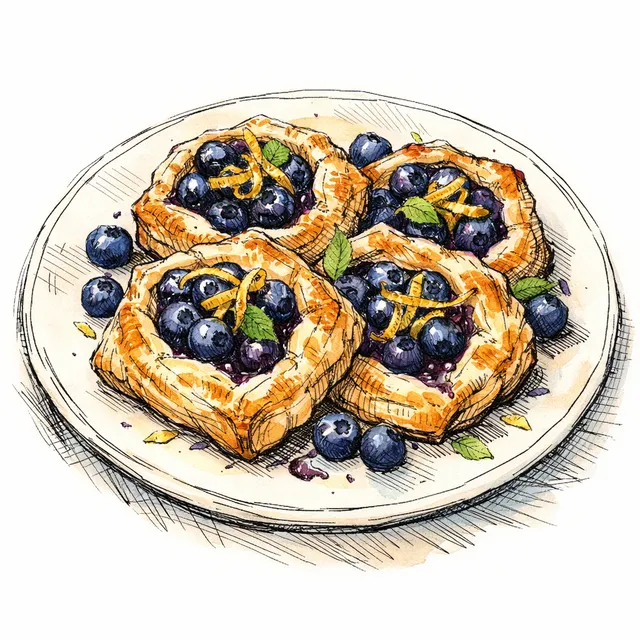
Blueberry & Lemon Zest Rough-Puff Feuilletés
When I want bakery-case drama without spending three days turning butter, I turn to rough-puff. Sitting in my tiny Bay Area kitchen years ago, staring at a flat of late-summer berries and a block of cold cultured butter, these feuilletés were born. I wanted something French-café level that respected a real person’s schedule. We’re not suffering for brunch here. By cutting big, visible blocks of butter into the flour rather than laminating meticulously, we get a lacy, shattering crumb that rivals any Parisian boulangerie. The secret is rubbing the lemon zest directly into the sugar to release the essential oils before it ever meets the fruit. Blueberry and lemon are a classic pair, but the cool crème fraîche base cuts the sweetness and keeps the pastry bottom crisp. Butter is not a garnish, so use the good stuff. If you can’t find fresh blueberries, blackberries or even thinly sliced stone fruit work brilliantly. Let time do the work of chilling your dough, bake them high and hot, and watch them disappear.
Featured Recipe
Blueberry & Lemon Zest Rough-Puff Feuilletés
Bright, juicy blueberries burst against a bed of lemon-rubbed sugar and cool crème fraîche, wrapped in shatteringly flaky, golden rough-puff pastry. Crisp, buttery, and baked high and hot, these French café-style morning pastries deliver bakery-case drama on a realistic weekend schedule.
Save a copy to your collection for editing
Timeline
Ingredients
- 250 g all-purpose flour(plus extra for dusting work surface)
- 0.5 tsp fine sea salt
- 225 g cold unsalted cultured butter(high fat content (82%+), cubed into 1/2-inch pieces)
- 120 ml ice-cold water
- 250 g fresh blueberries(dry thoroughly after washing)
- 100 g granulated sugar
- 1 lemon zest(zest of 1 organic lemon)
- 1 tbsp cornstarch
- 100 g crème fraîche(full fat)
- 0.5 tsp vanilla bean paste
- 1 egg(for egg wash)
- 1 tbsp water(for egg wash)
- 2 tbsp coarse turbinado sugar(for sprinkling edges)
Instructions
- 1
In a large bowl, whisk together 250 g all-purpose flour and 0.5 tsp fine sea salt. Toss in 225 g cold unsalted cultured butter, coating each cube in flour. Using your fingers, flatten the butter cubes into thick, coin-like ribbons rather than rubbing them down into fine meal. Pour in 120 ml ice-cold water and mix with a fork just until a shaggy, uneven dough forms. Wrap tightly in plastic wrap and pat into a rough square.
10 min
Tip: Butter is not a garnish, and it shouldn't disappear into the flour. Big butter chunks equal distinct steam pockets, which equals explosive rise.
- 2
Chill the wrapped rough-puff dough in the refrigerator to re-firm the butter.
20 min
Tip: If your kitchen is warm, don't rush this step. Warm butter makes a greasy dough with a tight crumb like a bad alibi.
- 3
Unwrap the dough onto a lightly floured counter and roll into an 8x18-inch rectangle. Fold the bottom third up and the top third down like a business letter (turn 1). Turn the dough 90 degrees, roll into an 8x18-inch rectangle again, and fold in thirds once more (turn 2). Repeat one last time (turn 3) for a total of three envelope folds. Wrap tightly in plastic.
10 min
Tip: This is lamination-lite: maximum puff with zero stress. If the dough snaps back or butter breaks through, stop and chill it for 10 minutes.
- 4
Rest the laminated dough in the refrigerator to allow gluten to relax completely.
30 min
Tip: The fridge is your friend—let time do the heavy lifting while you clean up or sip espresso.
- 5
Preheat your oven to 400°F (200°C) with an inverted rimmed baking sheet placed on the middle rack. In a bowl, rub 100 g granulated sugar and 1 lemon zest between your fingertips until fragrant and yellow. Toss in 250 g fresh blueberries and 1 tbsp cornstarch until coated. In a small bowl, stir 100 g crème fraîche with 0.5 tsp vanilla bean paste.
10 min
Tip: Preheating a baking sheet acts like a hearth stone, blasting bottom heat straight into the butter layers to prevent soggy bottoms.
- 6
Roll chilled dough on a floured surface into a 12x16-inch rectangle, about 1/4-inch thick. Use a chef's knife or pizza cutter to trim 1/2 inch off all edges, exposing the laminated layers. Cut into 6 equal 5x6-inch rectangles. Lightly score a 1/2-inch border inside each rectangle, and dock (prick) the inner center rectangle several times with a fork.
10 min
Tip: Trimming edges strips away compressed seams so the pastry edges can puff sky-high unimpeded.
- 7
Spread 1 generous tablespoon of the vanilla crème fraîche inside the scored border of each pastry. Top evenly with the blueberry mixture. Whisk 1 egg with 1 tbsp water, then brush the outer borders with egg wash. Sprinkle 2 tbsp coarse turbinado sugar over the egg-washed borders.
10 min
Tip: Keep filling confined inside the scored line so the edges can swell into crisp frames around the fruit.
- 8
Slide parchment with assembled feuilletés onto the hot preheated baking sheet in the oven. Bake at 400°F for 22 to 25 minutes until borders are deeply golden bronze, pastry layers are visible and shattered crisp, and blueberries are bursting and jammy.
25 min
Tip: Look for color, not just a clock time. Deep amber brown means carmelized butter flavor; pale pastry tastes like raw flour.
- 9
Transfer feuilletés to a wire cooling rack and let rest before serving warm.
10 min
Tip: Cooling on a rack lets steam escape underneath so the bottom crust stays wildly crisp.
Chef's Notes
Cami’s shortcut note: The dough can be made through the final fold up to 48 hours in advance and kept well-wrapped in the fridge. Don't skip this: Preheating the baking sheet inside the oven is non-negotiable. That thermal shock turns cold butter into immediate steam, delivering a lacy, shattered-glass crumb without needing a professional deck oven. We’re not suffering for brunch.

Camille Roux
Café-level bakes, weeknight methods, zero compromise.
Camille “Cami” Roux was born in Paris with flour in her hair and a healthy skepticism of culinary dogma. She grew up around neighborhood boulangeries that treated crust and crumb like religion—but what stuck with her wasn’t rigid tradition. It was the quiet precision: good butter that actually tastes like milk, patient fermentation that builds flavor for free, and desserts that know when to stop before they get cloying. After moving to the Bay Area, Cami trained in a bread-and-pastry scene obsessed with texture, naturally leavened doughs, and seasonal fruit—Tartine energy, minus the martyrdom. She became known for loaves that sing when they cool, jammy tarts with clean edges, and “how is this so good?” weeknight pastries made with a few smart shortcuts. Her motto is high impact, low fuss: splurge where it counts (butter, salt, time), streamline the rest (sheet pans, one bowl, cold-proofing). If it doesn’t improve flavor or structure, it doesn’t earn a step.