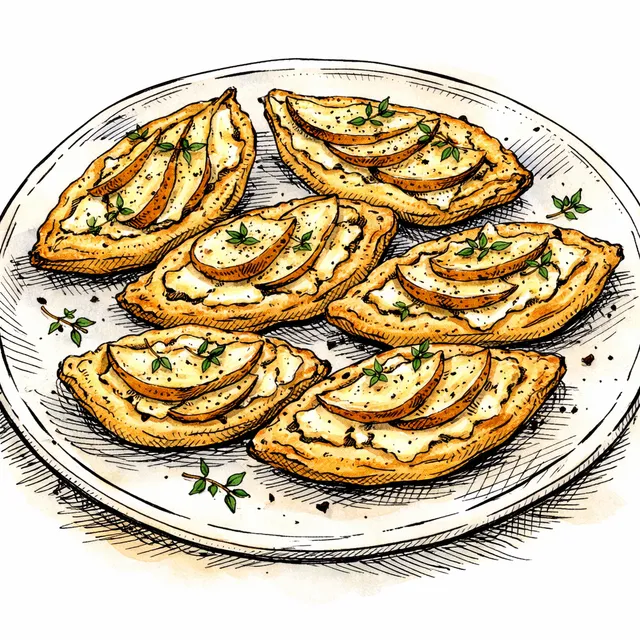
Bosc Pear, Camembert & Thyme Rough-Puff Barquettes
We are not suffering for brunch. When I crave that flaky, buttery café-counter experience on a random Tuesday, I do not spend three days laminating butter. Instead, I lean on a lamination-lite rough puff. The fridge is your friend here. This barquette recipe was born in my tiny kitchen when I needed something sophisticated yet fast, combining the crisp bite of autumn Bosc pears with the unapologetic funk of warm Normandy Camembert. Butter is not a garnish, and the way it mingles with earthy fresh thyme and fruit juice on a hot sheet pan is pure magic. Bosc pears hold their shape best—none of that mealy mush. Cut any step that doesn’t improve flavor or flake, but let time do the work on your chill. Cami's shortcut note: store-bought puff pastry works in a pinch if you are truly pressed, but my rough-puff takes twenty minutes and gives you a lacy, shatteringly crisp crumb that store-bought just cannot touch. Don't skip the flaky salt at the finish.
Featured Recipe
Bosc Pear, Camembert & Thyme Rough-Puff Barquettes
Crisp, deeply bronzed rough-puff pastry boats cradling tender wedges of Bosc pear, melty Normandy Camembert, and fragrant fresh thyme. It is the ultimate café-counter snack: high-impact lamination without the weekend-long ordeal.
Save a copy to your collection for editing
Timeline
Ingredients
- 250 g all-purpose flour(unbleached, plus extra for dusting)
- 0.75 tsp fine sea salt
- 200 g cold unsalted European butter(82% fat minimum, cut into 1/2-inch cubes)
- 110 ml ice water(ice strained out)
- 1 tsp raw apple cider vinegar(relaxes dough elasticity)
- 2 medium firm Bosc pears(peeled, cored, and sliced into 1/4-inch wedges)
- 150 g Camembert cheese(chilled, sliced into 8 even slabs)
- 1.5 tbsp fresh thyme leaves(divided)
- 1 large egg yolk(for wash)
- 1 tbsp heavy cream(for wash)
- 0.5 tsp flaky sea salt(such as Maldon)
- 0.5 tsp freshly cracked black pepper(coarse grind)
- 1.5 tbsp runny wildflower honey(for finishing drizzle)
Instructions
- 1
In a wide bowl, whisk 250 g all-purpose flour and 0.75 tsp fine sea salt. Scatter in 200 g cold unsalted European butter. Using your fingertips or a pastry blender, press the cubes into flat walnut-sized flakes—do not turn it into cornmeal; you want distinct shingles of fat. Stir 1 tsp raw apple cider vinegar into 110 ml ice water, then drizzle across the flour. Stir briskly with a fork until a ragged, dry-looking dough forms. Turn onto a counter and press gently into a cohesive rectangle.
10 min
Tip: Butter is not a garnish; keeping visible fat pockets is what creates explosive steam and lacy layers later.
- 2
Lightly dust the counter with flour. Roll the shaggy dough into a roughly 8x16-inch band. Fold like a business letter (turn one). Rotate 90 degrees, roll again to 8x16 inches, and fold into thirds (turn two). Repeat one final time for a total of three letter turns. Wrap tightly and rest in the refrigerator for 20 minutes to firm the butter and relax the gluten.
12 min
Tip: If your kitchen is warm and the butter smears instead of sheets, slide the dough onto a tray and chill immediately for 10 minutes.
- 3
While dough chills, set an oven rack to the lower-middle position and preheat to 400°F (205°C). Line a large rimmed sheet pan with parchment. Peel, core, and slice 2 medium firm Bosc pears into thin wedges. Slice 150 g Camembert cheese into 8 slabs. In a small ramekin, whisk 1 large egg yolk with 1 tbsp heavy cream to make your wash.
15 min
Tip: Pick pears that are fragrant at the stem but firm to the touch; overly ripe fruit collapses and leaves the crust soggy.
- 4
Unwrap the chilled pastry onto a lightly floured surface. Roll into a 10x16-inch rectangle, roughly 1/8-inch thick. Trim ragged edges with a sharp knife to expose the laminations, then cut into 8 equal rectangles (roughly 4x5 inches each). Transfer rectangles to the prepared sheet pan, leaving 2 inches between them. Pinch the two short ends of each rectangle tightly to fashion boat-shaped shells ('barquettes') with a recessed center.
10 min
Tip: Pinching the tips creates a natural containment dike for the melting cheese without requiring special tins.
- 5
Dock the center floor of each pastry boat with a fork 3 to 4 times. Place 1 slab of 150 g Camembert cheese in the middle of each shell. Shingle sliced 2 medium firm Bosc pears tightly over the cheese. Scatter 1 tbsp fresh thyme leaves evenly across the pears. Brush the exposed pastry borders thoroughly with the prepared egg and cream wash, making sure no wash pools in the pan.
8 min
Tip: Avoid brushing egg wash over cut outer edges; egg wash glues pastry layers together and prevents maximum lift.
- 6
Bake at 400°F (205°C) for 24 to 26 minutes until the edges are skyscraper-tall, lacy, and deeply caramelized amber, and the cheese is bubbling vigorously against the fruit.
25 min
Tip: Do not pull them out at golden; wait for deep chestnut edges so the bottom stays shattering and crisp.
- 7
Remove from the oven and transfer to a wire cooling rack for 5 minutes. Drizzle with 1.5 tbsp runny wildflower honey, then finish with remaining 0.5 tbsp fresh thyme leaves, 0.5 tsp flaky sea salt, and 0.5 tsp freshly cracked black pepper. Serve warm.
5 min
Tip: A brief rest lets the molten cheese settle into the tender pear slices so you get a clean, crunchy bite.
Chef's Notes
Cami's shortcut note: Rough puff gives you 90% of classic feuilletage volume with 10% of the anxiety. You don't need a butter block or three hours of measured chilling—just respect the cold butter chunks and get three clean folds in. Don't skip this: The vinegar in the dough relaxes the gluten matrix instantly so your dough rolls without fighting back, and the high bake temp (400°F) guarantees that steam puffs the butter before it melts out onto your baking sheet.

Camille Roux
Café-level bakes, weeknight methods, zero compromise.
Camille “Cami” Roux was born in Paris with flour in her hair and a healthy skepticism of culinary dogma. She grew up around neighborhood boulangeries that treated crust and crumb like religion—but what stuck with her wasn’t rigid tradition. It was the quiet precision: good butter that actually tastes like milk, patient fermentation that builds flavor for free, and desserts that know when to stop before they get cloying. After moving to the Bay Area, Cami trained in a bread-and-pastry scene obsessed with texture, naturally leavened doughs, and seasonal fruit—Tartine energy, minus the martyrdom. She became known for loaves that sing when they cool, jammy tarts with clean edges, and “how is this so good?” weeknight pastries made with a few smart shortcuts. Her motto is high impact, low fuss: splurge where it counts (butter, salt, time), streamline the rest (sheet pans, one bowl, cold-proofing). If it doesn’t improve flavor or structure, it doesn’t earn a step.