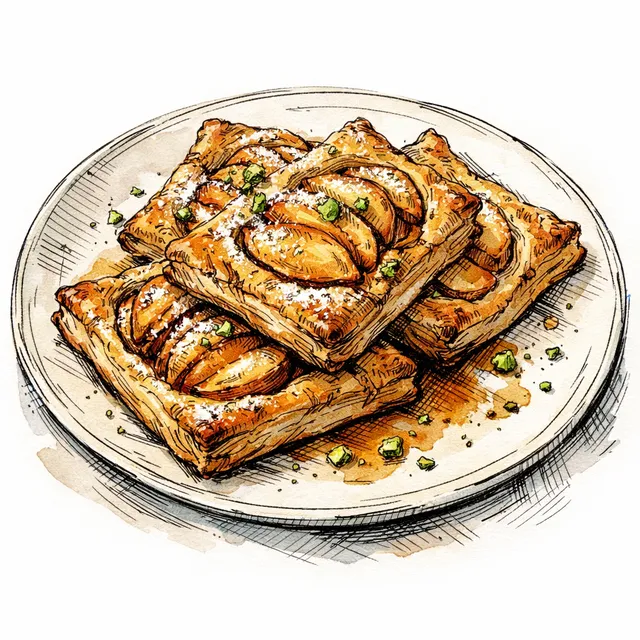
Braeburn Apple & Salted Brown Butter Rough-Puff Feuilletés
We are not suffering for brunch. That has always been my rule. Back in my Paris days, I admired the sheer dedication of classic puff pastry, but in my tiny Bay Area kitchen with real schedules to keep, I needed a smarter way. Enter the rough-puff method. By keeping the butter in cold, jagged chunks and letting time do the work, you get hundreds of shatteringly crisp layers in a fraction of the traditional time. The inspiration came from a craving for that quintessential bakery-window apple tart, but streamlined for real life. I pair thinly sliced Braeburn apples—because they hold their shape and punch through the sweetness—with nutty brown butter and a aggressive pinch of flaky sea salt. Butter is not a garnish, and neither is salt. Why it works is simple: laminated butter creates steam pockets, while the brown butter adds a deep, toasty background note that elevates humble fruit into something extraordinary. Cami's shortcut note: keep your butter cold and don't overwork the dough. Don't skip this. If your kitchen runs warm, slide the tray back into the fridge for ten minutes before baking. Let the oven do the heavy lifting, and enjoy a lacy, buttery masterpiece without spending your entire weekend tied to the counter.
Featured Recipe
Braeburn Apple & Salted Brown Butter Rough-Puff Feuilletés
Crisp, blistered, and shamelessly buttery, these café-counter strip pastries turn crisp Braeburn apples into pure architectural drama. A streamlined rough-puff method delivers hundreds of shatteringly crisp layers in a fraction of the traditional time, anchored by nutty brown butter and flaky sea salt.
Save a copy to your collection for editing
Timeline
Ingredients
- 2 cups all-purpose flour(unbleached, chilled if your kitchen is warm)
- 0.5 tsp kosher salt(Diamond Crystal preferred)
- 1 tbsp granulated sugar
- 1 cup cold unsalted cultured butter(2 sticks, cut into 1/2-inch cubes and kept refrigerator-cold)
- 0.5 cup ice water(plus 1 additional tablespoon if needed)
- 1 tsp apple cider vinegar(relaxes gluten for easier rolling)
- 3 tbsp unsalted cultured butter(for browning)
- 3 medium Braeburn apples(firm and unpeeled, cored and sliced 1/8-inch thick)
- 1 tbsp fresh lemon juice
- 1 tsp Calvados(or pure vanilla extract)
- 3 tbsp turbinado sugar(divided; coarse raw cane sugar)
- 1 large egg(beaten with water for egg wash)
- 1 tbsp water(for egg wash)
- 2 tbsp apricot jam(warmed and strained for finishing glaze)
- 0.5 tsp flaky sea salt(such as Maldon)
- 1 instance floured surface(for rolling out dough)
Instructions
- 1
In a large bowl, whisk together 2 cups all-purpose flour, 0.5 tsp kosher salt, and 1 tbsp granulated sugar. Add 1 cup cold unsalted cultured butter cubes. Using your fingertips or a pastry blender, quickly press the cubes into flat walnut- and nickel-sized flakes. Do not rub it down to peas; visible sheets of cold fat are non-negotiable for lift.
10 min
Tip: Why it works: flattened butter shards vaporize in the oven, generating pockets of steam that puff the pastry into distinct, shatteringly crisp leaves without manual lamination.
- 2
Stir 1 tsp apple cider vinegar into 0.5 cup ice water. Drizzle over the flour mixture and toss with a fork until large, shaggy clumps form. If dry pockets persist, add up to 1 tablespoon extra ice water. Tip the dough onto parchment paper and firmly gather into a rough 6x8-inch rectangle. Wrap tightly.
5 min
Tip: The dough will look dry and messy; resist the urge to knead. The butter layers must stay discrete.
- 3
Transfer wrapped dough to the refrigerator for its first cold rest. The fridge is your best friend here—it relaxes gluten and resets butter solidity.
20 min
Tip: If your kitchen is unusually warm, pop the wrapped slab into the freezer for 10 minutes instead.
- 4
While the dough chills, melt 3 tbsp unsalted cultured butter in a small skillet over medium heat. Swirl constantly as the foam subsides and milk solids turn hazelnut-brown with a nutty aroma, about 4 to 5 minutes. Immediately pour into a small heatproof bowl to arrest cooking, then whisk in 1 tsp Calvados.
7 min
Tip: Watch the pan closely; butter goes from perfectly nutty noisette to burnt in thirty seconds.
- 5
Unwrap the chilled dough onto a lightly floured surface. Roll into a 6x15-inch rectangle. Fold into thirds like a business letter (a tour simple). Rotate 90 degrees, roll out again to 6x15 inches, and fold into thirds a second time. Repeat one more time for a total of three turns. Re-wrap into a compact rectangle.
10 min
Tip: Keep edges neat and square to ensure even distribution of butter sheets across the entire slab.
- 6
Chill the laminated rough puff in the refrigerator until completely firm and thoroughly relaxed.
30 min
Tip: Don't rush fermentation or chilling. Warm butter smears into flour, yielding pastry that is tight like a bad alibi instead of lacy and crisp.
- 7
Using a sharp mandoline or chef's knife, cut 3 medium Braeburn apples into 1/8-inch thick half-moons. In a medium bowl, gently toss apple slices with 1 tbsp fresh lemon juice and 1 tbsp turbinado sugar.
10 min
Tip: Why Braeburns: their firm cellular structure and snappy acidity hold clean geometry in the oven without collapsing into applesauce.
- 8
Position oven racks in the upper and lower thirds of your oven and preheat to 400°F (205°C). Line two large rimmed baking sheets with parchment paper. In a small ramekin, whisk together 1 large egg and 1 tbsp water to make the egg wash (la dorure).
5 min
Tip: A truly hot oven is required immediately upon insertion to shock butter water into steam.
- 9
Roll the chilled dough on a lightly floured bench to a 10x15-inch rectangle, roughly 1/8-inch thick. Trim ragged edges with a pizza wheel for clean cuts that puff freely. Slice into six even 5x5-inch squares. Transfer squares onto the prepared baking sheets. Using the tip of a paring knife, score a 1/2-inch border around each square without cutting all the way through, then dock inside the border lightly with a fork.
12 min
Tip: Scoring creates a natural picture-frame wall that towers around your apple filling.
- 10
Shingle seasoned 3 medium Braeburn apples slices in overlapping rows inside the scored borders of each pastry. Brush the apples generously with the Calvados-scented browned butter from Step 4. Brush the raised dough borders lightly with the prepared egg wash. Sprinkle the entire pastry—border and fruit—with remaining 2 tbsp turbinado sugar.
8 min
Tip: Keep egg wash strictly off cut edges; dried egg seals dough layers together and inhibits the rise.
- 11
Bake at 400°F (205°C) for 25 to 28 minutes, swapping sheets from top to bottom and front to back halfway through. Bake until pastry borders are deep bronze, blistered, and audibly crisp, and the apple edges show caramelized singe.
28 min
Tip: Visual cue: pastry must be fully copper-toned, not pale blond. Blond puff tastes like raw flour.
- 12
In a small saucepan or microwave ramekin, warm 2 tbsp apricot jam with a splash of water until fluid. As soon as the feuilletés leave the oven, gently brush warm jam over the hot apples for bakery-level gloss, then immediately dust each pastry with 0.5 tsp flaky sea salt.
6 min
Tip: Butter is not a garnish, and neither is salt; that hit of sea salt cuts through rich browned butter and sharp apple sugars.
Chef's Notes
Cami's shortcut note: The rough-puff base can be made up to 2 days ahead and rested in the fridge, or frozen flat for up to a month. If frozen, thaw overnight in the refrigerator. Don't skip this: keep your butter stone-cold throughout handling; if at any point the dough feels slack or greasy, pause and chuck it into the freezer for 8 minutes.

Camille Roux
Café-level bakes, weeknight methods, zero compromise.
Camille “Cami” Roux was born in Paris with flour in her hair and a healthy skepticism of culinary dogma. She grew up around neighborhood boulangeries that treated crust and crumb like religion—but what stuck with her wasn’t rigid tradition. It was the quiet precision: good butter that actually tastes like milk, patient fermentation that builds flavor for free, and desserts that know when to stop before they get cloying. After moving to the Bay Area, Cami trained in a bread-and-pastry scene obsessed with texture, naturally leavened doughs, and seasonal fruit—Tartine energy, minus the martyrdom. She became known for loaves that sing when they cool, jammy tarts with clean edges, and “how is this so good?” weeknight pastries made with a few smart shortcuts. Her motto is high impact, low fuss: splurge where it counts (butter, salt, time), streamline the rest (sheet pans, one bowl, cold-proofing). If it doesn’t improve flavor or structure, it doesn’t earn a step.