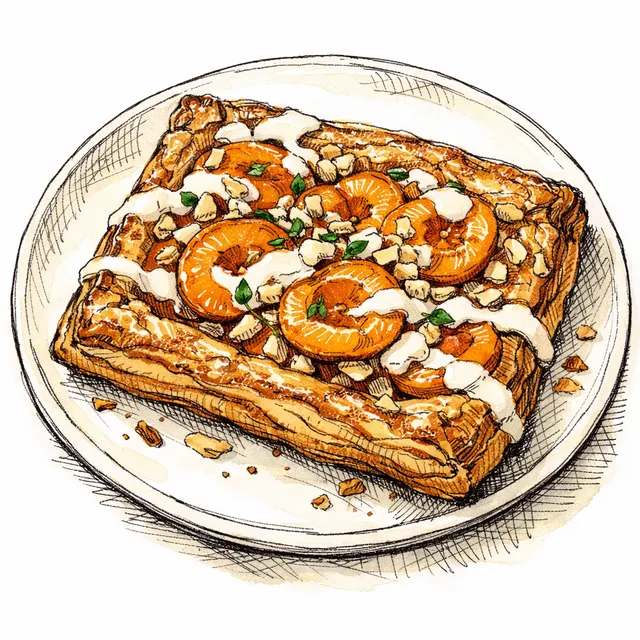
The Weekend Slab: Brown Butter & Apricot Rough-Puff Danish
Paris gave me my pastry standards, but the Bay Area taught me not to stress about them. I used to spend three days on traditional détrempe (dough blocks) and precise butter locks. Then I had friends coming for Sunday coffee and zero time. Enter the rough-puff slab. We bypass the intricate folding for a quick lamination that still shatters when you bite it. Why it works: Keeping the butter ice-cold and doing a few quick letter folds mimics classic layers in a fraction of the time. I spread a thick layer of browned butter frangipane—because butter is not a garnish—and press halves of tart summer apricots straight in. The acidity of the local fruit cuts the rich, nutty base perfectly. Bake it until the edges are deeply caramelized and the frangipane puffs with a slight wobble in the center. We're not suffering for brunch. One massive slab means maximum crispy edges and zero fussy shaping. Cami's shortcut note: Store-bought all-butter puff pastry works in a pinch. Don't skip this: Chill the assembled slab for twenty minutes before baking. Cold pastry hitting a hot oven equals lacy, expansive flakes instead of a flat puddle. Make it your own by swapping apricots for tart plums, just let time do the work in the fridge.
Featured Recipe
Brown Butter & Apricot Rough-Puff Slab Danish
Café-level laminated pastry without the three-day commitment. We build a high-flake rough puff, slather it with browned butter frangipane, and sink tart summer apricots right into the center. One massive slab means maximum crispy edges and zero fussy shaping—we’re not suffering for brunch.
Save a copy to your collection for editing
Timeline
Ingredients
- 250 g all-purpose flour(Plus extra for rolling)
- 275 g cultured unsalted butter(225g freezing cold and cubed for dough, 50g for frangipane)
- 5 g sea salt(Fine grain)
- 120 ml ice water(Must be freezing cold)
- 100 g almond flour(Finely ground)
- 75 g toasted sugar(Or standard organic cane sugar)
- 2 large eggs(1 for frangipane, 1 for egg wash)
- 400 g fresh apricots(Ripe but firm)
- 1 tsp vanilla paste(Or high-quality extract)
- 1 pinch flaky sea salt(For finishing)
- 50 g cultured unsalted butter(used for toasting)
- 1 large egg(used for frangipane)
- 1 large egg(used for egg wash)
Instructions
- 1
In a large bowl, toss 250g all-purpose flour and 5g sea salt. Cut in 225g cultured unsalted butter, smashing the freezing cold cubes between your thumbs and index fingers. Stop when the pieces range from pea-sized to walnut-sized.
3 min
Tip: Leave some butter pieces big. Butter is not a garnish here—it’s the architecture of your flake.
- 2
Drizzle 120ml ice water over the flour mixture. Toss gently with your hands until a shaggy dough forms. Turn it out onto a board, pat into a rough rectangle, and fold it in thirds like a letter. Rotate 90 degrees, roll out slightly, and fold in thirds again.
7 min
Tip: Shaggy is good. Overworked dough is tight like a bad alibi. If it’s crumbling, let the ambient moisture hydrate it as you fold.
- 3
Wrap the dough tightly in plastic and place it in the freezer. We need the cold to relax the gluten and lock up the butter so the layers don't bleed.
30 min
Tip: Cami's shortcut note: The freezer accelerates the chill just enough so you can roll this out in one morning. Let time do the work.
- 4
While the dough chills, melt 50g cultured unsalted butter in a small saucepan over medium heat. Swirl constantly until the milk solids toast and smell intensely nutty. Pour into a bowl to cool slightly.
5 min
Tip: Watch the pan—browned butter goes from liquid gold to burnt disaster in seconds.
- 5
To the cooled brown butter, vigorously whisk in 100g almond flour, 75g toasted sugar, 1 large egg, and 1 tsp vanilla paste until a smooth, thick paste forms.
5 min
Tip: Toasted sugar amplifies the nutty depth, but regular cane sugar works perfectly if you're out.
- 6
Preheat your oven to 400°F (200°C). Halve and pit 400g fresh apricots. Set them aside on a plate.
5 min
Tip: Don't peel the apricots. The skins hold tart flavor and beautiful structure.
- 7
Pull the dough from the freezer. On a floured surface, roll it into a 9x13-inch slab. Transfer to a parchment-lined sheet pan. Lightly score a 1-inch border around the edge with a paring knife. Spread the frangipane inside the border. Shingle the apricots on top, pressing them slightly in. Beat the remaining 1 large egg and brush the border generously.
10 min
Tip: If the dough resists rolling and shrinks back, give it 10 more minutes in the fridge. Never force it.
- 8
Bake until the pastry edges are puffed, beautifully lacy, and deeply bronzed, and the apricots are bubbling in their juices.
35 min
Tip: Don't pull it early. Pale pastry is a tragedy; we want a serious crust-to-crumb ratio.
- 9
Pull from the oven and let cool on the pan for 15 minutes to allow the frangipane to set. Finish with 1 pinch flaky sea salt before slicing.
15 min
Tip: The salt cuts the sweetness and brings out the stone fruit's tang.
Chef's Notes
Cami’s shortcut note: Rough puff (pâte feuilletée rapide) gives you 80% of the lamination of a true croissant dough for 20% of the effort. If you want to get ahead, do the folds the night before and let it sleep in the fridge. The overnight cold retard develops an insanely lacy crumb and deeper flavor, meaning you wake up and just assemble. We’re not suffering for brunch.

Camille Roux
Café-level bakes, weeknight methods, zero compromise.
Camille “Cami” Roux was born in Paris with flour in her hair and a healthy skepticism of culinary dogma. She grew up around neighborhood boulangeries that treated crust and crumb like religion—but what stuck with her wasn’t rigid tradition. It was the quiet precision: good butter that actually tastes like milk, patient fermentation that builds flavor for free, and desserts that know when to stop before they get cloying. After moving to the Bay Area, Cami trained in a bread-and-pastry scene obsessed with texture, naturally leavened doughs, and seasonal fruit—Tartine energy, minus the martyrdom. She became known for loaves that sing when they cool, jammy tarts with clean edges, and “how is this so good?” weeknight pastries made with a few smart shortcuts. Her motto is high impact, low fuss: splurge where it counts (butter, salt, time), streamline the rest (sheet pans, one bowl, cold-proofing). If it doesn’t improve flavor or structure, it doesn’t earn a step.