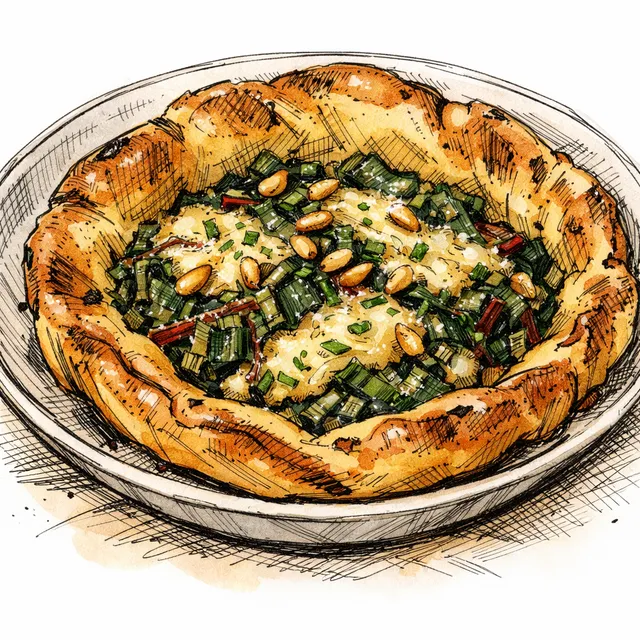
Brown Butter, Swiss Chard & Gruyère Savory Pascade
I first met the Pascade on a rainy drive through Aveyron. It is essentially a caramelized, puffed oven-crêpe—think of it as a savory Dutch baby with serious café attitude. My Parisian mother ordered one, and it arrived blistering hot, edges shattered like glass. It was love at first crunch.This Brown Butter, Swiss Chard & Gruyère Pascade is my Bay Area love letter to that memory. It is a weeknight savior built on a ridiculously simple, high-hydration batter. We blister earthy Swiss chard in browned butter, pour over the batter, and bury it in nutty Gruyère. The oven does the heavy lifting, delivering maximum lacy edges. We are not suffering for dinner here.Want to make it yours? Swap the chard for kale or spinach, but cook the water out first. Too much pan moisture means a dense base, and your crumb will end up tight like a bad alibi.Cami's shortcut note: You can mix this batter in a blender thirty seconds before baking. The fridge is your friend if you want to prep the batter in the morning, but no resting is mandatory.Don't skip this: The brown butter (beurre noisette). Butter is not a garnish; it is the foundational flavor that elevates earthy greens. Watch for the foam, smell the toast, and pour immediately.
Featured Recipe
Brown Butter, Swiss Chard & Gruyère Savory Pascade
A Pascade is a caramelized, puffed oven-crêpe hailing from the Aveyron region of France. Think of it as a savory Dutch baby with a serious café attitude, built on a ridiculously simple quick-batter. We blister earthy Swiss chard in browned butter, pour over a high-hydration batter, and bury it in nutty Gruyère for maximum crispy, lacy edges.
Save a copy to your collection for editing
Timeline
Ingredients
- 4 large Eggs(Room temperature)
- 1 cup Whole milk(Room temperature)
- 3/4 cup All-purpose flour
- 1/2 tsp Kosher salt
- 1/4 tsp Black pepper(Freshly cracked)
- 1 bunch Swiss chard(Stems and leaves separated)
- 1 tbsp Olive oil
- 1 clove Garlic(Smashed whole)
- 1/8 tsp Nutmeg(Freshly grated)
- 3 tbsp Unsalted butter(Cultured preferred)
- 1 cup Gruyère cheese(Freshly grated)
Instructions
- 1
Place a 10-inch cast-iron skillet on the middle rack and crank your oven to 425F (220C). We need a screaming hot pan to create the initial steam shock that lifts the batter.
20 min
Tip: Do not skip preheating the pan. Cold iron means flat batter.
- 2
In a single bowl, whisk 4 large eggs until frothy. Pour in 1 cup whole milk, then gently whisk in 3/4 cup all-purpose flour, 1/2 tsp kosher salt, and 1/4 tsp black pepper. Don't overmix; just get rid of the dry spots. Set aside. Let time do the work resting hydrates the flour so your crumb isn't tight like a bad alibi.
5 min
Tip: Room temperature dairy ensures the batter doesn't seize in the hot pan.
- 3
Prep the greens. Strip the leaves from 1 bunch Swiss chard. Dice the stems finely and roughly chop the leafy greens.
5 min
Tip: Keep stems and leaves separated since they cook at different rates.
- 4
Heat 1 tbsp olive oil in a separate skillet over medium-high. Sauté the diced chard stems with 1 clove garlic (smashed) for 2 minutes to soften. Toss in the chopped leaves and 1/8 tsp nutmeg. Cook until just wilted, about 2 minutes. Pull the garlic clove and discard it. We want the essence, not the bite.
5 min
Tip: Drive off excess moisture so your pascade doesn't turn soggy.
- 5
Carefully pull the blazing hot cast-iron pan from the oven. Drop in 3 tbsp unsalted butter. It will foam and brown almost instantly smell for toasted nuts. Scatter the wilted chard across the browned butter, pour the rested batter directly over the greens, and bury the whole thing under 1 cup Gruyère cheese.
2 min
Tip: Work quickly here so the pan doesn't lose its heat.
- 6
Return the cast-iron to the oven. Bake until the edges climb the pan, turning a deep, lacy mahogany, and the center is puffed and golden. Look for a pronounced wobble in the center when you nudge the pan.
20 min
Tip: Do not open the oven door for the first 15 minutes, or the steam structure will collapse.
- 7
Pull from the oven. Cami's shortcut note: The dramatic puff will deflate slightly as it cools. This is exactly what it should do. Let it rest 5 minutes so the custardy base sets before you slice into wedges.
5 min
Tip: We're not suffering for brunch. Serve warm, straight from the pan.
Chef's Notes
Butter is not a garnish. The immediate sizzle of dropping butter into a 425-degree pan is what guarantees those irresistible, lacy edges that shatter when you bite them. Gruyère brings the necessary nutty tension to the earthy chard, but a sharp Comté works beautifully as a backup.

Camille Roux
Café-level bakes, weeknight methods, zero compromise.
Camille “Cami” Roux was born in Paris with flour in her hair and a healthy skepticism of culinary dogma. She grew up around neighborhood boulangeries that treated crust and crumb like religion—but what stuck with her wasn’t rigid tradition. It was the quiet precision: good butter that actually tastes like milk, patient fermentation that builds flavor for free, and desserts that know when to stop before they get cloying. After moving to the Bay Area, Cami trained in a bread-and-pastry scene obsessed with texture, naturally leavened doughs, and seasonal fruit—Tartine energy, minus the martyrdom. She became known for loaves that sing when they cool, jammy tarts with clean edges, and “how is this so good?” weeknight pastries made with a few smart shortcuts. Her motto is high impact, low fuss: splurge where it counts (butter, salt, time), streamline the rest (sheet pans, one bowl, cold-proofing). If it doesn’t improve flavor or structure, it doesn’t earn a step.