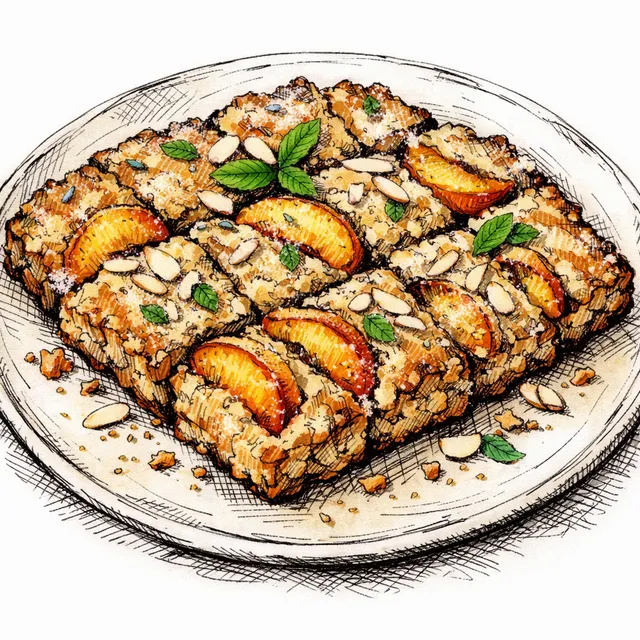
Browned Butter & Peach Rustic Scone Slab
I spent too many early mornings in cramped San Francisco kitchens agonizing over perfectly round scones. Individual scones are a fussy affair that often result in a crumb tight like a bad alibi. We bypass the biscuit cutter entirely. My breakthrough came last July. I had a basket of bruised local peaches and zero patience. I browned my cultured butter—beurre noisette, cooking it until it smells like toasted hazelnuts, which evaporates the water and concentrates the fat for a flakier texture. After chilling it back into solid shards, I employed a few rustic letter-folds before pressing the dough into a single, craggy slab. No scraps, maximum crust-to-crumb ratio. The browned butter shards and fresh July peaches melt right into the lacy layers, proving once again that we're not suffering for brunch. This recipe is my love letter to lazy, high-impact weekends. Make it your own by swapping peaches for tart plums or folding in toasted pecans. Cami's shortcut note: You can build the slab the night before. The fridge is your friend. Don't skip this: Freeze your browned butter solid before mixing. If the butter melts before hitting the hot oven, you lose the flake. Butter is not a garnish, and let time do the work.
Featured Recipe
Browned Butter & Peach Rustic Scone Slab
Individual scones are a fussy affair that often result in a crumb tight like a bad alibi. We bypass the biscuit cutter entirely, employing a few rustic letter-folds before pressing the dough into a single, craggy slab. Browned butter shards and fresh July peaches melt into the lacy layers, proving once again that we're not suffering for brunch.
Save a copy to your collection for editing
Timeline
Ingredients
- 1/2 cup Cultured butter(Plus extra for greasing if needed)
- 2.5 cups All-purpose flour
- 1/3 cup + 1 tbsp Light brown sugar(Divided use)
- 1 tbsp Baking powder
- 1 tsp Flaky sea salt
- 2 Fresh peaches(Ripe but firm, skin left on)
- 1/2 cup Toasted pecans(Roughly chopped)
- 3/4 cup Crème fraîche(Cold)
- 1 tsp Vanilla extract
- 1 tbsp Heavy cream(For brushing)
Instructions
- 1
Melt 1/2 cup cultured butter in a skillet over medium heat until it foams, smells like toasted hazelnuts, and brown bits form at the bottom (about 5 minutes). Immediately pour onto a parchment-lined plate and place in the freezer to solidify. We need those butter shards ice-cold to create a flaky, lacy crumb.
5 min
Tip: Don't walk away from browning butter; it goes from nutty to burnt in seconds.
- 2
Preheat oven to 400°F (200°C). While the butter chills, whisk 2.5 cups all-purpose flour, 1/3 cup light brown sugar, 1 tbsp baking powder, and 1 tsp flaky sea salt in a large bowl. Dice 2 fresh peaches into bite-sized chunks and roughly chop 1/2 cup toasted pecans.
10 min
Tip: Leave the peach skins on. They add color, texture, and keep the fruit from turning to mush.
- 3
Pull the solidified browned butter from the freezer and chop it into rough, pea-sized shards. Toss the butter into the flour mixture, coating the pieces completely so they don't stick together.
3 min
Tip: Use a sharp knife or bench scraper to chop the frozen butter.
- 4
In a small measuring cup, stir 3/4 cup crème fraîche with 1 tsp vanilla extract. Pour into the dry ingredients, add the chopped peaches and pecans, and use a fork to gently toss until just moistened. The dough will look incredibly shaggy. Let time do the work, don't overmix.
2 min
Tip: If there's dry flour at the bottom of the bowl, resist the urge to add more liquid. The peaches will release moisture.
- 5
Turn the shaggy dough onto a piece of parchment paper. Pat it roughly into a rectangle, fold it in half like a letter, and flatten it again. Repeat this rustic fold one more time—this is your lamination-lite shortcut for high-impact flakiness. Press the dough into an even 8x8-inch square slab.
3 min
Tip: Use the parchment paper to help lift and fold the dough if it feels sticky.
- 6
Brush the top of the slab with 1 tbsp heavy cream and sprinkle generously with the remaining 1 tbsp light brown sugar. Slide the parchment onto a baking sheet and chill in the fridge for 10 minutes. The fridge is your friend here; it relaxes the gluten and re-chills the butter.
10 min
Tip: Never skip the chill. Warm butter leads to flat pastries.
- 7
Bake for 22 to 25 minutes until the top is deeply golden, craggy, and the fruit is bubbling. Let it cool slightly on the pan before slicing into rustic squares or wedges.
25 min
Tip: Look for a firm jiggle and toasted edges. If it's pale, keep it in the oven.
Chef's Notes
Cami's shortcut note: Freezing browned butter on a plate takes exactly 10 minutes. It gives you the deep, nutty flavor of brown butter while preserving the solid fat chunks needed for maximum flake. Don't skip the final resting time in the fridge before baking—we want height, and we want lacy layers. Butter is not a garnish, but an extra dollop of crème fraîche on top when serving wouldn't hurt.

Camille Roux
Café-level bakes, weeknight methods, zero compromise.
Camille “Cami” Roux was born in Paris with flour in her hair and a healthy skepticism of culinary dogma. She grew up around neighborhood boulangeries that treated crust and crumb like religion—but what stuck with her wasn’t rigid tradition. It was the quiet precision: good butter that actually tastes like milk, patient fermentation that builds flavor for free, and desserts that know when to stop before they get cloying. After moving to the Bay Area, Cami trained in a bread-and-pastry scene obsessed with texture, naturally leavened doughs, and seasonal fruit—Tartine energy, minus the martyrdom. She became known for loaves that sing when they cool, jammy tarts with clean edges, and “how is this so good?” weeknight pastries made with a few smart shortcuts. Her motto is high impact, low fuss: splurge where it counts (butter, salt, time), streamline the rest (sheet pans, one bowl, cold-proofing). If it doesn’t improve flavor or structure, it doesn’t earn a step.