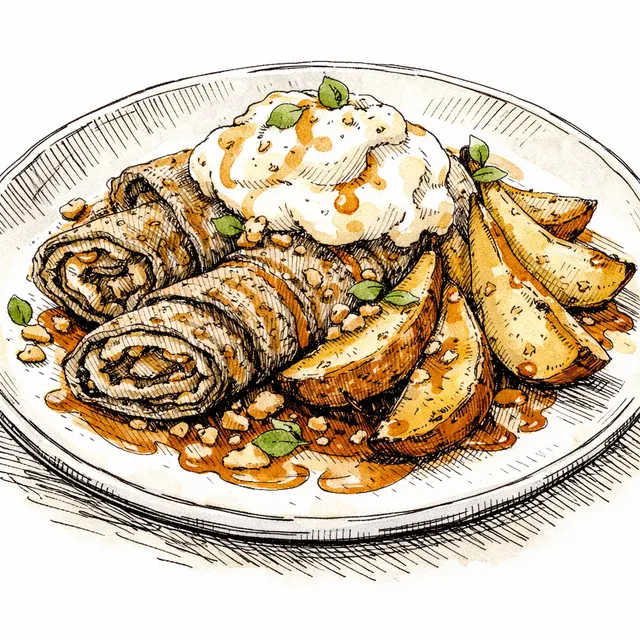
Buckwheat Crêpe Roulade: Roasted Pears, Crème Fraîche Cloud & Cider-Salted Caramel
This roulade is my Paris-meets-January dessert: buckwheat crêpes rolled into a rustic log, stuffed with roasted pears and a crème fraîche “cloud,” then dragged over the finish line with cider-salted caramel. It eats like a crêpe cake’s cooler, sturdier cousin—tender layers, nutty edges, jammy fruit, and that café-level glow.
The idea came from a little crêperie habit I had back in Paris: galette au sarrasin (buckwheat crêpe) followed by something sweet, always. In California, January pears are everywhere, and I’m not suffering for brunch with a stacked, fussy cake. So I rolled it. Same pleasure, less drama.
What makes it special to me is the balance: buckwheat’s toastiness, pears that taste like themselves, and crème fraîche that stays tangy and light because we don’t over-sweeten it. Butter is not a garnish here—it’s the backbone of the caramel.
Make it yours: swap pears for apples or quinces, add toasted hazelnuts, or spike the cloud with a whisper of Calvados.
Cami’s shortcut note: Roast the pears the day before.
Don’t skip this: Flaky salt on the caramel. Under-salted dessert is just sweet cardboard.
Featured Recipe
Buckwheat Crêpe Roulade with Roasted Pears, Crème Fraîche–Vanilla Cloud & Cider-Salted Caramel
This is a Paris-meets-January dessert: buckwheat crêpes rolled into a rustic roulade, filled with roasted winter pears and a barely-sweet crème fraîche “cloud,” then finished with a quick cider caramel and flaky salt. It eats like a crêpe cake’s cooler, sturdier cousin—tender layers, nutty edges, jammy fruit, and that café-level finish without a single fussy garnish.
Save a copy to your collection for editing
Ingredients
- 3 Pears (Bosc or Anjou)(firm, ripe; about 750–850 g total)
- 60 g Unsalted butter(plus extra for the pan)
- 35 g Light brown sugar(for roasting pears)
- 2 g Fine sea salt(for pears; about 1/3 tsp)
- 240 g Apple cider (not vinegar)(for caramel; about 1 cup)
- 120 g Granulated sugar(for caramel; about 1/2 cup + 2 tbsp)
- 120 g Heavy cream(for caramel; warm it slightly so it doesn’t seize)
- to taste Flaky sea salt(finish; I like 1/2–3/4 tsp)
- 420 g Whole milk(for crêpe batter; about 1 3/4 cups)
- 3 Eggs
- 120 g Buckwheat flour(about 1 cup, spooned and leveled if using cups)
- 45 g All-purpose flour(for flexibility and less brittleness; about 1/3 cup)
- 4 g Fine sea salt(for batter; about 3/4 tsp)
- 6 g Vanilla bean paste (or good extract)(about 1 tsp)
- 35 g Unsalted butter, melted(for batter; let it cool slightly)
- 240 g Crème fraîche(cold; about 1 cup)
- 120 g Heavy cream(cold; about 1/2 cup)
- 25 g Powdered sugar(for filling; about 3 tbsp)
- 1 lemon Lemon zest(optional but sharpens everything)
- 60 g Toasted walnuts or pecans(optional, chopped; adds crunch and a wintery edge)
Instructions
- 1
Roast the pears. Heat oven to 200°C / 400°F. Halve pears, core, and slice into 1 cm wedges. Toss on a sheet pan with 20 g Unsalted butter, 35 g Light brown sugar, and 2 g Fine sea salt. Roast 20–25 minutes until the edges bronzed and the pears are tender but not collapsing.
25 min
Tip: Don’t overcrowd. Pears need space to caramelize, not steam. If they look wet at minute 20, give them 3–5 more minutes.
- 2
Make the crêpe batter (one bowl). Whisk 420 g Whole milk and 3 Eggs until smooth. Whisk in 120 g Buckwheat flour, 45 g All-purpose flour, 4 g Fine sea salt, 6 g Vanilla bean paste (or good extract), then whisk in 35 g Unsalted butter, melted. Rest 20 minutes (room temp) or up to overnight in the fridge.
20 min
Tip: Resting is not a vibe—it hydrates the flour so your crêpes don’t tear. Overnight is even better and makes this very weeknight-friendly.
- 3
Cook the crêpes. Heat a 24–28 cm (9–11 in) nonstick or seasoned pan over medium. Lightly butter. Pour about 60–70 g batter, swirl thin, cook 45–60 seconds until the surface looks set and the edges lift, flip 10–15 seconds. Stack on a plate. You want 10–12 crêpes.
25 min
Tip: Adjust heat after the first one. If they color too fast, you’re too hot; if they’re pale and rubbery, you’re too low.
- 4
Make the cider-salted caramel. In a small pot, simmer 240 g Apple cider (not vinegar) until reduced to 80–90 g (about 1/3 cup), 10–15 minutes. In a second pot (or the same pot wiped), heat 120 g Granulated sugar over medium until it melts and turns amber. Off heat, whisk in reduced cider (careful—steam), then whisk in 120 g Heavy cream. Return to low heat 1–2 minutes until smooth. Stir in 40 g Unsalted butter. Cool to warm; it will thicken as it sits. Finish with to taste Flaky sea salt to taste.
20 min
Tip: Amber means honey-dark, not mahogany-black. If it smells acrid, it’s burnt—start over. Precision saves heartbreak.
- 5
Whip the crème fraîche cloud. Whisk 240 g Crème fraîche, 120 g Heavy cream, 25 g Powdered sugar, and 1 lemon Lemon zest (if using) just to soft peaks—billowy, not stiff. Fold in 60 g Toasted walnuts or pecans if using.
5 min
Tip: Stop early. Over-whipped crème fraîche goes grainy fast. Soft peaks = spreads like a dream.
- 6
Assemble the roulade. Lay a crêpe down. Spread a thin layer of crème fraîche cloud (about 2 tbsp). Add a few 3 Pears (Bosc or Anjou) slices. Repeat, stacking 6–7 crêpes into a thick ‘crêpe stack,’ then roll it up like a jelly roll (tight but not crushing). Repeat with remaining crêpes to make a second roulade or one larger, depending on your pan size and ambition. Chill 30 minutes to set.
30 min
Tip: This is the shortcut that’s safe: rolling gives you the ‘layered’ effect without the tall, wobbly crêpe cake drama. We’re not suffering for brunch—or dessert.
- 7
Slice and finish. Cut on a bias into 2–3 cm slices. Spoon warm cider caramel over, add a final pinch of flaky sea salt. Serve immediately.
5 min
Tip: Warm caramel + chilled roulade = contrast. That’s the whole point. If caramel thickens too much, warm it 10 seconds at a time.
Chef's Notes
This one is personal: buckwheat crêpes (galettes) are what I grew up eating when Paris felt too loud—simple, nutty, honest. In January, pears are patient and reliable, which is exactly what you want in a dessert. Why it works: buckwheat brings deep toastiness, crème fraîche keeps the filling tangy and not-too-sweet, and reducing cider gives you apple aromatics without needing citrus (yes, I can quit citrus—sometimes). Cami’s shortcut note: Cook crêpes and roast pears the night before. Assemble in 10 minutes the next day; caramel reheats like a champ. Don’t skip this: the rest for the batter. Tight like a bad alibi crêpes come from rushed hydration.

Camille Roux
Café-level bakes, weeknight methods, zero compromise.
Camille “Cami” Roux was born in Paris with flour in her hair and a healthy skepticism of culinary dogma. She grew up around neighborhood boulangeries that treated crust and crumb like religion—but what stuck with her wasn’t rigid tradition. It was the quiet precision: good butter that actually tastes like milk, patient fermentation that builds flavor for free, and desserts that know when to stop before they get cloying. After moving to the Bay Area, Cami trained in a bread-and-pastry scene obsessed with texture, naturally leavened doughs, and seasonal fruit—Tartine energy, minus the martyrdom. She became known for loaves that sing when they cool, jammy tarts with clean edges, and “how is this so good?” weeknight pastries made with a few smart shortcuts. Her motto is high impact, low fuss: splurge where it counts (butter, salt, time), streamline the rest (sheet pans, one bowl, cold-proofing). If it doesn’t improve flavor or structure, it doesn’t earn a step.