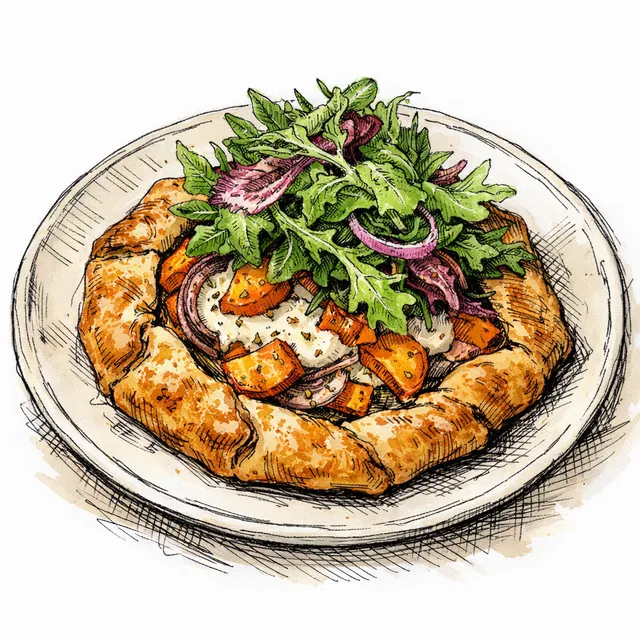
Butternut Squash–Shallot Café Galette (with Dijon Crème Fraîche + Greens on Top)
This galette is my French-café lunch, minus the tiny fork and the €9 side salad. You get fast, flaky pastry, sweet-roasted butternut and shallots that go properly jammy, and a salty alpine cheese that melts into the edges like it means it. Then I finish it the only way that makes sense: a handful of bitter greens tossed on top so every bite has crunch and bite.
The inspiration is pure café comptoir (counter lunch): something baked, something sharp, something fresh. I learned early that pastry + salad isn’t a gimmick—it’s balance. In Paris, I’d grab a slice of tarte salée between classes; in the Bay, I started doing the same at home, because we’re not suffering for brunch.
What makes this one special is the contrast. The squash is sweet, the shallots are deep, the cheese is salty, and the greens keep it awake. And the Dijon crème fraîche? It’s the small luxury that makes the whole thing feel intentional.
Make it yours: swap the cheese (Comté, Gruyère, even feta), change the greens (arugula, radicchio, frisée), or add toasted walnuts for bite.
Cami’s shortcut note: Roast the squash and shallots ahead; the fridge is your friend.
Don’t skip this: Let the galette cool 10 minutes before topping—hot crust + dressed greens = soggy alibi.
Featured Recipe
Butternut Squash–Shallot Café Galette with Dijon Crème Fraîche + Bitter Greens Salad Finish
This is my French-café lunch at home: a fast, flaky free-form galette with jammy roasted squash, sweet shallots, and a salty alpine cheese, then a bright little salad tossed right on top so every bite snaps. It’s crisp, savory, packable, and not-too-rich—until you hit the Dijon crème fraîche, because butter is not a garnish.
Save a copy to your collection for editing
Ingredients
- 200 g All-purpose flour(plus more for rolling)
- 5 g Fine sea salt(divided)
- 140 g Unsalted butter (cold)(cut into 1/2-inch cubes)
- 10 g Apple cider vinegar(or white wine vinegar)
- 70 g Ice water(plus 1–2 tbsp as needed)
- 25 g Dijon mustard(divided)
- 120 g Crème fraîche(or thick sour cream)
- 1 Black pepper(to taste)
- 500 g Butternut squash (or kabocha)(peeled, seeded, sliced 1/4-inch (about 4 cups))
- 3 Shallots(large; thinly sliced into half-moons)
- 30 g Olive oil(about 2 tbsp, divided)
- 10 g Maple syrup or honey(optional but excellent)
- 6 g Thyme (fresh)(about 6–8 sprigs, leaves picked)
- 1 pinch Nutmeg(optional, but very café)
- 120 g Gruyère or Comté (or aged cheddar)(coarsely grated)
- 1 Egg(for egg wash)
- 5 g Water or milk(1 tsp, to thin egg wash)
- 1 Flaky salt(to finish)
- 90 g Arugula or chicory mix (frisée/escargot/radicchio)(about 3 packed cups)
- 15 g Lemon juice(about 1 tbsp)
- 10 g Sherry vinegar or red wine vinegar(about 2 tsp)
- 35 g Toasted walnuts or hazelnuts(roughly chopped)
- 10 g Chives(finely sliced)
Instructions
- 1
Make the fast flaky dough (rough puff, weeknight edition). In a large bowl, whisk 200 g All-purpose flour with 3 g of the salt. Toss in 140 g Unsalted butter (cold) cubes. Smash each cube flat between your fingertips (you want big flakes, not sandy crumbs).
6 min
Tip: If your kitchen is warm, chill the bowl 5 minutes first. Cold butter = flaky layers.
- 2
Drizzle in 10 g Apple cider vinegar and 70 g Ice water. Mix with a fork until you get shaggy clumps. If it’s dusty, add 1 tbsp water at a time—stop when it just holds when squeezed.
2 min
Tip: Vinegar keeps the dough tender and makes it easier to roll without fighting back.
- 3
Do 2 quick “turns” (safe shortcut). Dump dough onto the counter, press into a rectangle, then roll to about 8x14 inches. Fold into thirds like a letter. Rotate 90°, roll again, fold again. Wrap and chill 20 minutes (or up to 2 days).
25 min
Tip: This is lamination-lite: enough layers for shatter, not enough fuss to ruin your lunch.
- 4
Roast the squash and shallots. Heat oven to 425°F / 220°C. On a sheet pan, toss 500 g Butternut squash (or kabocha) and 3 Shallots with 30 g Olive oil, remaining 2 g salt, 6 g Thyme (fresh), 1 Black pepper, and 10 g Maple syrup or honey if using. Roast until edges bronze and centers are tender, 18–22 minutes. Cool 10 minutes.
32 min
Tip: Don’t crowd: you want roasting, not steaming. Look for browned corners—the flavor lives there.
- 5
Mix the 25 g Dijon mustard crème fraîche. Stir 120 g Crème fraîche with 25 g Dijon mustard and 1 pinch Black pepper (and 1 pinch Nutmeg if using). Refrigerate until needed.
2 min
Tip: This is your café sauce. It also protects the crust from getting soggy.
- 6
Roll and build. On a floured surface, roll chilled dough into a 12–13 inch round (about 1/8 inch thick). Transfer to parchment on a sheet pan. Spread 1–2 tsp Dijon over the center, leaving a 2-inch border. Sprinkle half the 120 g Gruyère or Comté (or aged cheddar) over the mustard. Pile on roasted squash/shallots. Top with remaining 120 g Gruyère or Comté (or aged cheddar).
10 min
Tip: Cheese under + cheese over = glue + gratin. That’s how you keep a clean slice.
- 7
Fold and bake. Fold the border up and over the filling, pleating as you go. Beat 1 Egg with 5 g Water or milk; brush the crust. Bake at 425°F / 220°C until deeply golden and crisp, 25–30 minutes.
30 min
Tip: Don’t pull it pale. You want the crust the color of good café toast: bronzed, not beige.
- 8
Salad finish (the crisp, packable move). In a bowl, toss 90 g Arugula or chicory mix (frisée/escargot/radicchio) with 15 g Lemon juice, 10 g Sherry vinegar or red wine vinegar, remaining 30 g Olive oil, 1 pinch salt, and 1 pinch Black pepper. Add 35 g Toasted walnuts or hazelnuts and 10 g Chives.
4 min
Tip: Dress lightly. The galette is rich; the salad is the snap.
- 9
Serve like a French café. Let galette cool 10 minutes (it sets). Slice. Dollop 25 g Dijon mustard crème fraîche on each piece and mound a small handful of dressed greens on top. Finish with 1 pinch Flaky salt.
10 min
Tip: For packing: keep salad + crème fraîche separate; assemble at lunch so it stays crisp.
Chef's Notes
I grew up eating tartes salées (savory tarts) at cafés that treated lunch like a small luxury: crisp pastry, something sweet-savory inside, and a sharp little salad to cut through. This is my at-home version—free-form galette so you don’t need a tart pan, and a two-turn rough puff so you still get that shattery, layered bite. Cami’s shortcut note: The 20-minute chill is the whole game. It’s what lets butter stay in pieces, which turns into flaky layers in the oven. If you’re truly slammed, you can chill 10 minutes in the freezer—just don’t let it freeze solid. Don’t skip this: Roast the squash until you see real browning at the edges. Pale squash tastes sweet but flat; browned squash tastes like lunch. Troubleshooting: If the galette leaks butter, your dough got warm—next time chill longer between turns and before baking. If the bottom is soft, bake on a preheated sheet pan or pizza steel for the last 10 minutes.

Camille Roux
Café-level bakes, weeknight methods, zero compromise.
Camille “Cami” Roux was born in Paris with flour in her hair and a healthy skepticism of culinary dogma. She grew up around neighborhood boulangeries that treated crust and crumb like religion—but what stuck with her wasn’t rigid tradition. It was the quiet precision: good butter that actually tastes like milk, patient fermentation that builds flavor for free, and desserts that know when to stop before they get cloying. After moving to the Bay Area, Cami trained in a bread-and-pastry scene obsessed with texture, naturally leavened doughs, and seasonal fruit—Tartine energy, minus the martyrdom. She became known for loaves that sing when they cool, jammy tarts with clean edges, and “how is this so good?” weeknight pastries made with a few smart shortcuts. Her motto is high impact, low fuss: splurge where it counts (butter, salt, time), streamline the rest (sheet pans, one bowl, cold-proofing). If it doesn’t improve flavor or structure, it doesn’t earn a step.