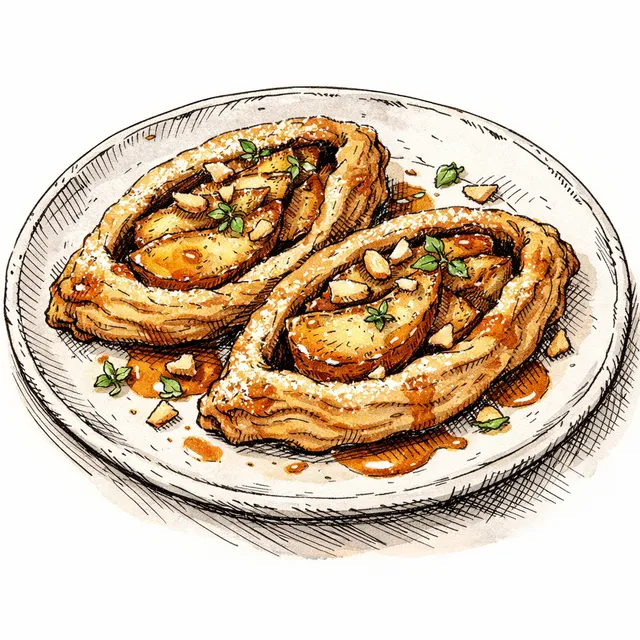
Caramelized Bosc Pear & Buckwheat Rough-Puff Lunettes
We are not suffering for brunch. When I crave the shatteringly crisp layers of a high-end Parisian patisserie but refuse to spend my entire weekend laminating butter, I make these lunettes. The inspiration came from a chilly autumn morning in my Bay Area kitchen, staring down a box of rock-hard Bosc pears and a bag of earthy buckwheat flour. Buckwheat brings a rustic, nutty depth that cuts right through the rich, caramelized fruit without making things heavy. By using a lightning-fast rough-puff technique, you get all those glorious, lacy layers with zero fuss. Butter is not a garnish here; keep it cold, and let time do the work in the fridge. Cut them into circles, slice little crescent peekaboo windows on top—hence lunettes, or spectacles—and watch them bake into golden perfection. Cami’s shortcut note: store-bought puff pastry works in a pinch if you are truly pressed for time, but adding that hit of buckwheat to your dusting flour changes the game entirely. Don't skip the flaky salt on the finish. It wakes up the sweet pear and brown butter instantly.
Featured Recipe
Caramelized Bosc Pear & Buckwheat Rough-Puff Lunettes
Crisp, deeply flaky pastry spectacles filled with spiced, caramelized Bosc pears and a lick of nutty buckwheat flour. A lightning-fast rough-puff technique yields shatteringly crisp layers without an entire weekend spent laminating.
Save a copy to your collection for editing
Timeline
Ingredients
- 200 g bread flour(unbleached; provides structure without toughness)
- 50 g buckwheat flour(adds deep, nutty undertones to the pastry)
- 1 tsp fine sea salt
- 15 g granulated sugar(about 1 tbsp, for the dough)
- 225 g unsalted butter(very cold, cut into 1/2-inch cubes)
- 120 ml ice water(plus 1-2 tbsp extra if dough feels dry)
- 3 large Bosc pears(peeled, cored, and cut into 1/4-inch dice (firm, not overly ripe))
- 45 g dark brown sugar(about 3 tbsp)
- 1 tbsp lemon juice(freshly squeezed)
- 0.5 tsp ground cardamom(freshly cracked preferred)
- 1 tsp cornstarch(to set the fruit juices)
- 1 large egg(beaten with 1 tsp water for egg wash)
- 2 tbsp demerara sugar(for topping)
- 0.5 tsp flaky sea salt(such as Maldon, for finishing)
Instructions
- 1
In a large mixing bowl, whisk together 200 g bread flour, 50 g buckwheat flour, 1 tsp fine sea salt, and 15 g granulated sugar. Scatter 225 g unsalted butter cubes over the dry ingredients. Use your fingers or a pastry blender to press each cube flat into large walnut-sized shingles—do not rub them down into fine crumbs. We need defined butter streaks for lift.
5 min
Tip: If your kitchen runs warm, chill the flour and the butter cubes for 10 minutes before starting.
- 2
Drizzle 120 ml ice water over the flour-butter mixture. Use a silicone spatula to toss loosely until a shaggy, uneven mass forms with visible dry flour pockets. Turn out onto a lightly floured board, gather firmly with your hands, and press into an 8x12-inch rough rectangle.
5 min
Tip: Don't overwork the dough; if it crumbles slightly at the edges, that is fine. The rolling pins and folds will bind it.
- 3
Roll the dough out to roughly 8x16 inches. Fold the top third down, then the bottom third up like a business letter (single turn). Rotate 90 degrees, roll out to 8x16 inches again, and repeat the letter fold. Wrap tightly in parchment or plastic and chill in the refrigerator for 30 minutes to relax the gluten and firm the butter.
5 min
Tip: Work swiftly so the butter sheets rather than melts into the flour.
- 4
While the dough rests, prepare the filling. In a medium skillet over medium heat, combine diced 3 large Bosc pears, 45 g dark brown sugar, 1 tbsp lemon juice, and 0.5 tsp ground cardamom. Cook, stirring occasionally, until the pears soften slightly and their juices reduce into a thick, glossy syrup, about 8 minutes. Stir in 1 tsp cornstarch mixed with 1 tsp water, cook 1 minute until cleared, then scrape onto a wide plate to cool completely.
10 min
Tip: Bosc pears hold their shape beautifully here without turning to mush. Ensure the filling cools completely so it doesn't melt the raw pastry butter.
- 5
Preheat your oven to 400°F (200°C) and line a large baking sheet with parchment paper. Position your rack in the center. The dough continues to rest in the fridge during this time.
10 min
Tip: A screaming hot oven is non-negotiable for blasting cold butter into steam, generating lacy, crisp layers.
- 6
Transfer the chilled pastry to a lightly floured surface. Roll into a clean 12x16-inch rectangle, roughly 1/8-inch thick. Trim ragged edges with a sharp knife. Cut the sheet lengthwise into two 6x16-inch strips, then crosswise into four sections to yield 8 equal rectangles (roughly 4x6 inches each).
7 min
Tip: Use a clean, downward cut rather than sawing with the knife so you don't seal the laminated layers together.
- 7
To form the 'lunettes' (glasses), fold each 4x6-inch pastry piece gently in half crosswise without creasing hard. Using a 1-inch round cutter or paring knife, cut two side-by-side circular holes into the top half only to form the twin eyeholes. Unfold, spoon 2 heaping tablespoons of cooled pear filling onto the solid lower half, leaving a 1/2-inch perimeter. Lightly brush the edges with a dab of 1 large egg wash, fold the cut-out top half over the filling, and press the edges firmly with the tines of a fork to seal.
8 min
Tip: Keep the edges free of compote juices so the seal remains airtight during the oven spring.
- 8
Arrange the pastries on the prepared sheet pan, spacing them 2 inches apart. Chill the assembled pastries in the freezer for 10 minutes to reset the butter before baking.
10 min
Tip: Cold dough entering a hot oven maximizes puff height and prevents butter weeping.
- 9
Brush the pastry tops lightly with the remaining 1 large egg wash, avoiding the cut edges. Scatter 2 tbsp demerara sugar and 0.5 tsp flaky sea salt evenly over the tops. Bake at 400°F (200°C) for 24-26 minutes, until deeply golden, puffed, and the pear compote bubbles through the spectacles.
25 min
Tip: Look for a rich chestnut color on the ridges; pale rough puff is gummy rough puff.
- 10
Remove from the oven and slide the parchment sheet directly onto a wire cooling rack. Let cool for at least 15 minutes before serving so the spiced pear interior settles and the bottoms crisp completely.
15 min
Tip: Pastries are best enjoyed warm or at room temperature with an espresso.
Chef's Notes
Cami's shortcut note: Rough puff takes 15 minutes of hands-on effort and delivers 90% of classic puff pastry's majesty with zero trauma. Buckwheat flour lends an earthy counterpoint that keeps the filling from tasting too sweet, and bread flour ensures the pockets pop tall instead of slouching. Don't skip chilling the assembled pastries in the freezer right before they hit the oven: that thermal shock is the difference between lacy flake and a puddle of melted butter.

Camille Roux
Café-level bakes, weeknight methods, zero compromise.
Camille “Cami” Roux was born in Paris with flour in her hair and a healthy skepticism of culinary dogma. She grew up around neighborhood boulangeries that treated crust and crumb like religion—but what stuck with her wasn’t rigid tradition. It was the quiet precision: good butter that actually tastes like milk, patient fermentation that builds flavor for free, and desserts that know when to stop before they get cloying. After moving to the Bay Area, Cami trained in a bread-and-pastry scene obsessed with texture, naturally leavened doughs, and seasonal fruit—Tartine energy, minus the martyrdom. She became known for loaves that sing when they cool, jammy tarts with clean edges, and “how is this so good?” weeknight pastries made with a few smart shortcuts. Her motto is high impact, low fuss: splurge where it counts (butter, salt, time), streamline the rest (sheet pans, one bowl, cold-proofing). If it doesn’t improve flavor or structure, it doesn’t earn a step.