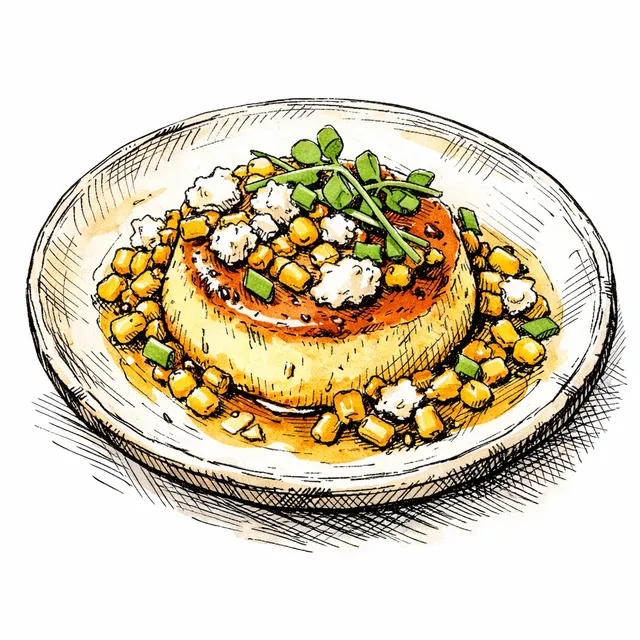
Summer's Savior: Caramelized Corn & Chèvre Cast-Iron Flan
Summer dinners in my Paris childhood meant endless cold salads, but my Bay Area training demands we push peak produce further. Enter the flan salé—a simple savory custard. We are not suffering over a hot stove in July, so this high-impact, low-fuss dinner happens entirely in one skillet.\n\nThe inspiration came from watching my grandmother toss bare corn cobs into simmering milk. That memory built the foundation of this recipe: you will steep your stripped cobs in the cream before mixing. Why it works: the cob holds the corn's natural starches and sweetest milk, acting as a built-in thickener and flavor amplifier.\n\nNext, brown the kernels in cultured butter. Butter is not a garnish; it is the essential bridge between the caramelized sweet corn and the tangy pockets of chèvre we drop in before baking. Let time do the work. Pull the skillet when the edges are deeply golden but the center still has a confident wobble.\n\nCami’s shortcut note: Swap the chèvre for feta if you need to, but do not skip steeping the cobs. Serve straight from the iron with a sharp, acidic green salad and a desperately cold white wine.
Featured Recipe
Caramelized Corn & Chèvre Cast-Iron Flan
An effortless summer dinner built on a high-impact, low-fuss flan salé. We extract every drop of flavor from peak-season corn by steeping the bare cobs in cream, browning the kernels in cultured butter, and setting it all with tangy pockets of goat cheese. We are not suffering over a hot stove in July. Serve this straight from the skillet with a sharp, acidic green salad and a desperately cold glass of white wine.
Save a copy to your collection for editing
Timeline
Ingredients
- 3 large ears fresh summer corn(shucked, kernels removed, cobs reserved)
- 1 cup heavy cream(cold)
- 1/2 cup whole milk(cold)
- 3 tbsp cultured butter (unsalted)
- 4 large eggs(room temperature)
- 1 tsp kosher salt
- 1/2 tsp freshly ground black pepper
- 1 tsp Dijon mustard
- 4 oz fresh goat cheese (chèvre)(cold)
- 2 tbsp fresh chives(finely chopped)
Instructions
- 1
Preheat your oven to 375°F (190°C). Shuck 3 large ears fresh summer corn. Cut the kernels off the cobs, reserving both the kernels and the bare cobs.
5 min
Tip: Cut the corn inside a wide bowl to keep the kernels from flying across your kitchen.
- 2
In a small saucepan over medium heat, combine 1 cup heavy cream and 1/2 cup whole milk. Add the bare corn cobs. Bring to a gentle simmer, then immediately turn off the heat, cover, and let steep to extract the sweet corn milk.
15 min
Tip: This is free flavor. The cobs hold incredible sweetness and natural starch that improves the custard's texture.
- 3
While the dairy steeps, heat an oven-safe cast-iron skillet over medium-high heat. Add 3 tbsp cultured butter (unsalted). Let it melt and foam until it smells nutty and the milk solids toast. Add the reserved corn kernels and sear without moving for two minutes, then toss. Cook until blistered and golden. Remove the skillet from heat.
10 min
Tip: Don't stir immediately. You want a hard sear on the corn to amplify its sweetness.
- 4
In a mixing bowl, vigorously whisk 4 large eggs, 1 tsp kosher salt, 1/2 tsp freshly ground black pepper, and 1 tsp Dijon mustard until completely smooth. Remove the cobs from the saucepan, pressing them to release any trapped liquid, and discard them. Slowly whisk the warm steeped dairy into the egg mixture.
5 min
Tip: Whisking the warm dairy into the eggs tempers them gently so they don't scramble.
- 5
Pour the custard base directly over the blistered corn in the skillet. Tear 4 oz fresh goat cheese (chèvre) into bite-sized nuggets and scatter them evenly across the skillet, letting them sink into the custard. Sprinkle with 2 tbsp fresh chives, finely chopped.
2 min
Tip: Leave the cheese in distinct chunks so you get sharp, tangy bites against the sweet corn custard.
- 6
Carefully transfer the skillet to the oven. Bake until the edges are puffed, deeply golden, and pulling away from the pan, and the center has a distinct wobble. If you overbake it, the custard gets tight like a bad alibi. Pull it when it jiggles.
30 min
Tip: Check at 25 minutes. Every oven lies, and cast-iron retains heat differently.
- 7
Let the skillet rest at room temperature. The residual heat will finish setting the custard. Serve warm or at room temperature.
10 min
Tip: Let time do the work. A piping hot custard masks the delicate flavor of the corn and chèvre.
Chef's Notes
Cami's shortcut note: If you are racing the clock, skip steeping the cobs. Just use cold cream and milk, but blend half a cup of the raw kernels into the dairy before whisking with the eggs. Don't skip the browned butter, though. Butter is not a garnish here; it is the foundational fat that elevates the corn. Let time do the work when resting the flan—a piping hot custard masks the delicate chèvre and corn flavor. Pull it from the oven when the center still has a confident wobble; it will set perfectly as it cools.

Camille Roux
Café-level bakes, weeknight methods, zero compromise.
Camille “Cami” Roux was born in Paris with flour in her hair and a healthy skepticism of culinary dogma. She grew up around neighborhood boulangeries that treated crust and crumb like religion—but what stuck with her wasn’t rigid tradition. It was the quiet precision: good butter that actually tastes like milk, patient fermentation that builds flavor for free, and desserts that know when to stop before they get cloying. After moving to the Bay Area, Cami trained in a bread-and-pastry scene obsessed with texture, naturally leavened doughs, and seasonal fruit—Tartine energy, minus the martyrdom. She became known for loaves that sing when they cool, jammy tarts with clean edges, and “how is this so good?” weeknight pastries made with a few smart shortcuts. Her motto is high impact, low fuss: splurge where it counts (butter, salt, time), streamline the rest (sheet pans, one bowl, cold-proofing). If it doesn’t improve flavor or structure, it doesn’t earn a step.