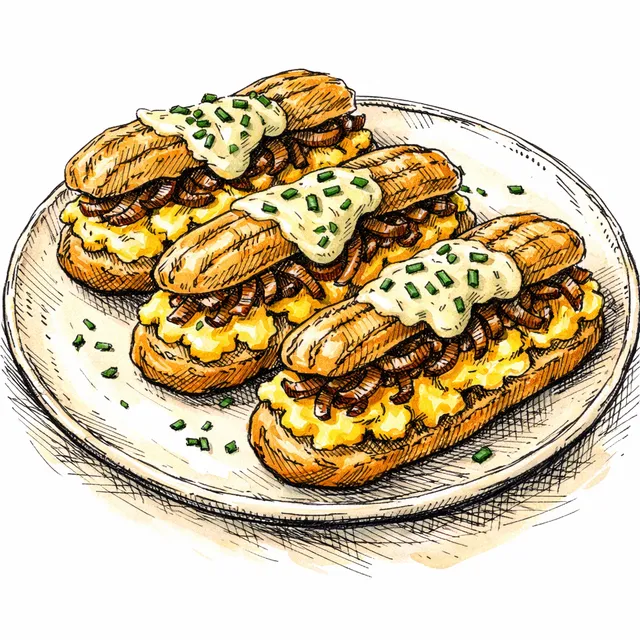
Caramelized Onion–Gruyère Choux “Breakfast Éclairs” (Soft-Scramble + Dijon Chive Crème)
I made these because I love French bistro breakfasts… but I refuse to laminate anything before coffee. Choux is my loophole: quick stovetop dough, big payoff. You get crackly edges, a lacy (airy, webby) interior, and that steamy hush when you split one open.
The inspiration is equal parts Paris and the Bay. In Paris, I ate too many onion tarts and learned that sweetness from onions isn’t sugar—it’s patience. In the Bay, I learned the fridge is your friend. So these “breakfast éclairs” are built to be staged: caramelize onions whenever, bake shells whenever, then fill in minutes like you’re running a tiny café out of your kitchen.
What makes them special to me is the contrast: onion-forward caramelized onions, a loose Gruyère béchamel that tastes like winter sunlight, and a soft-scramble tucked inside like a sunrise. No tight like a bad alibi eggs—keep them loose.
Make it yours: swap Gruyère for Comté, add black pepper and thyme to the onions, or fold in sautéed mushrooms. Finish with Dijon chive crème for bite.
Cami’s shortcut note: bake the shells until deeply golden, then poke a vent and cool—steam is the enemy of crisp.
Don’t skip this: caramelize the onions properly. Let time do the work.
Featured Recipe
Caramelized Onion–Gruyère Choux “Breakfast Éclairs” (Soft-Scramble + Dijon Chive Crème)
These are café-style savory éclairs—crisp choux shells packed with onion-forward caramelized onions, a loose Gruyère béchamel, and a soft-scramble tucked inside like a sunrise. You get crackly edges, a lacy, steamy interior, and big French bistro energy—without laminating dough at 7 a.m. The workflow is make-ahead by design: onions and shells done whenever, fill in minutes, eat like you’re not suffering for brunch.
Save a copy to your collection for editing
Ingredients
- 3 large Yellow onions, thinly sliced(about 900 g / 2 lb total)
- 2 tbsp Unsalted butter(for onions)
- 1 tbsp Olive oil(for onions)
- 1 1/2 tsp Kosher salt(divided, plus more to taste)
- 1 tsp Fresh thyme leaves(optional but excellent)
- 1 tsp Balsamic vinegar(or sherry vinegar; for finishing onions)
- 120 g Water(for choux (1/2 cup))
- 120 g Whole milk(for choux (1/2 cup))
- 85 g Unsalted butter(for choux (6 tbsp), cubed)
- 5 g Granulated sugar(for choux (1 tsp); helps browning)
- 150 g All-purpose flour(for choux (about 1 1/4 cups), sifted if lumpy)
- 4 large Eggs(for choux; plus 1 more if needed for consistency)
- 90 g Gruyère, finely grated(for choux (about 1 cup packed))
- 1/2 tsp Black pepper(for choux)
- 240 g Whole milk(for Gruyère béchamel (1 cup))
- 25 g Unsalted butter(for béchamel (about 2 tbsp))
- 20 g All-purpose flour(for béchamel (about 2 tbsp))
- 2 tsp Dijon mustard(for béchamel)
- 120 g Gruyère, finely grated(for béchamel (about 1 1/3 cups packed))
- 1 pinch Ground nutmeg(optional, classic with Gruyère)
- 6 large Eggs(for soft scramble)
- 2 tbsp Crème fraîche(for soft scramble (or heavy cream))
- 1 tbsp Unsalted butter(for soft scramble)
- 2 tbsp Chives, finely sliced(plus more to finish)
- 120 g Crème fraîche(for Dijon chive crème (1/2 cup))
- 1 tsp Dijon mustard(for Dijon chive crème)
- 1/2 tsp Lemon zest(optional, wakes everything up)
- 1 pinch Flaky salt(to finish)
Instructions
- 1
Caramelize the onions: In a wide skillet over medium-low, melt 2 tbsp Unsalted butter with 1 tbsp Olive oil. Add 3 large Yellow onions, thinly sliced and 1/2 tsp Kosher salt. Cook 35–45 minutes, stirring often, until deeply bronzed and jammy (not just translucent). Add 1 tsp Fresh thyme leaves if using. Finish with 1 tsp Balsamic vinegar and cook 30 seconds. Taste and salt as needed. Cool.
50 min
Tip: Non-negotiable: color. You want mahogany edges and a sweet-onion perfume. If they’re pale, they’re just sautéed—keep going.
- 2
Make the choux base (panade): Heat 120 g Water, 120 g Whole milk, 85 g Unsalted butter, 5 g Granulated sugar, and 1 tsp Kosher salt in a saucepan until butter melts and the liquid just comes to a simmer. Dump in 150 g All-purpose flour all at once. Stir hard with a spatula until it forms a smooth ball and a thin film coats the pan.
5 min
Tip: That film is your cue: you’ve cooked off enough moisture so the eggs can do their job.
- 3
Dry the dough, then add eggs: Keep cooking the dough over medium for 1–2 minutes, stirring, to dry it slightly. Transfer to a bowl (or stand mixer). Let cool 2 minutes, then beat in 4 large Eggs one at a time until glossy and elastic. The dough should fall from the spatula in a thick “V” ribbon. If it’s too stiff, beat in the 5th egg a little at a time.
8 min
Tip: Too many eggs = spready éclairs. Add the last egg slowly and watch the texture, not the count.
- 4
Fold in Gruyère and pepper: Stir in 90 g Gruyère, finely grated and 1/2 tsp Black pepper until evenly combined. Pipe 10–12 logs (about 4 inches / 10 cm) onto a parchment-lined sheet pan.
5 min
Tip: No piping bag? Use a zip-top bag with the corner snipped. Keep the logs even so they bake evenly.
- 5
Bake the shells: Bake at 425°F / 220°C for 15 minutes, then reduce to 375°F / 190°C and bake 15–20 minutes more until deeply golden and crisp. Turn off oven, crack the door, and let shells dry 10 minutes. Cool completely.
40 min
Tip: Don’t open the oven early. Steam is what inflates choux; impatience deflates it.
- 6
Make the Gruyère béchamel: Warm 240 g Whole milk. In a small pot, melt 25 g Unsalted butter, whisk in 20 g All-purpose flour, and cook 1 minute. Whisk in warm milk and simmer until thick and smooth, 2–3 minutes. Off heat, whisk in 2 tsp Dijon mustard, 1 pinch Ground nutmeg, and 120 g Gruyère, finely grated. Season lightly; the cheese brings salt.
8 min
Tip: Keep it pourable, not stiff. If it tightens, loosen with a spoonful of warm milk.
- 7
Soft-scramble the eggs: Whisk 6 large Eggs with 2 tbsp Crème fraîche and 1 pinch of salt. Cook in a nonstick pan over low heat with 1 tbsp Unsalted butter, stirring constantly, until creamy curds form—still glossy, still loose. Off heat, stir in 2 tbsp Chives, finely sliced.
6 min
Tip: Stop early. Residual heat finishes the job. Dry eggs are tight like a bad alibi.
- 8
Assemble: Split éclairs lengthwise. Spoon a swipe of 1 tsp Dijon mustard 120 g Crème fraîche 2 tbsp Chives, finely sliced 1/2 tsp Lemon zest on the bottom. Add a line of caramelized onions, a spoon of Gruyère béchamel, then tuck in soft-scramble. Close, finish with 1 pinch Flaky salt and extra chives. Eat warm.
10 min
Tip: Assembly rule: warm fillings, room-temp shells. Hot shells soften fast.
Chef's Notes
This one’s personal: it tastes like the corner boulangerie in Paris where the air smelled like butter and onions at 8 a.m.—except now I’m doing it in a tiny Bay Area kitchen with a real schedule. Choux is the weeknight pastry cheat code: no lamination, no drama, still crisp. Cami’s shortcut note: Make the onions up to 5 days ahead. Bake the choux shells up to 2 days ahead, then re-crisp 6–8 minutes at 350°F / 175°C. You can also freeze baked shells airtight for 1 month; re-crisp straight from frozen. Don’t skip this: the post-bake dry-out (10 minutes in the turned-off, cracked-door oven). That’s how you keep crackly shells that don’t collapse or go soggy the moment you fill them.

Camille Roux
Café-level bakes, weeknight methods, zero compromise.
Camille “Cami” Roux was born in Paris with flour in her hair and a healthy skepticism of culinary dogma. She grew up around neighborhood boulangeries that treated crust and crumb like religion—but what stuck with her wasn’t rigid tradition. It was the quiet precision: good butter that actually tastes like milk, patient fermentation that builds flavor for free, and desserts that know when to stop before they get cloying. After moving to the Bay Area, Cami trained in a bread-and-pastry scene obsessed with texture, naturally leavened doughs, and seasonal fruit—Tartine energy, minus the martyrdom. She became known for loaves that sing when they cool, jammy tarts with clean edges, and “how is this so good?” weeknight pastries made with a few smart shortcuts. Her motto is high impact, low fuss: splurge where it counts (butter, salt, time), streamline the rest (sheet pans, one bowl, cold-proofing). If it doesn’t improve flavor or structure, it doesn’t earn a step.