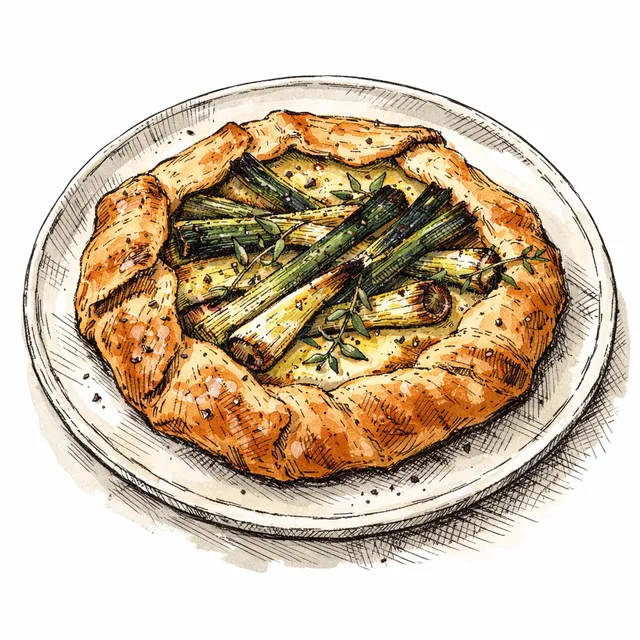
Charred Spring Onion & Gruyère Rough-Puff Galette
I grew up eating proper savory tarts in Paris, but Bay Area spring onions ruined me for anything else. They are sweet, aggressive, and practically beg to be charred in a hot pan. I wanted that café-level experience to kick off the weekend, but we're not suffering for brunch, let alone Friday dinner. Enter my 10-minute rough-puff.The secret is a quick-flake method. We freeze grated cultured butter, toss it with flour, and hydrate just enough to hold. The freezer does the heavy lifting, giving you bakery-level lamination without the folding marathon. Butter is not a garnish here; it is the structural integrity of your crust.Toss the spring onions in a bit of olive oil, pile them over lacy, nutty Gruyère, and fold the dough into a rustic slab. Bake until the cheese bubbles and the crust is shatteringly crisp. Make it your own by swapping in leeks or wild mushrooms, but always cook off their moisture first.Cami's shortcut note: Grate the butter on a box grater straight from the freezer. It coats the flour faster and stays freezing cold.Don't skip this: Chill the assembled galette for 15 minutes before baking. Cold butter hitting a hot oven creates rapid steam, which equals maximum flake. Tight crumb is like a bad alibi. Pour the wine and let time do the work.
Featured Recipe
Charred Spring Onion & Gruyère Rough-Puff Galette
This is Friday night café fare: lacy, nutty Gruyère and sweet, blistering spring onions wrapped in a shatteringly crisp rough-puff crust. We use a 10-minute quick-flake pastry method—letting the freezer do the hard work—so you get bakery-level lamination without the all-day fuss. Cut the work, keep the flake, and pour the wine.
Save a copy to your collection for editing
Timeline
Ingredients
- 250g g All-purpose flour(Plus extra for dusting)
- 1 tsp Kosher salt
- 170g g Cultured butter(Cold and cubed)
- 60ml ml Ice water
- 1 tbsp Apple cider vinegar(Inhibits gluten for a tender crust)
- 2 bunches Spring onions(Bulbs halved, greens trimmed)
- 1 tbsp Olive oil
- 150g g Aged Gruyère(Freshly grated)
- 2 tbsp Dijon mustard
- 1 tbsp Fresh thyme(Chopped)
- 1 Egg(Beaten, for egg wash)
- 1 pinch Flaky sea salt
Instructions
- 1
Smash the 170g Cultured butter into the 250g All-purpose flour and 1 tsp Kosher salt with your fingers until the pieces are flat like coins. This is your quick-flake insurance; large, flat shards of butter create steam pockets later. Combine the 60ml Ice water and 1 tbsp Apple cider vinegar, drizzle over the flour mixture, and toss lightly to form a shaggy mass.
10 min
Tip: The acid in the vinegar inhibits gluten development, keeping the crust tender. Work quickly so the butter doesn't melt.
- 2
Turn the dough onto a piece of parchment paper, press it into a rough 1-inch thick disc, and wrap it tightly. Shove the dough in the freezer for a fast 20-minute chill. The fridge is your friend, but the freezer is your Friday-night savior. Meanwhile, preheat the oven to 400°F (200°C).
20 min
Tip: Don't over-knead. The dough should look messy and hold together just enough to form a disc.
- 3
While the dough chills, trim the roots off the 2 bunches Spring onions and slice them in half lengthwise. Toss them in a bowl with the 1 tbsp Olive oil and a small pinch of salt. Grate the 150g Aged Gruyère. Whisk the 1 Egg in a small bowl.
10 min
Tip: Avoid pre-shredded cheese; the anti-caking agents make it melt tight like a bad alibi.
- 4
Remove the dough from the freezer. On a lightly floured sheet of parchment, roll it out into a 14-inch rough circle. Smear 2 tbsp Dijon mustard evenly over the center, leaving a 2-inch clean border. Scatter the 150g Aged Gruyère and 1 tbsp Fresh thyme directly over the mustard.
5 min
Tip: If the dough cracks at the edges while rolling, just pinch it back together. Freeform means no fuss.
- 5
Arrange the 2 bunches Spring onions uniformly over the cheese layer. Fold the clean border of dough up and over the filling, pleating as you go. Brush the exposed pastry with the 1 Egg wash and scatter a generous pinch of 1 pinch Flaky sea salt over the edges.
5 min
Tip: Press the pleats down firmly so they don't unfold in the oven.
- 6
Slide the parchment paper directly onto a heavy baking sheet. Bake until the crust is deeply golden brown, the cheese is lacy and bubbling, and the spring onions are charred and jammy.
35 min
Tip: Look for a dark, confident bake. Pale pastry is tragic. Don't pull it early.
- 7
Remove the galette from the oven and let it sit on the pan for 10 minutes. The hot cheese needs time to set up and stabilize before you cut into it.
10 min
Tip: We're not suffering for Friday dinner, but we do need a clean slice. Don't skip the rest.
Chef's Notes
Cami's shortcut note: If the dough feels warm or greasy at any point while you are rolling and assembling, slide the whole sheet pan into the fridge for 10 minutes before baking. Cold butter hitting a hot oven equals rapid steam expansion, and that steam is what forces the dough layers apart to create flakes. Don't skip this—butter is not a garnish, it's the structural foundation of the crust.

Camille Roux
Café-level bakes, weeknight methods, zero compromise.
Camille “Cami” Roux was born in Paris with flour in her hair and a healthy skepticism of culinary dogma. She grew up around neighborhood boulangeries that treated crust and crumb like religion—but what stuck with her wasn’t rigid tradition. It was the quiet precision: good butter that actually tastes like milk, patient fermentation that builds flavor for free, and desserts that know when to stop before they get cloying. After moving to the Bay Area, Cami trained in a bread-and-pastry scene obsessed with texture, naturally leavened doughs, and seasonal fruit—Tartine energy, minus the martyrdom. She became known for loaves that sing when they cool, jammy tarts with clean edges, and “how is this so good?” weeknight pastries made with a few smart shortcuts. Her motto is high impact, low fuss: splurge where it counts (butter, salt, time), streamline the rest (sheet pans, one bowl, cold-proofing). If it doesn’t improve flavor or structure, it doesn’t earn a step.