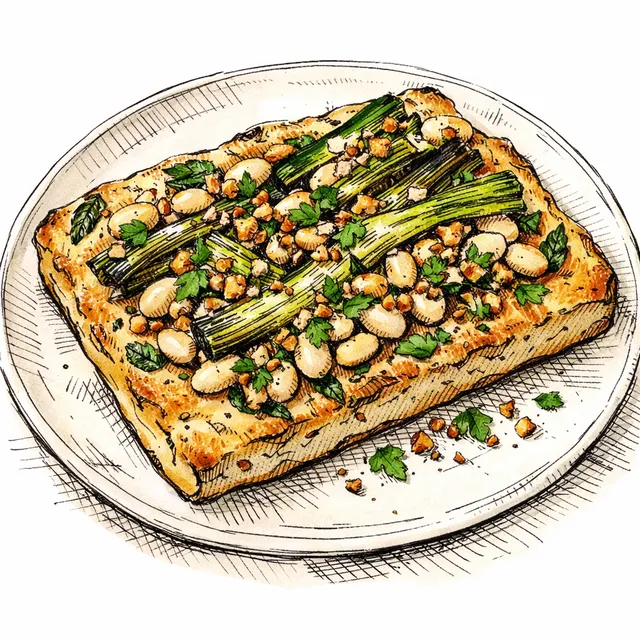
Citrus-Leaf Sourdough Focaccia Slab with Charred Leeks, White Beans & Brown-Butter Hazelnut Gremolata
January makes me crave two things: citrus and something warm I can eat with one hand while I answer emails with the other. This focaccia slab is my fix—crisp corners, a lacy crumb (never tight like a bad alibi), and clean lemony brightness over deep, sweet leeks.
The inspiration came from a Bay Area café lunch I couldn’t stop thinking about: grilled alliums on toast, beans dressed like a salad, and a shower of something herb-and-nutty on top. I wanted that feeling—without waiting in line, and without turning my kitchen into a pastry lab.
My shortcut is the sheet pan. No shaping gymnastics. The dough spreads, the olive oil fries the edges, and the long rest does the flavor work. Let time do the work.
This one’s special to me because it tastes like winter sunlight: brown-butter hazelnuts for warmth, lemon zest and parsley for lift, and beans that stay creamy instead of bland.
Make it yours: swap cannellini for chickpeas, add chili flakes, or finish with shaved pecorino.
Don’t skip this: preheat hard. Timid ovens make sad focaccia.
Cami’s shortcut note: toppings can be prepped ahead; bake the slab from cold and assemble while it’s hot.
Featured Recipe
Citrus-Leaf Sourdough Focaccia Slab with Charred Leeks, Creamy White Beans & Brown-Butter Hazelnut Gremolata
This is my January love letter: a crackly, olive-oil-edged sourdough focaccia baked in a sheet pan, then topped like a warm tart with jammy charred leeks, lemony white beans, and a brown-butter hazelnut gremolata. It eats like café lunch—crisp corners, lacy crumb, clean citrus—without any fussy shaping or last-minute panic.
Save a copy to your collection for editing
Ingredients
- 120 g Active sourdough starter (100% hydration)(Bubbly and at peak; use straight from its rise, not collapsing)
- 380 g Warm water(About 26–29°C / 80–85°F)
- 450 g Bread flour(Strong flour for a lacy crumb; AP works but will be a touch less lofty)
- 55 g Extra-virgin olive oil(Plus more for the pan and finishing; use the good bottle)
- 10 g Fine sea salt(Don’t under-salt—this is the backbone)
- 3 large Leeks(Trimmed; dark green tops reserved for stock if you want)
- 45 g Unsalted cultured butter(Brown it for the topping—this is not optional if you want the nutty perfume)
- 60 g Hazelnuts(Toasted and roughly chopped)
- 1 15-oz can Canned cannellini beans(Drained and rinsed; or 1 1/2 cups cooked)
- 80 g Crème fraîche(Or Greek yogurt; crème fraîche stays silky when warmed)
- 1 Lemon(Zest and 1–2 tbsp juice)
- 1 Orange or mandarin(Zest only; January citrus is the point)
- 1 clove Garlic(Finely grated or smashed to a paste)
- 1 pinch Flaky sea salt(For finishing)
- as needed Black pepper(Freshly cracked)
- 1 small sprig Optional: rosemary or thyme(Use sparingly; I don’t want it to bully the citrus)
Instructions
- 1
Mix the dough (one bowl). In a large bowl, whisk 380 g Warm water with 120 g Active sourdough starter (100% hydration) until milky. Add 450 g Bread flour and 10 g Fine sea salt. Mix with a spatula or wet hand until no dry flour remains. Drizzle in 55 g Extra-virgin olive oil and fold it through until the dough looks cohesive and glossy.
10 min
Tip: Why it works: adding oil after the initial mix lets gluten start forming first, so you keep strength without needing a mixer.
- 2
Bulk ferment with strength-building folds. Cover and let the dough rise at room temperature until puffed and aerated, doing 3 sets of coil folds (or stretch-and-folds) every 30 minutes during the first 90 minutes.
210 min
Tip: Checkpoint: after the last fold, the dough should hold shape briefly and show bubbles along the sides. If your kitchen is cold (January), expect 4–5 hours total bulk.
- 3
Cold-proof for schedule and flavor. Oil a 9x13-inch (23x33 cm) metal pan generously with 55 g Extra-virgin olive oil. Scrape dough into the pan, turn to coat in oil, cover tightly, and refrigerate overnight.
720 min
Tip: Cami’s shortcut note: the fridge is your friend. This gives you flavor without babysitting—let time do the work.
- 4
Char the leeks. The next day, slice 3 large Leeks into 1 cm / 1/2-inch rounds, rinse well to remove grit, and pat dry. Heat a wide skillet with a slick of 55 g Extra-virgin olive oil over medium-high. Cook leeks in a single layer until deeply golden and a little charred at the edges, then soften on medium with 10 g Fine sea salt.
18 min
Tip: Non-negotiable: drive off moisture. Wet leeks steam and turn sweet but limp; dry leeks caramelize and taste like winter sunlight.
- 5
Make the creamy beans. In a bowl, lightly mash half of 1 15-oz can Canned cannellini beans with 80 g Crème fraîche, 1 Lemon juice, 1 Lemon zest, 1 Orange or mandarin zest, 1 clove Garlic, as needed Black pepper, and 10 g Fine sea salt. Fold in remaining beans for texture. Taste—it should be bright, not bland.
7 min
Tip: Why it works: mashing just half gives you a spreadable base plus whole-bean bite. Clean flavor, no heaviness.
- 6
Brown the butter and build the gremolata. In a small saucepan, cook 45 g Unsalted cultured butter over medium heat until nutty and amber (brown flecks, not burnt). Immediately pour into a bowl. Stir in chopped toasted 60 g Hazelnuts, a little extra citrus zest if you like, as needed Black pepper, and 1 pinch Flaky sea salt. Optional: a whisper of 1 small sprig Optional: rosemary or thyme leaves.
6 min
Tip: Don’t walk away. Butter goes from brown to bitter fast. You want toasted-hazelnut aroma—like a good bakery, not campfire.
- 7
Bring dough to life and dimple. Remove pan from fridge 60–90 minutes before baking. Heat oven to 230°C / 450°F with a rack in the lower third. When the dough looks puffy and jiggly, oil your fingertips and dimple deeply all over, pressing to the pan without deflating completely.
90 min
Tip: Checkpoint: the dough should wobble like a waterbed and show visible bubbles. If it’s tight like a bad alibi, give it more time.
- 8
Bake until aggressively golden. Bake 20–25 minutes, rotating once, until the top is deep golden and the edges are crisp and nearly fried in 55 g Extra-virgin olive oil.
24 min
Tip: Non-negotiable: preheat properly. A timid oven gives you pale, bready focaccia. We want crunch and color.
- 9
Top while warm, then slice. Let focaccia cool 10 minutes in the pan. Spoon creamy beans over the surface (not too thick), scatter charred leeks, then drizzle the brown-butter hazelnut gremolata. Finish with 1 pinch Flaky sea salt and as needed Black pepper. Slice into big squares.
15 min
Tip: If you’re serving later: keep toppings separate and assemble at the last minute to preserve crisp edges.
Chef's Notes
This one is personal: January in Paris meant markets full of leeks and citrus when everything else felt gray. In California, sourdough is my comfort language—so I married them into a slab you can eat with one hand and a good attitude. Cami’s shortcut note: You can mix the dough after dinner, fridge it, and bake it at lunch the next day. No shaping, no drama. Don’t skip this: Bake until truly golden. Pale focaccia is just soft bread with dimples. We’re here for crisp edges and a lacy, olive-oil crumb. Optional upgrade (if you want to flex): Add 1 tsp toasted fennel seed to the leeks, or finish with a few curls of aged goat cheese. Keep it restrained—understated is the point.

Camille Roux
Café-level bakes, weeknight methods, zero compromise.
Camille “Cami” Roux was born in Paris with flour in her hair and a healthy skepticism of culinary dogma. She grew up around neighborhood boulangeries that treated crust and crumb like religion—but what stuck with her wasn’t rigid tradition. It was the quiet precision: good butter that actually tastes like milk, patient fermentation that builds flavor for free, and desserts that know when to stop before they get cloying. After moving to the Bay Area, Cami trained in a bread-and-pastry scene obsessed with texture, naturally leavened doughs, and seasonal fruit—Tartine energy, minus the martyrdom. She became known for loaves that sing when they cool, jammy tarts with clean edges, and “how is this so good?” weeknight pastries made with a few smart shortcuts. Her motto is high impact, low fuss: splurge where it counts (butter, salt, time), streamline the rest (sheet pans, one bowl, cold-proofing). If it doesn’t improve flavor or structure, it doesn’t earn a step.