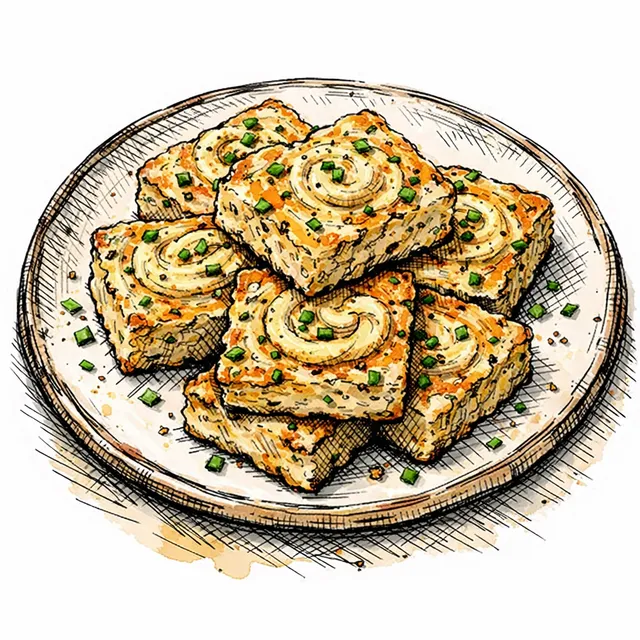
Comté & Black Pepper–Chive Lunchbox Scone Bars (with Dijon Butter Swirl)
I made these because I wanted a real lunchbox bake—something that eats like a café scone but packs like a sandwich. Bars win: more edge, more crust, less fuss. We’re not suffering for brunch.
The idea started with a memory from Paris: a tiny boulangerie that sold cheese “scones” (they weren’t British, they were just right). I’d buy one, tuck it into my bag, and by the time I got to the métro it was warm enough to smell like toasted milk. That nutty Comté perfume is still my comfort cue.
What makes this version special is the Dijon butter swirl. It’s not a topping—it’s architecture. Those pockets melt while baking and turn the crumb lacy, not tight like a bad alibi. Black pepper keeps it sharp; chives keep it green.
Make it yours: swap Comté for aged cheddar or Gruyère, add toasted walnuts, or fold in a spoon of whole-grain mustard for extra bite.
Cami’s shortcut note: freeze the Dijon butter in small blobs and tuck them into the dough—clean, fast, guaranteed pockets.
Don’t skip this: grate the cheese cold and bake until the edges are deeply golden. Butter is not a garnish.
Featured Recipe
Comté & Black Pepper–Chive Lunchbox Scone Bars (with Dijon Butter Swirl)
These are café-style savory scones baked as bars: maximum crust, minimal fuss, and they travel like a dream. You get nutty Comté, a peppery bite, and little pockets of Dijon-butter that melt into the crumb like a built-in sauce. Not too rich, not too bready—just tender, salty, and shamelessly snackable.
Save a copy to your collection for editing
Ingredients
- 300 g All-purpose flour(about 2 1/2 cups, spooned and leveled)
- 16 g Baking powder(about 1 tablespoon + 1 teaspoon)
- 6 g Fine sea salt(about 1 teaspoon)
- 2 g Freshly ground black pepper(about 1 1/2 teaspoons, or to taste)
- 85 g Unsalted cultured butter, cold(cut into 1/2-inch cubes (6 tablespoons))
- 140 g Comté (or Gruyère), coarsely grated(packed, about 1 1/2 cups)
- 25 g Fresh chives, finely sliced(about 1/2 cup, lightly packed)
- 120 g Crème fraîche(about 1/2 cup; sour cream works too)
- 120 g Whole milk(about 1/2 cup, plus a splash if needed)
- 1 Large egg(for richness and structure)
- 20 g Dijon mustard(about 1 tablespoon)
- 20 g Butter, melted(about 1 1/2 tablespoons; for the Dijon swirl)
- 1 pinch Flaky salt(for finishing)
Instructions
- 1
Heat the oven to 220°C / 425°F. Line an 8x8-inch (20x20 cm) pan with parchment, leaving a little overhang so you can lift the bars out.
10 min
Tip: Metal pan = better crust. Glass runs hotter and can overbrown the edges before the center sets.
- 2
In a large bowl, whisk 300 g All-purpose flour, 16 g Baking powder, 6 g Fine sea salt, and 2 g Freshly ground black pepper until evenly mixed.
2 min
Tip: This is your single-bowl insurance policy—whisk like you mean it so the leavening doesn’t clump.
- 3
Add 85 g Unsalted cultured butter, cold cubes. Toss to coat, then rub the butter into the flour with your fingertips until you have a mix of pea-size pieces and some flatter shards.
4 min
Tip: Those butter shards are the whole point: they melt and steam, giving you a tender, lacy crumb instead of tight like a bad alibi.
- 4
Stir in 140 g Comté (or Gruyère), coarsely grated and 25 g Fresh chives, finely sliced, separating any cheese clumps so it distributes evenly.
1 min
Tip: Comté is nutty and sweet-salty; it browns beautifully and tastes like a café without the markup.
- 5
In a small bowl (or measuring jug), whisk 120 g Crème fraîche, 120 g Whole milk, 1 Large egg, and 20 g Dijon mustard. Pour into the flour mixture and fold with a spatula just until no dry flour remains.
2 min
Tip: Non-negotiable: stop mixing the moment it comes together. Overmix = tough bars.
- 6
Make the Dijon butter swirl: stir 20 g Butter, melted with the Dijon. Dollop half the dough into the pan, drizzle half the Dijon butter over it, then add the remaining dough and drizzle the rest. Use a knife to make 3–4 gentle figure-eight swirls—don’t overdo it.
3 min
Tip: We’re not marbling a cake. A few swirls = pockets of flavor, not a greasy layer.
- 7
Press the dough evenly into the pan (light pressure; don’t pack it down). Score into 12 bars with a knife for clean portions later. Sprinkle with 1 pinch Flaky salt.
3 min
Tip: Press level so the center bakes through before the corners go dark.
- 8
Bake until deeply golden and set in the center, 18–22 minutes. You’re looking for browned edges and a top that feels springy, not squishy.
20 min
Tip: If the top browns fast but the center feels soft, tent loosely with foil for the last 5 minutes.
- 9
Cool in the pan 10 minutes, then lift out and cool another 10 minutes before cutting along the score lines.
20 min
Tip: Cut too early and the cheese steam makes the crumb smear. Give it a minute—let time do the work.
Chef's Notes
I made these for the kind of January day where the light is stingy and you still need something warm in your hand. The Dijon-butter swirl is my little Paris-to-Bay-Area bridge: bistro flavor, bakery method, home-kitchen ease. Cami’s shortcut note: Freeze the shaped, unbaked slab right in the pan until firm (30–45 minutes), then wrap well. Bake from frozen at 220°C / 425°F, adding 4–6 minutes. Don’t skip this: Keep the butter cold and stop mixing early. That’s the difference between tender café crumb and a dense, sad brick. Storage: Keeps 2 days airtight at room temp, 5 days refrigerated. Rewarm 5 minutes at 175°C / 350°F to revive the crust.

Camille Roux
Café-level bakes, weeknight methods, zero compromise.
Camille “Cami” Roux was born in Paris with flour in her hair and a healthy skepticism of culinary dogma. She grew up around neighborhood boulangeries that treated crust and crumb like religion—but what stuck with her wasn’t rigid tradition. It was the quiet precision: good butter that actually tastes like milk, patient fermentation that builds flavor for free, and desserts that know when to stop before they get cloying. After moving to the Bay Area, Cami trained in a bread-and-pastry scene obsessed with texture, naturally leavened doughs, and seasonal fruit—Tartine energy, minus the martyrdom. She became known for loaves that sing when they cool, jammy tarts with clean edges, and “how is this so good?” weeknight pastries made with a few smart shortcuts. Her motto is high impact, low fuss: splurge where it counts (butter, salt, time), streamline the rest (sheet pans, one bowl, cold-proofing). If it doesn’t improve flavor or structure, it doesn’t earn a step.