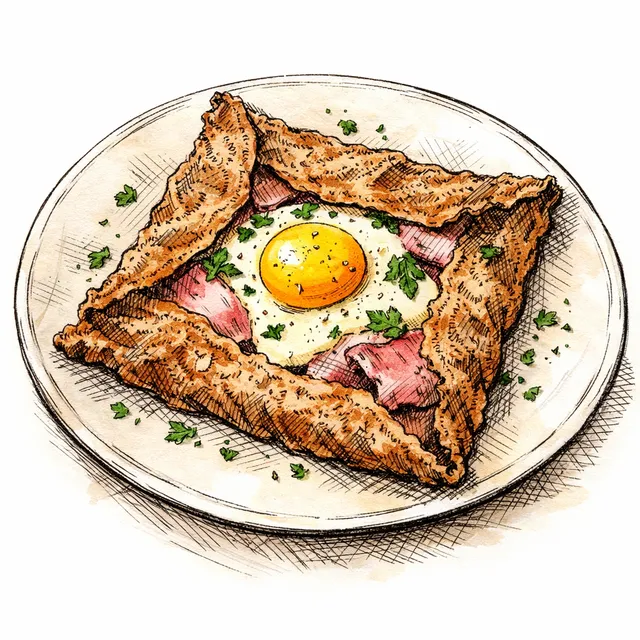
Crispy-Edged Buckwheat Galette Complète
Growing up in Paris, a proper Breton galette was Friday night salvation. Fast, savory, and aggressively crispy. The contrast is everything: a lacy, shatteringly crisp buckwheat shell protecting melted Gruyère, savory ham, and an egg yolk that wobbles just right.\n\nThe secret isn't a professional crêpe pan or a wooden rozell (spreader). It is a fiercely hot skillet and letting the batter hydrate in the fridge overnight. Buckwheat has no gluten, so time lets the starches swell. This means it spreads paper-thin without tearing. The fridge is your friend. Let time do the work.\n\nThis galette bridges my Paris childhood with my Bay Area reality—deeply savory, unfussy, and reliant on technique rather than fancy gear.\n\nMake it yours: Swap the ham for sautéed local mushrooms or add a handful of bitter greens. Butter is not a garnish here, so use the cultured stuff to crisp the edges.\n\nCami's shortcut note: Mix the batter in one bowl the night before. Come morning, you are five minutes away from café-level brunch.\n\nDon't skip this: Wait for the edges to pull away and look like dark lace before adding your egg. A tight, pale crumb is like a bad alibi. We want deeply browned and shattered.
Featured Recipe
Crispy-Edged Buckwheat Galette Complète
A proper Breton galette is about contrast: a lacy, shatteringly crisp buckwheat shell protecting melted Gruyère, savory ham, and an egg yolk that wobbles just right. The secret isn't a professional crêpe pan; it's a fiercely hot skillet and letting the batter hydrate in the fridge so it spreads thin without tearing. We're not suffering for brunch, but we are eating like we're in Paris.
Save a copy to your collection for editing
Timeline
Ingredients
- 1 cup buckwheat flour (blé noir)(Must be 100% buckwheat, finely milled)
- 0.5 tsp fine sea salt(Plus more for seasoning the eggs)
- 1.5 cups cold water(Keep it cold to prevent early starch gelatinization)
- 5 large eggs(1 for the batter, 4 for the filling)
- 4 tbsp cultured salted butter(3 tbsp melted for batter, 1 tbsp cold for the pan)
- 1.5 cups Gruyère or Comté cheese(Freshly grated)
- 4 slices good quality ham (Jambon de Paris or similar)(Torn into pieces or left whole, depending on preference)
- 1 tsp freshly cracked black pepper(To taste)
- 3 tbsp melted butter(for the batter)
- 0.25 tbsp cold butter(for the first galette)
- tiny extra dab butter(for the crust)
Instructions
- 1
In a medium bowl, heavily whisk together 1 cup buckwheat flour and 0.5 tsp fine sea salt. Make a well in the center and crack in 1 large egg. Pour in half of the 1.5 cups cold water and whisk briskly from the center outward to avoid lumps. Once smooth, whisk in the remaining water and 3 tbsp cultured salted butter (melted).
5 min
Tip: The batter will look alarmingly thin. Don't panic. It thickens as it rests.
- 2
Cover the bowl and place it in the fridge to hydrate.
60 min
Tip: Buckwheat has zero gluten. It needs this rest for the starches to swell, otherwise your galette will tear and the crumb will be tight like a bad alibi. Let time do the work.
- 3
While the batter hydrates, grate 1.5 cups Gruyère or Comté cheese and prep 4 slices good quality ham. Have your remaining 4 large eggs nearby.
5 min
Tip: Mise en place is non-negotiable here. Once the batter hits the hot pan, you move fast.
- 4
Place a 10-inch non-stick or well-seasoned cast-iron skillet over medium-high heat until very hot. Swirl in 0.25 tbsp cultured salted butter (cold) for the first galette. Give the chilled batter a vigorous stir.
3 min
Tip: You want the butter to sizzle immediately but not burn. A hot pan equals a lacy crust.
- 5
Pour a scant 1/2 cup of batter into the center of the pan. Immediately tilt and swirl the pan in a wide circular motion to coat the entire bottom evenly.
2 min
Tip: If the batter sets before hitting the edges, your pan is either too hot or you hesitated. Swirl with confidence.
- 6
Let it cook untouched until the edges look dry and start to pull away from the pan. Scatter a generous handful (about 1/4 of total) of the grated cheese in a wide ring, leaving the center bare. Arrange 1 slice good quality ham over the cheese. Crack 1 large egg directly into the bare center.
2 min
Tip: If the white is spilling too far, use a spatula to corral it back toward the yolk.
- 7
Cover the skillet with a lid for 1 to 2 minutes until the egg white is mostly set but the yolk still has a distinct jiggle and wobble. Uncover, and using a spatula, fold the four edges of the galette inward toward the yolk to form a square envelope.
3 min
Tip: Folding traps the heat and gently finishes setting the white. Don't cover it for too long or you'll lose the runny yolk.
- 8
Slide the finished galette onto a warm plate. Top with 0.25 tsp freshly cracked black pepper and a tiny extra dab of butter on the crust. Repeat the cooking process with the remaining batter, butter, and fillings.
15 min
Tip: Wipe the pan with a paper towel between galettes if the butter starts browning too deeply.
Chef's Notes
Cami’s shortcut note: You can make this batter up to 48 hours in advance—in fact, a 24-hour cold ferment adds an incredible sourdough-like tang that I highly recommend. Don't skip the minimum 1-hour rest, though. Without it, you're making a tragic, gummy pancake instead of a crisp galette. And remember: butter is not a garnish here. It conducts the heat that creates those lacy, shatteringly crisp edges.

Camille Roux
Café-level bakes, weeknight methods, zero compromise.
Camille “Cami” Roux was born in Paris with flour in her hair and a healthy skepticism of culinary dogma. She grew up around neighborhood boulangeries that treated crust and crumb like religion—but what stuck with her wasn’t rigid tradition. It was the quiet precision: good butter that actually tastes like milk, patient fermentation that builds flavor for free, and desserts that know when to stop before they get cloying. After moving to the Bay Area, Cami trained in a bread-and-pastry scene obsessed with texture, naturally leavened doughs, and seasonal fruit—Tartine energy, minus the martyrdom. She became known for loaves that sing when they cool, jammy tarts with clean edges, and “how is this so good?” weeknight pastries made with a few smart shortcuts. Her motto is high impact, low fuss: splurge where it counts (butter, salt, time), streamline the rest (sheet pans, one bowl, cold-proofing). If it doesn’t improve flavor or structure, it doesn’t earn a step.