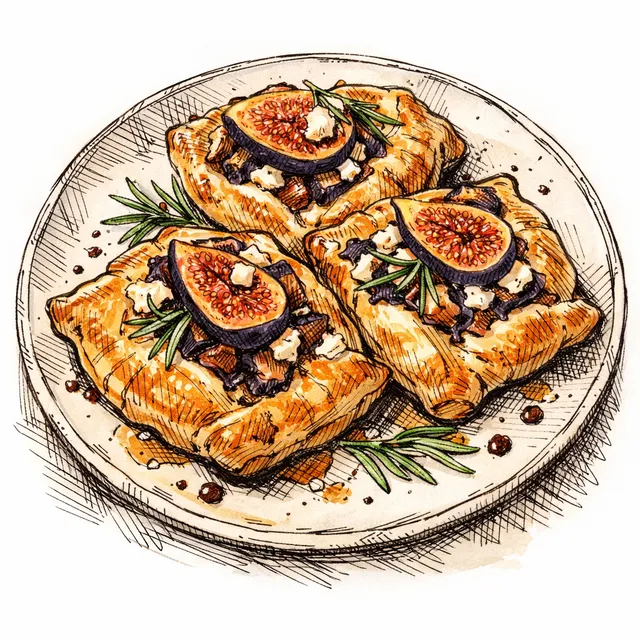
Black Mission Fig, Rosemary & Chèvre Rough-Puff Chaussons
When late-summer Black Mission figs hit the market, I immediately think of a tiny corner bakery in the 6th arrondissement where sweet and savory collided without apology. We are not suffering for brunch, which is why we are using a weeknight lamination—a quick rough-puff that gives you all the buttery, lacy layers with zero fuss.
Inside this golden package, jammy caramelized figs meet herbaceous rosemary and sharp fresh goat cheese (chèvre). The inspiration came from a late-night kitchen experiment after returning from a trip to Northern California with a box of overripe figs and a stubborn refusal to make yet another tart.
Why does it work? The contrast. The fat in the cultured butter carries the earthy pine of the rosemary, while the goat cheese cuts through the rich fruit like a well-placed knife.
Cami's shortcut note: Buy all-butter store-bought puff if you are completely pressed for time, but a ten-minute rough-puff in your own kitchen changes the game. Don't skip the egg wash for that café-counter gloss. Let time do the work, and bake until deeply golden. Tight like a bad alibi? Never here.
Featured Recipe
Black Mission Fig, Rosemary & Chèvre Rough-Puff Chaussons
Buttery, shattering rough-puff pastry wraps around jammy caramelized figs, herbaceous fresh rosemary, and tangy fresh goat cheese. A café-counter French turnover built with weeknight lamination for a high-impact, savory-sweet snack.
Save a copy to your collection for editing
Timeline
Ingredients
- 250 g all-purpose flour(plus extra for dusting)
- 1 tsp fine sea salt
- 200 g unsalted cultured butter(cold, cut into 1/2-inch cubes)
- 110 ml ice water
- 280 g fresh Black Mission figs(stemmed and diced (about 8 medium figs))
- 1.5 tbsp honey(wildflower or clover)
- 1 tsp fresh rosemary(very finely minced)
- 0.5 tsp freshly cracked black pepper
- 120 g fresh goat cheese (chèvre)(crumbled into large distinct curds)
- 1 egg(beaten with 1 tsp cold water for egg wash)
- 1 tsp flaky sea salt(Maldon)
Instructions
- 1
In a wide bowl, whisk together 250 g all-purpose flour and 1 tsp fine sea salt. Toss in 200 g unsalted cultured butter. Press each cube flat between your thumbs and index fingers into coarse walnut-sized shards, keeping the butter visibly cold and coated in flour.
5 min
Tip: Do not rub the butter into sand; big flat sheets of butter equal explosive, lacy puff layers.
- 2
Drizzle 110 ml ice water over the flour mixture. Using a flexible bench knife, toss gently until a shaggy, uneven mass forms. Tip onto a clean counter and press into a rough 6x10-inch rectangle.
4 min
Tip: It will look dry and messy; trust the process and resist adding extra water.
- 3
Roll the dough into an 8x16-inch band. Fold it into thirds like a business letter. Turn 90 degrees, roll out again to 8x16 inches, and fold into thirds a second time. Wrap tightly in parchment and rest in the refrigerator.
6 min
Tip: Two quick letter folds provide all the lamination you need without an afternoon of fussy turns.
- 4
In a small saucepan over medium heat, combine 280 g fresh Black Mission figs, 1.5 tbsp honey, 1 tsp fresh rosemary, and 0.5 tsp freshly cracked black pepper. Cook, stirring frequently, until the figs break down into a thick, glossy compote that holds its shape, about 6 minutes. Remove from heat and chill in the fridge.
8 min
Tip: Cook off excess liquid so the pastry bottom stays crisp rather than soggy.
- 5
Keep the laminated dough and cooked fig filling chilling in the refrigerator to relax gluten and firm the cultured butter completely.
25 min
Tip: The fridge is your best friend here. Warm butter equals sluggish lift and greasy pastry.
- 6
Preheat your oven to 400°F (205°C) with a baking steel or heavy baking sheet placed on the center rack. Line a second flat sheet pan with parchment paper.
5 min
Tip: A preheated baking steel ensures intense bottom heat to flash-cook the laminated base.
- 7
On a lightly floured surface, roll the chilled dough into a 12x18-inch rectangle, about 1/8-inch thick. Use a 5-inch round cutter (or a bowl) to punch out 6 pastry discs, brushing off excess flour.
6 min
Tip: Cut straight down without twisting so the edge layers remain open and free to expand upward.
- 8
Spoon 1 rounded tablespoon of cooled fig compote onto the center of each disc. Top evenly with crumbled 120 g fresh goat cheese (chèvre). Brush bottom edges lightly with cold water, fold the top half over to create half-moons, and press edges firmly with fingertips to seal.
6 min
Tip: Leave a dry 1/2-inch border so the seal stays intact during violent oven bloom.
- 9
Transfer chaussons to the parchment-lined pan. Brush the tops evenly with 1 egg beaten with water, avoiding running down cut edges. Score arches lightly with the tip of a paring knife, poke a tiny steam hole in each center, and sprinkle with 1 tsp flaky sea salt.
4 min
Tip: Keep egg wash off the cut sides, or it will glue the laminated strata shut.
- 10
Slide the parchment sheet directly onto the hot preheated steel in the oven. Bake at 400°F (205°C) until deeply burnished, audibly crisp, and towering with puffed flakes, 24 to 26 minutes.
25 min
Tip: Look for a rich mahogany rim and blistering bubbles of escaping savory juice.
- 11
Transfer chaussons to a wire rack to cool slightly before serving warm or at room temperature.
10 min
Tip: Molten fig retains extreme heat; give the filling ten minutes to set before taking your first bite.
Chef's Notes
Cami’s shortcut note: Two rapid letter folds provide café-grade rough-puff in under ten minutes without classical weekend-long turns. Don’t skip this: The compote must be chilled cold before assembling. Warm filling melts the butter layers prematurely, turning your flaky lacy crumb into something tight like a bad alibi. Butter is not a garnish, so buy the best cultured block you can get your hands on.

Camille Roux
Café-level bakes, weeknight methods, zero compromise.
Camille “Cami” Roux was born in Paris with flour in her hair and a healthy skepticism of culinary dogma. She grew up around neighborhood boulangeries that treated crust and crumb like religion—but what stuck with her wasn’t rigid tradition. It was the quiet precision: good butter that actually tastes like milk, patient fermentation that builds flavor for free, and desserts that know when to stop before they get cloying. After moving to the Bay Area, Cami trained in a bread-and-pastry scene obsessed with texture, naturally leavened doughs, and seasonal fruit—Tartine energy, minus the martyrdom. She became known for loaves that sing when they cool, jammy tarts with clean edges, and “how is this so good?” weeknight pastries made with a few smart shortcuts. Her motto is high impact, low fuss: splurge where it counts (butter, salt, time), streamline the rest (sheet pans, one bowl, cold-proofing). If it doesn’t improve flavor or structure, it doesn’t earn a step.