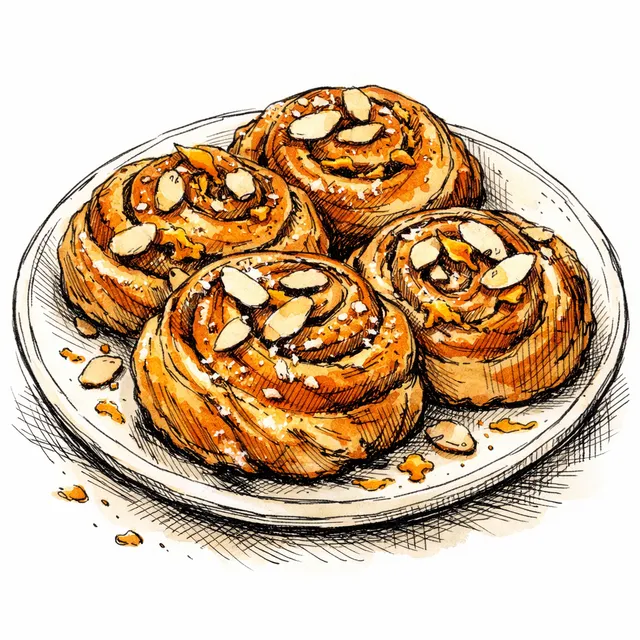
Freezer-Ready Cara Cara Orange–Almond Morning Buns (Overnight Brioche Swirl, Café-Glossy)
I built these morning buns for the winter mornings when I want Paris café energy but I’m not performing laminated pastry at 7 a.m. We’re not suffering for brunch.
The spark was a memory: standing at a counter in the 11th, hands wrapped around a coffee, watching trays of glossy buns disappear before the sun really showed up. Back then it was usually citrus and almonds—simple, restrained, not-too-sweet. Cara cara oranges give me that same bright perfume, but with a rosy sweetness that feels like cheating.
What makes this recipe special is the schedule. You mix once, then let time do the work: an overnight cold proof (cold rise) builds flavor and makes the dough easy to handle. The “laminated-adjacent” swirl is rough puff’s relaxed cousin—enough layering for a lacy pull, none of the drama.
Make it yours: swap almonds for pistachios, add a pinch of cardamom, or tuck in dark chocolate with the orange segments. Keep two non-negotiables: zest goes in the dough (it perfumes everything), and butter is not a garnish—it’s the tenderness, the gloss, the café-level bite.
Cami’s shortcut note: freeze shaped buns on a tray, then bag them. Bake from frozen—just give them time to puff until they wobble slightly. Don’t skip the fast orange glaze; it sets glossy and turns crackly at the edges.
Featured Recipe
Freezer-Ready Cara Cara Orange–Almond Morning Buns (Overnight Brioche Swirl, Café-Glossy)
These are my Paris café winter-morning buns: plush brioche-style dough, laminated-adjacent swirl without the drama, and a bright hit of cara cara orange—zest in the dough, juicy segments tucked into the spiral. You mix once, let the fridge do the work, then bake from fresh or straight from the freezer with a fast orange glaze that turns glossy and crackly at the edges.
Save a copy to your collection for editing
Ingredients
- 120 g Whole milk, cold to lukewarm(about 1/2 cup)
- 6 g Instant yeast(2 tsp; or active dry 7 g (2 1/4 tsp), bloom in milk 5 minutes)
- 2 Large eggs(cold is fine)
- 60 g Granulated sugar(1/3 cup)
- 8 g Fine sea salt(1 1/4 tsp)
- 2 tbsp Cara cara orange zest(from 2 large oranges; save fruit for segments)
- 1 tsp Vanilla extract
- 360 g All-purpose flour(3 cups, spooned/leveled)
- 85 g Unsalted butter, very soft(6 tbsp; soft enough to smear, not melted)
- 85 g Unsalted butter, cold(6 tbsp; for the “lamination-adjacent” butter sheet)
- 140 g Light brown sugar(2/3 cup, packed)
- 60 g Toasted almond flour(about 2/3 cup; toast in a dry pan until fragrant, cool)
- 1 tsp Ground cardamom(optional but very café)
- 1/2 tsp Flaky salt(plus more to finish)
- 2 Cara cara oranges, segmented(cut into supremes (segments without membranes))
- 1 tbsp All-purpose flour(to toss with segments; prevents soggy pockets)
- 120 g Powdered sugar(1 cup, for glaze)
- 45 g Cara cara orange juice(3 tbsp, plus more as needed)
- 15 g Crème fraîche or plain Greek yogurt(1 tbsp; makes the glaze creamy, not brittle)
- 10 g Butter, melted (optional)(2 tsp; for extra shine)
- 1–2 tablespoons tablespoon Water(Used to brush the dough before adding filling (alternatively use a spoonful of milk, which is in the list))
Instructions
- 1
Make the dough (one bowl). In a large bowl, whisk 120 g Whole milk, cold to lukewarm and 6 g Instant yeast. Whisk in 2 Large eggs, 60 g Granulated sugar, 8 g Fine sea salt, 2 tbsp Cara cara orange zest, and 1 tsp Vanilla extract. Add 360 g All-purpose flour and mix with a sturdy spoon or dough whisk until no dry flour remains.
8 min
Tip: Dough will look shaggy and a bit sticky—good. Tight like a bad alibi usually means too much flour.
- 2
Add the soft butter. Smear in the 85 g Unsalted butter, very soft a tablespoon at a time, squeezing and folding the dough until it’s mostly absorbed and the dough looks smoother.
6 min
Tip: This is brioche-style enrichment without a stand mixer. It feels messy for 2 minutes, then it clicks.
- 3
Short room-temp rise + strength. Cover and rest 20 minutes, then do 1 set of folds (stretch one side up, fold over; rotate bowl, repeat 4 times). Cover and rest 20 minutes more.
45 min
Tip: The folds build structure so the buns bake tall and lacy, not squat.
- 4
Overnight cold ferment. Cover tightly and refrigerate 8–16 hours.
600 min
Tip: Let time do the work. Cold dough is easier to roll and it tastes like a bakery, not sweet bread.
- 5
Make the butter sheet (lamination-adjacent, no drama). Place the 85 g Unsalted butter, cold between two pieces of parchment and bash/roll into a thin rectangle about 15 x 20 cm (6 x 8 in). Chill until firm but bendable.
8 min
Tip: We’re not doing full croissant turns—just one butter layer for extra flake and a café-style tear.
- 6
Roll + lock in butter (one simple fold). On a lightly floured counter, roll cold dough into a rectangle about 30 x 45 cm (12 x 18 in). Place butter sheet on one half, fold the other half over like a book, and seal edges. Roll gently to about 25 x 45 cm (10 x 18 in).
12 min
Tip: If butter starts smearing, stop and chill 10 minutes. Cold wins.
- 7
Mix the filling. Stir 140 g Light brown sugar, 60 g Toasted almond flour, 1 tsp Ground cardamom (if using), and 1/2 tsp Flaky salt. Set aside.
3 min
Tip: Almond flour soaks up orange juice so the spiral stays plush, not wet.
- 8
Prep the cara cara segments. Supremes the 2 Cara cara oranges, segmented, then chop segments into 2–3 cm pieces. Toss with 1 tbsp All-purpose flour.
10 min
Tip: The flour is tiny insurance against soggy tunnels.
- 9
Fill + roll. Brush the dough lightly with water (or a spoonful of milk) so the filling sticks. Sprinkle filling evenly, then scatter the floured orange pieces. Roll up tightly from the long side into a log.
8 min
Tip: Roll tight like you mean it—this is what gives that clean swirl and lofty rise.
- 10
Cut + pan. Trim ends, then cut into 12 pieces. Arrange in a buttered 23 x 33 cm (9 x 13 in) pan or two 20 cm (8 in) round pans, swirl-side up.
6 min
Tip: Dental floss works best for clean cuts: slide under, cross, pull.
- 11
Proof (or freeze). For baking now: cover and let rise at room temp until puffy and jiggly, 60–90 minutes. For freezer: freeze uncovered until solid (2–3 hours), then wrap tightly and store up to 6 weeks.
90 min
Tip: Visual cue: they should wobble slightly when you nudge the pan. If they look dense, give them more time.
- 12
Bake. Heat oven to 180°C/350°F. Bake until deeply golden and set, 25–30 minutes (a bit longer if your pan is crowded or the buns were very cold).
30 min
Tip: Don’t underbake—this dough is enriched. You want caramel edges, not pale tops.
- 13
Glaze while warm. Whisk 120 g Powdered sugar, 45 g Cara cara orange juice, 15 g Crème fraîche or plain Greek yogurt, and 10 g Butter, melted (optional). Drizzle over warm buns and finish with a pinch of flaky salt and a little extra zest if you have it.
5 min
Tip: Warm buns drink glaze into the crevices and stay soft for days.
- 14
Bake from frozen (morning-of). Put frozen buns in a pan, cover, and let thaw/proof overnight in the fridge (8–12 hours). In the morning, leave at room temp 30–60 minutes until puffy, then bake as above.
780 min
Tip: Fridge proof is your friend: controlled rise, better flavor, zero stress.
Chef's Notes
I grew up with winter oranges on the radiator—perfume in the apartment before school. These buns are that memory, but Bay Area-trained: long cold ferment for flavor, and a single butter layer for tearable flakes without a weekend of folding. Cami’s shortcut note: if you skip the butter sheet, you still get great brioche buns—just less of that laminated “shatter-and-stretch.” Don’t skip this: toast the almond flour and use lots of zest. That’s where the café-level flavor lives.

Camille Roux
Café-level bakes, weeknight methods, zero compromise.
Camille “Cami” Roux was born in Paris with flour in her hair and a healthy skepticism of culinary dogma. She grew up around neighborhood boulangeries that treated crust and crumb like religion—but what stuck with her wasn’t rigid tradition. It was the quiet precision: good butter that actually tastes like milk, patient fermentation that builds flavor for free, and desserts that know when to stop before they get cloying. After moving to the Bay Area, Cami trained in a bread-and-pastry scene obsessed with texture, naturally leavened doughs, and seasonal fruit—Tartine energy, minus the martyrdom. She became known for loaves that sing when they cool, jammy tarts with clean edges, and “how is this so good?” weeknight pastries made with a few smart shortcuts. Her motto is high impact, low fuss: splurge where it counts (butter, salt, time), streamline the rest (sheet pans, one bowl, cold-proofing). If it doesn’t improve flavor or structure, it doesn’t earn a step.