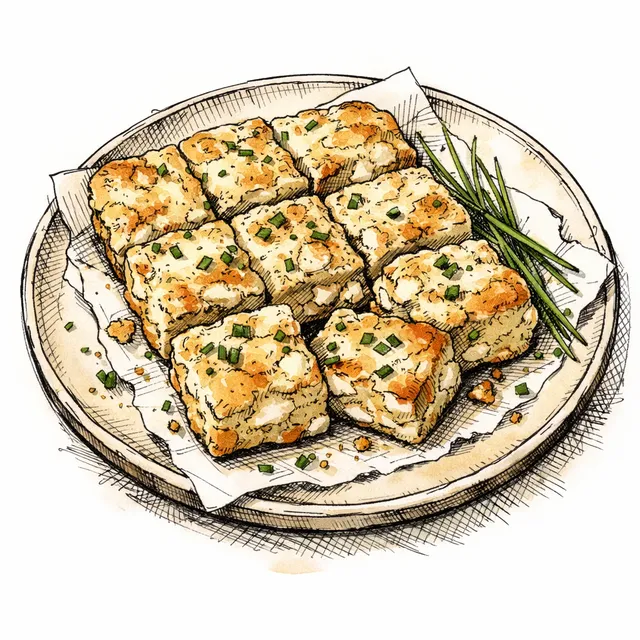
Goat Cheese & Chive Buttermilk Biscuit Slab: No Stamping Required
I used to spend Sunday mornings stamping out individual biscuits, stressed that the leftover scraps would yield a crumb tight like a bad alibi. Listen, we’re not suffering for brunch.
The inspiration for this Goat Cheese & Chive Buttermilk Biscuit Slab came after a long, grueling week in my Bay Area kitchen. I craved the lacy layers of a perfect biscuit but had zero patience for the geometry of dough scraps. So, I stopped stamping.
By baking the dough as a single slab (en bloc—in one solid piece), we completely eliminate re-rolling. Why it works: Handling the dough less keeps your cultured butter ice-cold. When that cold butter hits a hot oven, its water content evaporates into steam, pushing the flour upward into towering, flaky layers.
Loaded with sharp goat cheese pockets and bright spring chives, it’s a deeply savory bake. It’s special to me because it proves a fundamental truth: sometimes the shortcut actually improves the crumb.
Cami’s shortcut note: Make it your own by swapping chives for scallions, or goat cheese for an aged cheddar. Just don't skimp on the fat. Butter is not a garnish. Bake it bold until the edges are deeply bronzed, cut it hot, and never look back.
Featured Recipe
Goat Cheese & Chive Buttermilk Biscuit Slab
Individual biscuits require rolling, stamping, and re-rolling—which only warms your butter and toughens your dough. This slab method guarantees a lacy, towering crumb and zero wasted scraps, loaded with sharp goat cheese pockets and bright spring chives. Bake it bold, cut it hot, and never look back.
Save a copy to your collection for editing
Timeline
Ingredients
- 360 g AP Flour(about 3 cups)
- 1 tbsp baking powder(aluminum-free preferred)
- 1/2 tsp baking soda
- 1 1/2 tsp Kosher salt(Diamond Crystal)
- 1 tsp Black pepper(coarsely ground)
- 170 g Cultured butter(1.5 sticks, frozen solid)
- 1/2 cup Fresh chives(finely chopped)
- 115 g Goat cheese(crumbled)
- 240 ml Cold buttermilk(well-shaken)
- 1 large Egg(beaten, for egg wash)
- 1 tsp Flaky sea salt(for finishing)
Instructions
- 1
Preheat your oven to 400°F (200°C) with a rack in the upper third. Place the crumbled 115 g Goat cheese into the freezer. Why? Because warm goat cheese smears into the dough, acting like a liquid and giving you a tight, heavy crumb instead of distinct, tangy pockets.
5 min
Tip: If your kitchen is very warm, put your mixing bowl in the fridge now, too.
- 2
In a large, wide bowl, vigorously whisk together the 360 g AP Flour, 1 tbsp baking powder, 1/2 tsp baking soda, 1 1/2 tsp Kosher salt, and 1 tsp Black pepper.
3 min
Tip: A wide bowl gives your hands room to toss ingredients without compressing them.
- 3
Take your 170 g Cultured butter straight from the freezer and box-grate it directly into the dry ingredients. Toss the shards lightly with your fingertips so every piece of butter is separated and coated in flour. Remember my rule: Butter is not a garnish; it is the engine of your flake.
4 min
Tip: Use the large holes of the grater. Work quickly so the butter doesn't melt from the heat of your hands.
- 4
Pull the chilled goat cheese from the freezer. Add the firm chunks and the 1/2 cup Fresh chives to the bowl, tossing gently just to distribute them evenly through the flour.
2 min
Tip: Keep a light hand. Don't squeeze the cheese.
- 5
Pour in the 240 ml Cold buttermilk. Use a fork or an open hand to lightly toss the mixture until it just barely comes together into a shaggy, dry-looking mass. Stop mixing before it looks fully homogeneous. If you overwork this, the crumb will be tight like a bad alibi.
3 min
Tip: If the dough seems impossibly dry, add a tiny splash more buttermilk, but trust the shaggy stage.
- 6
Dump the shaggy dough onto a parchment-lined sheet pan. Gently pat it together into a rough 8x10-inch rectangle, about 1-inch thick. Use a bench scraper to press deeply into the dough to score the slab into 8 squares (don't drag, just press down). Beat the 1 large Egg and brush it generously over the top, then scatter the 1 tsp Flaky sea salt across the surface.
3 min
Tip: Scoring before baking gives the steam an escape route and creates perfect fault lines for breaking later.
- 7
Bake for 22 to 25 minutes. Look for a deep, confident golden-brown crust and a visible rise along those score lines. Let time do the work in the oven; pale biscuits are sad biscuits.
25 min
Tip: Rotate the pan halfway through if your oven has hot spots.
- 8
Remove from the oven and let the slab cool directly on the pan for at least 10 minutes. This allows the crumb to set. Break or cut along the score lines and serve warm.
10 min
Tip: Do not rush the cooling step or the biscuits will crumble when cut.
Chef's Notes
Cami's shortcut note: The 'slab' method is the ultimate weeknight baking hack. Rolling and cutting individual rounds leaves you with scraps that get overworked when re-rolled. By patting the dough into a single slab and scoring it, every single piece gets an undisturbed, lacy lift. Don't skip freezing the goat cheese—it's the only way to get true pockets of tangy creaminess rather than a muddy dough. We're not suffering for brunch, people.

Camille Roux
Café-level bakes, weeknight methods, zero compromise.
Camille “Cami” Roux was born in Paris with flour in her hair and a healthy skepticism of culinary dogma. She grew up around neighborhood boulangeries that treated crust and crumb like religion—but what stuck with her wasn’t rigid tradition. It was the quiet precision: good butter that actually tastes like milk, patient fermentation that builds flavor for free, and desserts that know when to stop before they get cloying. After moving to the Bay Area, Cami trained in a bread-and-pastry scene obsessed with texture, naturally leavened doughs, and seasonal fruit—Tartine energy, minus the martyrdom. She became known for loaves that sing when they cool, jammy tarts with clean edges, and “how is this so good?” weeknight pastries made with a few smart shortcuts. Her motto is high impact, low fuss: splurge where it counts (butter, salt, time), streamline the rest (sheet pans, one bowl, cold-proofing). If it doesn’t improve flavor or structure, it doesn’t earn a step.