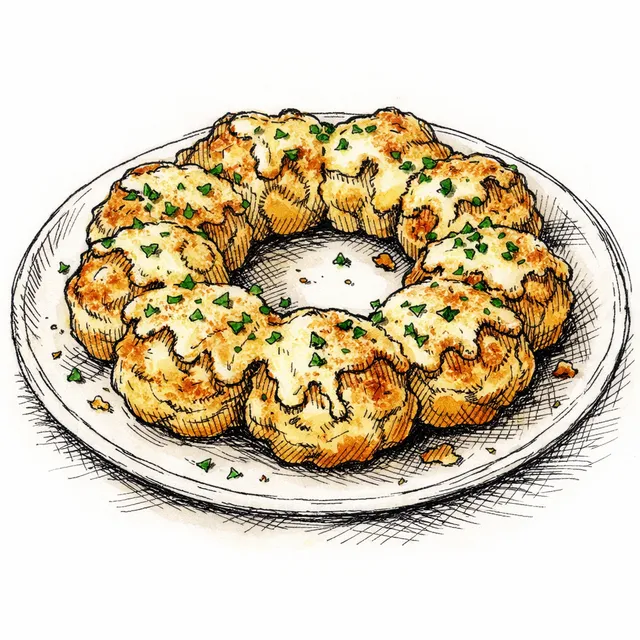
Weeknight Gougère: The Gruyère & Dijon Choux Couronne
I love gougères, but I hate piping thirty individual puffs on a Tuesday. We're not suffering for brunch, let alone for a weeknight appetizer.\n\nGrowing up in Paris, my mother would buy a couronne—a crown—of bread for Sunday dinners. It was communal, rustic, and meant to be torn apart with your hands. I brought that exact energy to choux pastry. By piping one continuous ring of dough, you get cafe-level architecture with none of the fuss.\n\nThis Gruyère & Dijon Choux Couronne is my answer to high-impact, low-effort hosting. You get a shattering, cheese-crusted exterior and a lacy, custardy crumb inside. Why it works? The mass of the ring creates intense steam in the oven, pushing the dough higher than small puffs ever could.\n\nMake it yours: Swap the Gruyère for an aged sharp cheddar, or fold in a handful of chopped Bay Area green garlic if it is spring. Butter is not a garnish here, so use the cultured stuff.\n\nCami's shortcut note: Make the choux dough ahead. The fridge is your friend—cold dough holds its shape much better in the hot oven.\n\nDon't skip this: Bake until deeply bronzed. Pale choux means a crumb that is tight like a bad alibi. Look for a crisp wobble and a hollow sound when tapped.
Featured Recipe
Gruyère & Dijon Choux Couronne
Think of this as the ultimate tear-and-share gougère, supersized into a rustic French crown (couronne). By piping one continuous ring instead of thirty individual puffs, you get maximum lift, a shattering cheese-crusted exterior, and a custardy, lacy interior in a fraction of the time. It is high-impact cafe architecture, zero piping fatigue.
Save a copy to your collection for editing
Timeline
Ingredients
- ½ cup Water
- ½ cup Whole milk
- 113 g Cultured butter(1 stick, unsalted)
- 1 tsp Kosher salt
- 130 g All-purpose flour(About 1 cup)
- 1 tbsp Dijon mustard(Smooth, high quality)
- 4 large Eggs(Room temperature)
- 150 g Gruyère cheese(Grated, divided)
- 1 tbsp Fresh thyme(Leaves only)
- ½ tsp Black pepper(Freshly cracked)
- ½ tsp Flaky sea salt
Instructions
- 1
Preheat oven to 425°F (220°C). Trace an 8-inch circle on a sheet of parchment paper, then flip it over on your baking sheet so you do not bake ink into your food. This is your stencil.
5 min
Tip: Use a heavy-duty baking sheet to prevent warping in the high heat.
- 2
In a medium saucepan, combine ½ cup water, ½ cup whole milk, 113g cultured butter, and 1 tsp kosher salt. Bring to a rolling boil over medium-high heat. We want the butter completely melted before the liquid boils off.
5 min
Tip: Butter is not a garnish, especially in choux. The cultured tang offsets the richness of the cheese.
- 3
Dump in 130g all-purpose flour all at once. Reduce heat to medium and beat vigorously with a wooden spoon. Cook until the dough pulls away from the sides and leaves a starchy film on the bottom of the pan.
3 min
Tip: This cooks out the raw flour and gelatinizes the starches. Do not rush it.
- 4
Transfer the panade (your dough base) to a stand mixer fitted with a paddle attachment. Let it cool slightly so you do not scramble the eggs later. Add 1 tbsp Dijon mustard.
5 min
Tip: If you don't have a mixer, use a bowl and a sturdy wooden spoon.
- 5
Turn the mixer to medium-low. Add the 4 large eggs one at a time, letting each fully incorporate before adding the next. Stop when the dough is glossy and falls from the paddle in a reluctant, heavy 'V' shape.
5 min
Tip: You might not need the very last drop of egg, so watch the texture. It should hold its shape.
- 6
Remove the bowl from the mixer and fold in 100g grated Gruyère cheese and 1 tbsp fresh thyme.
2 min
Tip: Save the remaining 50g of cheese for the crust.
- 7
Scrape the dough into a zip-top bag and snip off a 1-inch corner. Pipe a thick ring following your traced circle. Pipe a second ring right inside the first, then a third ring on top of the seam between the two. Scatter the remaining 50g grated Gruyère cheese, ½ tsp black pepper, and ½ tsp flaky sea salt aggressively over the top.
5 min
Tip: Cami's shortcut note: No star tip needed. The cheese blanket will create all the texture you need.
- 8
Bake at 425°F for 15 minutes to generate the steam that inflates the couronne. Do not open the door.
15 min
Tip: Opening the door lets out the steam, which is the only thing leavening this pastry.
- 9
Drop the heat to 375°F (190°C) and continue baking until deeply bronzed, puffed, and crisp.
20 min
Tip: If it looks pale, it will collapse later. Let time do the work.
- 10
Transfer to a wire rack. Immediately pierce the ring in a few spots with a paring knife. Let cool slightly before tearing into it.
10 min
Tip: Don't skip this. Venting the trapped steam prevents the lacy crumb from turning tight like a bad alibi.
Chef's Notes
We're not suffering for brunch, and we're definitely not suffering for snacks. This couronne is my answer to fussy hors d'oeuvres. Serve it warm with a crisp white wine. If you have leftovers, they crisp up beautifully in a 350°F oven for 5 minutes.

Camille Roux
Café-level bakes, weeknight methods, zero compromise.
Camille “Cami” Roux was born in Paris with flour in her hair and a healthy skepticism of culinary dogma. She grew up around neighborhood boulangeries that treated crust and crumb like religion—but what stuck with her wasn’t rigid tradition. It was the quiet precision: good butter that actually tastes like milk, patient fermentation that builds flavor for free, and desserts that know when to stop before they get cloying. After moving to the Bay Area, Cami trained in a bread-and-pastry scene obsessed with texture, naturally leavened doughs, and seasonal fruit—Tartine energy, minus the martyrdom. She became known for loaves that sing when they cool, jammy tarts with clean edges, and “how is this so good?” weeknight pastries made with a few smart shortcuts. Her motto is high impact, low fuss: splurge where it counts (butter, salt, time), streamline the rest (sheet pans, one bowl, cold-proofing). If it doesn’t improve flavor or structure, it doesn’t earn a step.