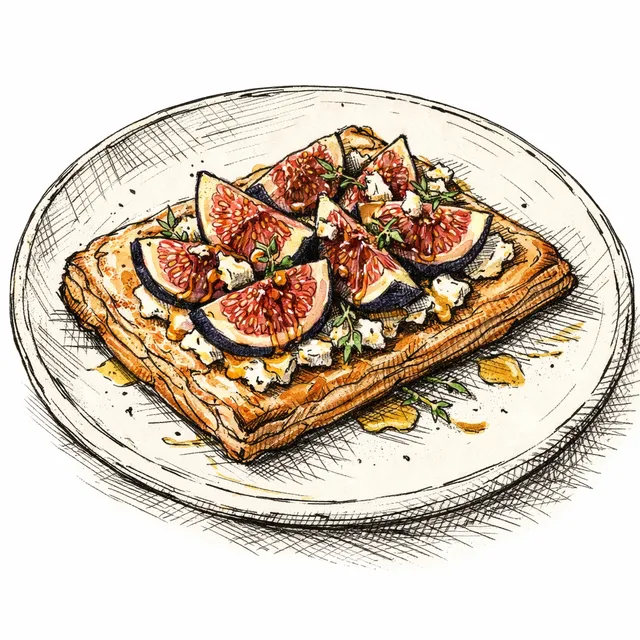
Late-Autumn Fig & Honeyed Chèvre Rough-Puff Tarte Fine
Late autumn in my kitchen is all about squeezing the very last drops of warmth out of the fruit season. This tarte fine was born on a chilly San Francisco afternoon when I had a handful of overripe black mission figs and zero patience for a traditional pastry lamination. Butter is not a garnish, and neither is your time. So, I leaned into a high-speed rough-puff pastry that gives you those shatteringly crisp, lacy layers in a fraction of the time. We are not suffering for brunch here. You get café-level results with weeknight methods. We spread a cloud of whipped honeyed chèvre—tangy goat cheese—over the buttery crust, lay down the figs like shingles, and let the oven do the heavy lifting. Why it works: cold butter chunks melting into the flour create steam pockets for ultimate flake, while the tart cheese cuts the rich fruit. Make it your own by swapping figs for pears or plums depending on what is lingering in your crisper drawer. Don't skip the flaky salt at the finish. Let time do the work, and enjoy your slice of Paris without the fuss.
Featured Recipe
Late-Autumn Fig & Honeyed Chèvre Rough-Puff Tarte Fine
A shatteringly crisp, slab-style French tarte fine layered with tangy whipped honey chèvre and glistening ripe figs. We skip classic lamination for a high-speed rough puff that delivers café-grade flakes in a fraction of the time.
Save a copy to your collection for editing
Timeline
Ingredients
- 240 g all-purpose flour(unbleached, plus extra for dusting)
- 1 tsp fine sea salt
- 225 g cold cultured unsalted butter(82% butterfat, cut into 1/2-inch cubes and chilled hard)
- 120 ml ice water(very cold)
- 150 g fresh young goat cheese(mild chèvre, softened at room temperature)
- 60 g crème fraîche(adds silkiness and cuts goatiness)
- 4 tbsp orange blossom honey(divided; 2 tbsp for cream, 2 tbsp for drizzling)
- 1 tsp finely grated orange zest(from 1 organic navel orange)
- 0.5 tsp pure vanilla bean paste(or pure vanilla extract)
- 450 g fresh ripe figs(Black Mission or Brown Turkey, stemmed and sliced 1/4-inch thick)
- 1 tsp fresh lemon juice
- 2 tbsp turbinado sugar(coarse raw sugar for crunch and caramelization)
- 1 tsp fresh thyme leaves(stripped from stems)
- 0.5 tsp flaky sea salt(such as Maldon)
Instructions
- 1
In a wide mixing bowl, whisk 240 g all-purpose flour and 1 tsp fine sea salt. Scatter in 225 g cold cultured unsalted butter. Using your fingertips or a pastry blender, press the cubes into flat walnut-sized flakes—do not turn it into cornmeal; you need visible ribbons of butter. Drizzle in 120 ml ice water and toss lightly with a fork until a shaggy dough comes together.
10 min
Tip: Why it works: flattening butter into large shingles rather than rubbing it fine creates steam pockets during baking, giving you dozens of crisp, airy layers without classic puff misery.
- 2
Tip dough onto a lightly floured bench. Gently pat into a rough rectangle, roll to 8x15 inches, then fold like a letter (top third down, bottom third up). Rotate 90 degrees, roll out, and fold in thirds a second time. Wrap tightly and refrigerate for 20 minutes to rest the gluten.
20 min
Tip: If the butter begins to feel squishy or warm at any second, park the dough in the freezer for 5 minutes. Cold fat is non-negotiable.
- 3
Position a rack in the lower third of the oven, slide an inverted rimmed baking sheet inside to preheat, and crank the oven to 400°F (205°C).
15 min
Tip: Preheating the sheet pan ensures immediate bottom heat hits the cold butter, guaranteeing an ultra-crisp base instead of a sad, soggy undercarriage.
- 4
While dough chills, mash 150 g fresh young goat cheese, 60 g crème fraîche, 2 tbsp orange blossom honey, 1 tsp finely grated orange zest, and 0.5 tsp pure vanilla bean paste in a medium bowl with a sturdy spatula until completely smooth and spreadable.
5 min
Tip: Room temperature chèvre incorporates easily with crème fraîche; cold cheese will remain lumpy.
- 5
Gently toss sliced 450 g fresh ripe figs in a small bowl with 1 tsp fresh lemon juice to brighten their natural acidity.
5 min
Tip: Handle ripe autumn figs gently so the slices retain their gorgeous petal shape.
- 6
On a sheet of parchment paper, roll the rested chilled dough into a 10x14-inch rectangle about 1/8-inch thick. Use a paring knife to lightly score a 3/4-inch border around all edges without cutting fully through. Dock the entire interior area generously with a fork.
8 min
Tip: Scoring creates a natural picture frame: the docked center stays flat beneath the fruit while the exterior border balloons tall and flaky.
- 7
Spread the whipped chèvre mixture evenly inside the scored border. Shingle the sliced 450 g fresh ripe figs across the cheese in overlapping diagonal rows. Sprinkle 2 tbsp turbinado sugar over the figs and the exposed pastry rim.
7 min
Tip: The turbinado sugar adds both crunch and deeply caramelized edges to the pastry frame.
- 8
Slide the parchment with the tart directly onto the piping-hot preheated baking sheet. Bake at 400°F (205°C) until the pastry border is puffed, deep golden mahogany, and the figs are bubbling and jammy, about 30 to 35 minutes.
35 min
Tip: Do not pull this pale. French café baking demands deep caramelization; pale pastry has a crumb tight like a bad alibi.
- 9
Transfer the tart to a wire cooling rack. Immediately warm the remaining 2 tbsp orange blossom honey slightly and brush or drizzle it over the warm figs. Scatter 1 tsp fresh thyme leaves and 0.5 tsp flaky sea salt across the top. Let settle 10 minutes before slicing into slabs.
10 min
Tip: A 10-minute rest lets the goat cheese set and the fruit juices stabilize so slices cut cleanly.
Chef's Notes
Butter is not a garnish, and we're not suffering for dessert. This is the ultimate weeknight French bake: lamination-lite rough puff that behaves like classic feuilletage without the four-hour timeline. Cami's shortcut note: If you want to get ahead, roll out the dough, score, dock, and park it on the parchment sheet in the fridge for up to 24 hours before topping and baking. Don't skip this: Slide the tart directly onto a blazing-hot preheated baking stone or inverted sheet pan. That thermal blast is the difference between a soggy crust and a base that shatters like autumn leaves.

Camille Roux
Café-level bakes, weeknight methods, zero compromise.
Camille “Cami” Roux was born in Paris with flour in her hair and a healthy skepticism of culinary dogma. She grew up around neighborhood boulangeries that treated crust and crumb like religion—but what stuck with her wasn’t rigid tradition. It was the quiet precision: good butter that actually tastes like milk, patient fermentation that builds flavor for free, and desserts that know when to stop before they get cloying. After moving to the Bay Area, Cami trained in a bread-and-pastry scene obsessed with texture, naturally leavened doughs, and seasonal fruit—Tartine energy, minus the martyrdom. She became known for loaves that sing when they cool, jammy tarts with clean edges, and “how is this so good?” weeknight pastries made with a few smart shortcuts. Her motto is high impact, low fuss: splurge where it counts (butter, salt, time), streamline the rest (sheet pans, one bowl, cold-proofing). If it doesn’t improve flavor or structure, it doesn’t earn a step.