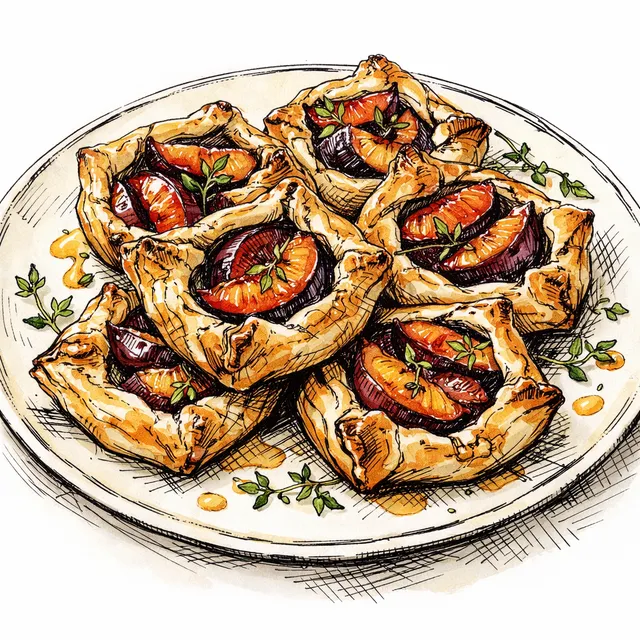
Late-Summer Plum & Thyme Honey Rough-Puff Paniers
Late summer gives us plums that beg to be baked until they collapse into jammy sweetness. I wanted that bakery-level pastry experience without spending my entire Sunday rolling and chilling butter. That is where these paniers come in. The inspiration hit me during a late-August market trip in Berkeley, where deep purple Santa Rosa plums sat next to bundles of fragrant garden thyme. My memory of biting into a warm, buttery tart in a tiny Marais arrondissement bakery sealed the deal—I needed that experience at home, fast. What makes this recipe special is the rapid letter-fold dough. We skip tedious traditional lamination because butter is not a garnish, but time is precious. We want towering, lacy layers before your second espresso. The fridge is your friend here; let it do the heavy lifting. Tip for making it your own? Swap the plums for apricots or figs depending on what looks best at your market. Don't skip the flaky salt right as they leave the oven. We are not suffering for brunch, but we are definitely eating exceptionally well.
Featured Recipe
Late-Summer Plum & Thyme Honey Rough-Puff Paniers
Crisp, shatteringly flaky rough-puff baskets cupping ripe, jammy plums nestled over honeyed crème fraîche with a whisper of fresh thyme. Made with a rapid letter-fold dough that skips tedious weekend lamination while delivering towering, bakery-level layers before your second espresso.
Save a copy to your collection for editing
Timeline
Ingredients
- 2 cups all-purpose flour(plus 1 tbsp for filling and extra for dusting; unbleached, about 250g total)
- 1 cup unsalted cultured butter(2 sticks / 225g, fridge-cold, cut into 1/2-inch cubes)
- 1/2 tsp fine sea salt
- 1/2 cup ice water(about 120ml, very cold)
- 1/3 cup crème fraîche(about 80g, full fat)
- 3 tbsp wildflower honey(divided; 2 tbsp for filling, 1 tbsp for finishing glaze)
- 1 tsp fresh thyme leaves(finely chopped, divided)
- 1 tsp vanilla bean paste
- 6 medium fresh plums(such as Santa Rosa or Italian prune plums, halved, pitted, and quartered)
- 1 large egg(beaten with 1 tbsp water for egg wash)
- 2 tbsp turbinado sugar(for topping)
- 1/4 tsp flaky sea salt(such as Maldon)
- 1 tbsp all-purpose flour(Mentioned in Step 3)
- 1 tbsp wildflower honey(Mentioned in Step 9)
- 1/2 tsp fresh thyme leaves(Mentioned in Step 9)
Instructions
- 1
Toss 2 cups all-purpose flour and 1/2 tsp fine sea salt together in a wide chilled bowl. Drop in 1 cup unsalted cultured butter cubes. Using your fingertips or a bench knife, press each butter cube flat into a rough walnut-sized shingle—do not rub it into breadcrumbs. Make a well, drizzle in 1/2 cup ice water, and fold with a flexible spatula just until the dough forms a shaggy, uneven mass that holds together when squeezed. Butter is not a garnish, and visible slabs are non-negotiable here; they create the steam pockets that give you explosive, lacy puff.
8 min
Tip: If the kitchen is warm and the butter feels tacky, chill the bowl for 10 minutes before proceeding.
- 2
Turn the shaggy dough out onto a lightly floured board and gently pat into an 8x12-inch rough rectangle. Fold like a business letter—bottom third up, top third over. Rotate 90 degrees, roll out to 8x12 inches again, and repeat the letter fold. That is two turns in two minutes. Wrap tightly in parchment or plastic and stash in the refrigerator to relax the gluten and reset the butter fat.
25 min
Tip: Don't stress about jagged edges on these initial turns; lamination happens through folding, not geometric perfection.
- 3
While the dough rests, whisk 1/3 cup crème fraîche, 2 tbsp wildflower honey, 1 tsp vanilla bean paste, 1/2 tsp fresh thyme leaves, and 1 tbsp all-purpose flour in a small bowl until smooth. Slice 6 medium fresh plums into neat quarters and set aside on a plate.
10 min
Tip: The tablespoon of flour in the crème fraîche locks in plum juices as they bubble, keeping your base crisp rather than soggy.
- 4
Start preheating the oven to 400°F (205°C) with a rack in the lower-middle position. Line a large heavy baking sheet with parchment paper.
5 min
Tip: A ripping hot sheet pan ensures bottom crust caramelization before the fruit juices pool.
- 5
Unwrap the chilled dough onto a lightly floured surface. Give it one final roll into an 8x12-inch rectangle and a third letter fold. Now roll the block into a clean, precise 10x15-inch sheet roughly 1/8-inch thick. Trim any ragged edges with a sharp chef's knife or pizza cutter, then divide into 6 equal 5x5-inch squares.
10 min
Tip: Cut straight down without dragging the blade; dragging seals the edges together and hinders lift.
- 6
Shape the squares into paniers (little baskets): cut an L-shaped slit parallel to the border inside two opposite corners, leaving two diagonal corners intact. Fold the outer ribbon from one side over across to the opposite inside rim, then repeat with the other ribbon to create a framed square nest with an elevated rim. Transfer the shaped shells to the prepared baking sheet and pop the sheet into the freezer for 8 minutes to firm.
12 min
Tip: Cold pastry entering a hot oven is the core rule of puff pastry; freezing guarantees maximum flakiness.
- 7
Spoon 1 rounded tablespoon of the thyme-crème fraîche mixture into the center of each panier. Fan 4 plum quarters snugly over the cream. Brush the pastry borders with 1 large egg wash, then scatter 2 tbsp turbinado sugar and 1/4 tsp flaky sea salt generously over the rims and plums.
6 min
Tip: Keep the egg wash off the cut raw edges, as dried egg will glue the pastry layers shut.
- 8
Slide the sheet into the oven and bake at 400°F (205°C) for 24 to 26 minutes, until the pastry walls are towering, deep mahogany bronze, and dry to the touch, and the plums are bubbling and puckered. If the center looks pale, give it 2 more minutes; we want deep caramelization, not limp blond puff.
25 min
Tip: Look for visible bubbling at the base of the pastry rim—that means water has turned to steam and the butter has fully crisped.
- 9
While the pastries finish baking, stir the remaining 1 tbsp wildflower honey with the remaining 1/2 tsp fresh thyme leaves in a small ramekin. The moment the paniers emerge from the oven, brush the warm honey over the hot fruit. Cool on the sheet for 10 minutes, then transfer to a wire rack. Serve warm while the crust is audibly shatter-crisp.
5 min
Tip: Brushing warm honey onto sizzling fruit produces a high-gloss café gleam and seals in moisture.
Chef's Notes
Paniers are basket-style folded pastries that look like they required three years at culinary school, but rely on two quick cuts and a fold. The fridge is your friend: keeping butter cold is the single difference between lacy, soaring pastry and a flat sheet of shortbread. Don't skip the turbinado on the rims—it forms a sugar glass crust against the tart stone fruit. If plums are exceptionally juicy, pat the cut sides lightly with a paper towel before nesting them into the cream.

Camille Roux
Café-level bakes, weeknight methods, zero compromise.
Camille “Cami” Roux was born in Paris with flour in her hair and a healthy skepticism of culinary dogma. She grew up around neighborhood boulangeries that treated crust and crumb like religion—but what stuck with her wasn’t rigid tradition. It was the quiet precision: good butter that actually tastes like milk, patient fermentation that builds flavor for free, and desserts that know when to stop before they get cloying. After moving to the Bay Area, Cami trained in a bread-and-pastry scene obsessed with texture, naturally leavened doughs, and seasonal fruit—Tartine energy, minus the martyrdom. She became known for loaves that sing when they cool, jammy tarts with clean edges, and “how is this so good?” weeknight pastries made with a few smart shortcuts. Her motto is high impact, low fuss: splurge where it counts (butter, salt, time), streamline the rest (sheet pans, one bowl, cold-proofing). If it doesn’t improve flavor or structure, it doesn’t earn a step.