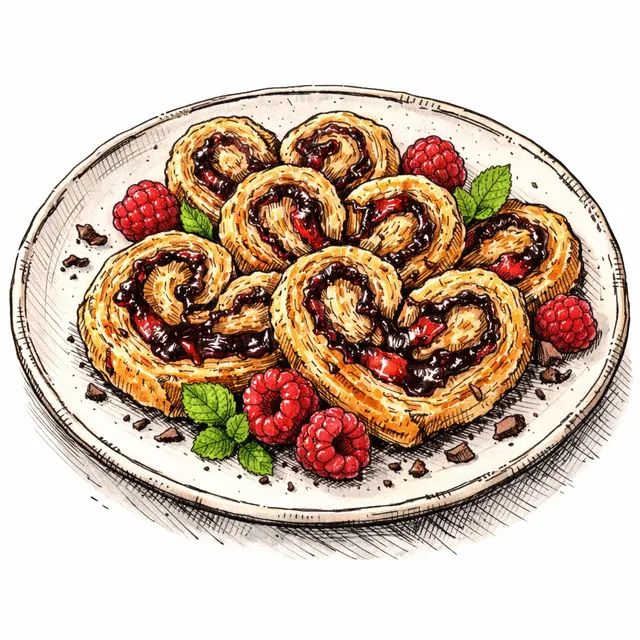
Raspberry & Bittersweet Chocolate Rough-Puff Palmiers
Parisian bakeries taught me restraint, but my Bay Area kitchen taught me to play with fruit. Traditional puff pastry is a weekend project, and honestly? We are not suffering for brunch. That is why I rely on rough-puff. You cut the butter into the flour with distinct chunks remaining, letting steam create that lacy, shatter-crisp crumb while the fridge does the heavy lifting. I developed these palmiers on a late-August morning when tart backyard raspberries and a block of bittersweet chocolate were begging to be folded together. Butter is not a garnish here; it melts into the sugar to create an aggressively crunchy, caramelized edge while the fruit and chocolate melt into pockets of sweet-tart intensity. Roll it tight, freeze it for twenty minutes so it slices clean, and let time do the work. Cami’s shortcut note: Store-bought all-butter puff pastry works in a pinch, but my rough-puff takes fifteen minutes and gives you actual flaky layers. Don’t skip the coarse sugar on the outside. That crunch is non-negotiable.
Featured Recipe
Raspberry & Bittersweet Chocolate Rough-Puff Palmiers
Crisp, caramelized morning palmiers with a quick-laminated butter dough, filled with crushed late-summer raspberries, dark chocolate, and coarse sugar. Cafe-level lamination with zero morning drama.
Save a copy to your collection for editing
Timeline
Ingredients
- 250 g All-purpose flour(Unbleached preferred)
- 225 g European cultured butter(Unsalted, very cold and cut into 1/2-inch cubes)
- 5 g Fine sea salt
- 120 ml Ice water(Very cold)
- 150 g Fresh raspberries(Dry and firm)
- 100 g Granulated sugar
- 60 g Demerara or coarse turbinado sugar(For crunch and caramelization)
- 50 g Bittersweet chocolate (70%)(Finely chopped)
- 1 Egg(Beaten with 1 tsp water for glaze)
- 1 pinch Flaky sea salt(Maldon or similar)
- 1 tablespoon water(for egg wash)
Instructions
- 1
In a large bowl, toss 250 g All-purpose flour and 5 g Fine sea salt together. Add 225 g European cultured butter cubes. Use your fingers to flatten each butter cube into a shingle. Do not rub into fine crumbs; you want visible, marble-sized sheets of cold butter. Drizzle in 120 ml Ice water and mix with a fork just until a shaggy dough comes together.
8 min
Tip: Butter must stay cold. If your kitchen is warm, chill the bowl for 5 minutes before folding.
- 2
Turn dough out onto a lightly floured counter. Pat into a rough rectangle. Roll into a 6x12-inch strip. Fold the top third down, then the bottom third up like a business letter (a tour simple). Turn dough 90 degrees, roll into a 6x12-inch strip again, and repeat the letter fold. You now have instant lamination.
6 min
Tip: Work quickly with a light touch. Flour your rolling pin, not the dough surface, to avoid tough pastry.
- 3
Wrap the dough block tightly in plastic wrap and chill in the freezer for 15 minutes (or fridge for 30 minutes) to reset the butter temperature.
15 min
Tip: The fridge is your friend. Cold butter creates steam pockets, which creates crisp, lacy layers.
- 4
While the dough rests, lightly crush 150 g Fresh raspberries with 100 g Granulated sugar using a fork in a small bowl until broken down but not pureed. Finely chop 50 g Bittersweet chocolate (70%).
5 min
Tip: Keep some raspberry texture intact so juice doesn't turn your pastry soggy.
- 5
Preheat your oven to 400°F (200°C) and line a heavy baking sheet with parchment paper.
2 min
Tip: A hot oven is non-negotiable for fast steam lift and crisp caramelized edges.
- 6
Sprinkle half of the 60 g Demerara or coarse turbinado sugar over your work surface. Unroll chilled dough onto the sugar. Roll into an 8x14-inch rectangle, pressing the coarse sugar into the bottom of the dough. Spread crushed raspberry mixture thinly over the dough, leaving a 1/2-inch border. Scatter chopped chocolate across the berries.
7 min
Tip: The coarse sugar on the outside caramelizes against the hot sheet pan for a shattering shell.
- 7
Fold the long edges of the dough inward so they meet halfway in the center. Fold over once more along the center seam like closing a book to create a tight scroll log. Place log in freezer for 10 minutes to firm up for clean slicing.
10 min
Tip: Firming the log prevents the fruit and chocolate from squishing out when cut.
- 8
Slice log into 1/2-inch thick slices using a sharp chef's knife. Lay palmiers cut-side up on the prepared baking sheet, leaving 2 inches between each. Gently reshape into palmier 'ears' if needed. Brush tops lightly with 1 Egg whisked with water, and sprinkle remaining coarse sugar and a tiny 1 pinch Flaky sea salt.
5 min
Tip: Slice cleanly in one swift motion rather than sawing back and forth.
- 9
Bake at 400°F for 18 to 22 minutes, flipping the palmiers over with a spatula at the 12-minute mark, until deeply golden brown and sticky-caramelized on both sides.
20 min
Tip: Flipping ensures both sides get equal heat and caramelized crunch without burning.
- 10
Transfer palmiers immediately to a wire cooling rack so the sugar shell hardens crisp rather than sticking to the hot parchment.
5 min
Tip: Eat warm within 4 hours for maximum flake and shatter.
Chef's Notes
Cami's shortcut note: Quick rough-puff (*pâte feuilletée rapide*) gives you 80% of classic puff pastry's rise with 10% of the effort. Don't skip this: Cultured butter has a lower water content and higher fat ratio, which means crispier layers and actual flavor. If your palmiers leak sugar onto the pan, that caramel is a feature, not a bug—scrape it up and enjoy the chef's treat.

Camille Roux
Café-level bakes, weeknight methods, zero compromise.
Camille “Cami” Roux was born in Paris with flour in her hair and a healthy skepticism of culinary dogma. She grew up around neighborhood boulangeries that treated crust and crumb like religion—but what stuck with her wasn’t rigid tradition. It was the quiet precision: good butter that actually tastes like milk, patient fermentation that builds flavor for free, and desserts that know when to stop before they get cloying. After moving to the Bay Area, Cami trained in a bread-and-pastry scene obsessed with texture, naturally leavened doughs, and seasonal fruit—Tartine energy, minus the martyrdom. She became known for loaves that sing when they cool, jammy tarts with clean edges, and “how is this so good?” weeknight pastries made with a few smart shortcuts. Her motto is high impact, low fuss: splurge where it counts (butter, salt, time), streamline the rest (sheet pans, one bowl, cold-proofing). If it doesn’t improve flavor or structure, it doesn’t earn a step.