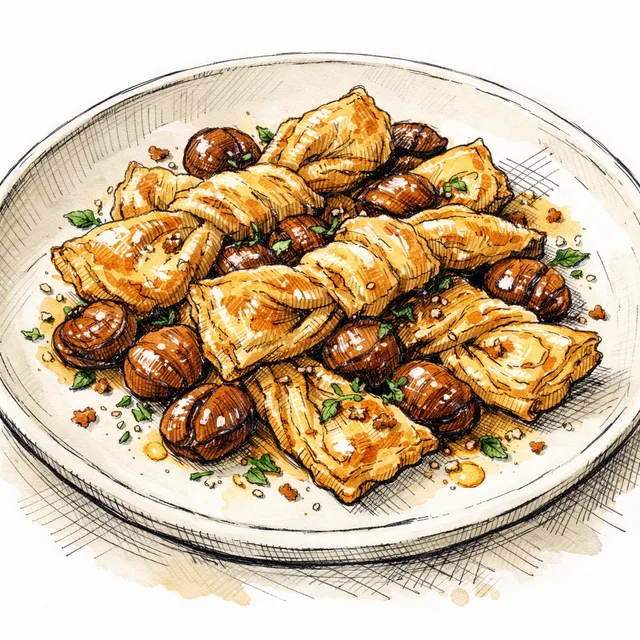
Roasted Chestnut & Brown Butter Rough-Puff Cravates
Fall in Paris always smelled like roasted chestnuts pulled straight from paper cones in the Métro, a scent that still stops me in my tracks. Years later in my Bay Area kitchen, I wanted that deep, earthy warmth translated into something flaky and fast. Enter the cravates—our twisted pastry bowties named for their necktie shape. We are not spending three days on classic French lamination here. Butter is not a garnish, and our rough-puff method delivers lacy, shattering layers in a fraction of the time. We smear the cold dough with a rich chestnut purée and nutty brown butter, twist them fast, and let the oven do the heavy lifting. Why it works: cold butter pockets create steam, while the chestnut paste keeps the crumb tender inside that shattering crust. Finish them with sparkling demerara sugar and bright orange zest. Cami's shortcut note: keep your butter cold and don't overthink the twists. Don't skip the orange zest at the end—that tiny pop of citrus cuts right through the rich nuttiness. We are not suffering for brunch, but we are definitely eating exceptionally well.
Featured Recipe
Roasted Chestnut & Brown Butter Rough-Puff Cravates
Crisp, deeply bronzed pastry bowties layered with nutty roasted chestnut purée and toasted brown butter. Finished with sparkling demerara sugar and a flicker of orange zest, this is bakery-case laminate pastry streamlined for a weeknight snack.
Save a copy to your collection for editing
Timeline
Ingredients
- 240 g all-purpose flour(unbleached, plus extra for dusting)
- 1 tsp fine sea salt
- 225 g cold cultured unsalted butter(cubed into 1/2-inch pieces, kept icy cold)
- 120 ml ice water(cold from the fridge)
- 45 g cultured unsalted butter (for browning)(about 3 tablespoons)
- 200 g roasted chestnuts(vacuum-packed or freshly roasted and peeled)
- 50 g dark brown sugar(lightly packed)
- 60 ml heavy cream(room temperature)
- 1 tsp vanilla bean paste
- 1 tsp orange zest(finely grated from 1 organic navel orange)
- 0.75 tsp flaky sea salt(Maldon preferred; divided)
- 1 large egg(beaten with 1 tsp cold water for egg wash)
- 2 tbsp demerara sugar(for topping)
- 1 tbsp all-purpose flour(for dusting board)
- 0.25 tsp flaky sea salt(for topping)
Instructions
- 1
In a wide mixing bowl, whisk 240g all-purpose flour and 1 tsp fine sea salt. Scatter in 225g cold cultured unsalted butter. Press the butter cubes flat between your thumb and fingertips until they resemble nickel-sized shingles—do not rub them down into breadcrumbs. Pour in 120ml ice water and use a flexible bench knife to toss until loose clumps form, then press firmly into a rough, shaggy rectangle.
10 min
Tip: Big butter shingles equal massive steam pockets; if you homogenize the butter into meal, your pastry crumb will end up tight like a bad alibi.
- 2
Turn the dough out onto a lightly floured board. Roll out into a roughly 8x16-inch strip. Fold the bottom third up and the top third down, just like a business letter. Rotate the dough 90 degrees, roll out again to an 8x16-inch strip, and complete a second letter fold. Wrap tightly in parchment paper and transfer to the refrigerator to chill for 30 minutes.
10 min
Tip: Two quick folds are all you need for rough puff. Keep the dough edges squared with your bench knife as you roll.
- 3
While the pastry rests in the chill, melt 45g cultured unsalted butter in a small saucepan over medium heat. Swirl constantly as the foam subsides and the milk solids toast into amber specks smelling of toasted hazelnuts, about 4 to 5 minutes. Remove immediately from heat and pour into a small bowl to halt cooking.
6 min
Tip: Butter is not a garnish; brown it properly until the sediment turns deep hazelnut brown, not pale beige.
- 4
In a food processor, combine 200g roasted chestnuts, the prepared browned butter, 50g dark brown sugar, 60ml heavy cream, 1 tsp vanilla bean paste, 1 tsp orange zest, and 0.5 tsp flaky sea salt. Pulse until a creamy, thick paste forms, scraping down the sides once or twice. Set aside at room temperature.
6 min
Tip: The purée should hold its shape like soft fudge so it doesn't leak out sideways in the oven.
- 5
Position an oven rack in the center and preheat the oven to 400°F (200°C). Line a heavy half-sheet baking pan with parchment paper. Remove chilled dough from the fridge and roll it out on a lightly floured surface into a 10x16-inch rectangle, about 1/8-inch thick. Neatly trim 1/4-inch off all four edges with a sharp knife to expose the lamination layers.
8 min
Tip: Trimming the edges isn't waste; it unseals the pressed borders so every lacy leaf of pastry can expand upward freely.
- 6
Spread the chestnut purée evenly across the lower half of the pastry dough lengthwise. Fold the top bare half over the filling to create a long, filled 5x16-inch sandwich. Press gently to seal. Cut crosswise into 8 even 2-inch strips. Pick up each strip by the ends and twist the center 180 degrees to form a bowtie (cravate), then arrange spaced apart on the lined baking sheet.
10 min
Tip: A single crisp twist in the center keeps the chestnut cream anchored while fanning the buttery corners outward.
- 7
Brush the exposed pastry tops lightly with 1 large egg wash, taking care not to drip wash over the exposed laminated cut edges. Sprinkle the tops generously with 2 tbsp demerara sugar and the remaining 0.25 tsp flaky sea salt. Transfer the tray to the refrigerator for 10 minutes to firm the butter before it hits the heat.
12 min
Tip: Never skip this flash chill. If warm butter hits a hot oven, it runs out onto the tray instead of puffing.
- 8
Bake at 400°F (200°C) for 22 to 25 minutes, rotating the pan front-to-back at the 15-minute mark, until the pastry is puffed high, the bottom is rigid, and the twists are deep mahogany gold. Slide the parchment onto a wire cooling rack and let rest for 10 minutes before serving warm.
25 min
Tip: Look for a firm, dark amber bottom and audible crackle when tapped. Underbaked puff turns limp the minute it cools.
Chef's Notes
Cami's shortcut note: Pre-cooked, vacuum-packed roasted chestnuts make this zero-sweat without sacrificing the earthy, sweet chestnut flavor. Don't skip this: The 10-minute flash-chill right after shaping is non-negotiable. Cold butter meeting high oven heat is the entire physical secret behind flaky, café-level layers.

Camille Roux
Café-level bakes, weeknight methods, zero compromise.
Camille “Cami” Roux was born in Paris with flour in her hair and a healthy skepticism of culinary dogma. She grew up around neighborhood boulangeries that treated crust and crumb like religion—but what stuck with her wasn’t rigid tradition. It was the quiet precision: good butter that actually tastes like milk, patient fermentation that builds flavor for free, and desserts that know when to stop before they get cloying. After moving to the Bay Area, Cami trained in a bread-and-pastry scene obsessed with texture, naturally leavened doughs, and seasonal fruit—Tartine energy, minus the martyrdom. She became known for loaves that sing when they cool, jammy tarts with clean edges, and “how is this so good?” weeknight pastries made with a few smart shortcuts. Her motto is high impact, low fuss: splurge where it counts (butter, salt, time), streamline the rest (sheet pans, one bowl, cold-proofing). If it doesn’t improve flavor or structure, it doesn’t earn a step.