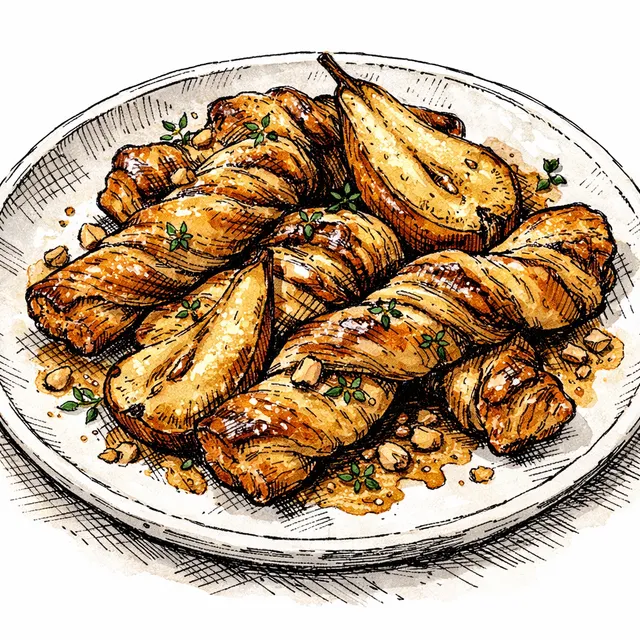
Roasted Pear and Brown Butter Rough-Puff Torsades
We are not suffering for brunch. When I crave bakery-counter drama on a lazy Saturday, I skip the traditional multi-day lamination and lean into my weeknight rough-puff. This recipe was born in my tiny apartment kitchen when I had a surplus of slightly bruised Bosc pears and a desperate need for something buttery, flaky, and warm. Butter is not a garnish, so we fold in nutty browned butter and let time do the work in the fridge. The inspiration came from classic French tarte Tatin flavors translated into a grab-and-go twist format. Roasting the pears first concentrates their natural sugars so your pastry doesn't get soggy—tight like a bad alibi. Cami's shortcut note: keep your butter cold and don't overthink the twists. Don't skip the flaky salt on top right out of the oven. Make it your own by swapping the pears for tart apples or adding a whisper of cardamom.
Featured Recipe
Roasted Pear & Brown Butter Rough-Puff Torsades
Buttery, flaky café-style pastry twists packed with caramelized Bosc pears, nutty browned butter, and warm vanilla. Built on my signature weeknight rough-puff method, these golden spirals deliver serious bakery-counter drama for breakfast without the twenty-four-hour laminate headache.
Save a copy to your collection for editing
Timeline
Ingredients
- 250 g all-purpose flour(unbleached, plus extra for rolling (about 2 cups))
- 1 tsp fine sea salt
- 1 tbsp granulated sugar
- 225 g unsalted European-style butter(16 tbsp / 2 sticks, cold, 82% butterfat, cut into 1/2-inch cubes)
- 120 ml ice water(1/2 cup, very cold)
- 2 tbsp unsalted butter(for sautéing the pears)
- 3 medium firm-ripe Bosc pears(peeled, cored, and cut into tiny 1/4-inch dice (about 350g))
- 3 tbsp dark brown sugar(packed)
- 1 tsp vanilla bean paste
- 1 tsp fresh lemon juice(standard yellow lemon)
- 1/4 tsp ground cardamom(freshly ground)
- 1 large egg(beaten with 1 tsp cold water for egg wash)
- 2 tbsp turbinado sugar(or demerara, for crunchy finishing crust)
- 1/2 tsp flaky sea salt(such as Maldon)
- 1 tsp cold water(for egg wash)
Instructions
- 1
In a wide mixing bowl, whisk together 250 g all-purpose flour, 1 tsp fine sea salt, and 1 tbsp granulated sugar. Toss in 225 g unsalted European-style butter until every cube is coated in flour. Using your thumbs and index fingers, press each butter cube flat into thin walnut-sized sheets—do not rub it into sand. Drizzle in 120 ml ice water and toss with a silicone spatula until a ragged, shaggy dough begins to gather.
10 min
Tip: Leave the butter chunks visible and flat; those large butter shingles are what steam and create explosive, lacy puff layers.
- 2
Turn the shaggy dough out onto a piece of plastic wrap, press it firmly into an 8-inch square, wrap it tightly, and rest it in the refrigerator for 20 minutes to relax the gluten.
20 min
Tip: The fridge is your friend here. If the butter starts sweating, stop and chill.
- 3
While the dough rests, set a wide stainless skillet over medium heat and melt 2 tbsp unsalted butter. Swirl until the foaming subsides and the milk solids turn amber and smell nutty, about 3 minutes. Immediately add 3 medium firm-ripe Bosc pears, 3 tbsp dark brown sugar, 1 tsp vanilla bean paste, 1 tsp fresh lemon juice, and 1/4 tsp ground cardamom. Sauté for 6 to 8 minutes, tossing frequently, until the pears are soft-edged, glossy, and all skillet liquid has evaporated into a clingy glaze.
12 min
Tip: Cook out all free moisture completely. Wet fruit is the mortal enemy of laminated pastry; liquid creates steam pockets that turn dough soggy.
- 4
Spread the warm pear filling across a wide plate in a thin layer and place it in the refrigerator to cool completely to room temperature or colder.
15 min
Tip: Never put hot fruit on laminated dough; it will melt your lamination layers on contact.
- 5
Flour your counter lightly. Unwrap the chilled dough and roll it into an 8x18-inch rectangle. Fold the bottom third up and top third down like a business letter. Turn the dough 90 degrees, roll it back out to 8x18 inches, and repeat the letter fold. You have just built dozens of flaky layers in under ten minutes.
10 min
Tip: Keep edges square using the side of your hands; straight edges mean uniform flake all the way across.
- 6
Wrap the laminated packet back in plastic wrap and chill in the refrigerator for 20 minutes to firm the butter.
20 min
Tip: Do not skip this rest. Warm butter shears through flour instead of creating defined sheets.
- 7
Adjust your oven rack to the middle position and preheat to 400°F (205°C). Line a heavy rimmed baking sheet with parchment paper. In a small ramekin, whisk 1 large egg with 1 tsp cold water until completely smooth.
10 min
Tip: A screaming hot oven is essential for quick lift before the butter has a chance to leak out.
- 8
Lightly dust your work surface. Roll the dough into a 10x16-inch rectangle, roughly 1/8-inch thick. Spread the chilled pear mixture evenly over the bottom half of the dough rectangle, leaving a 1/2-inch bare border along the edge. Fold the top bare half of the dough down over the pear-topped bottom half to create a 5x16-inch sandwich. Press gently with a rolling pin to seal. Using a sharp chef's knife or pizza wheel, cut crosswise into 8 equal strips (each roughly 2 inches wide). Hold each end of a strip and gently twist it twice into a spiral baton (torsade). Arrange them 2 inches apart on the prepared baking sheet.
15 min
Tip: Two gentle turns are plenty. If you over-twist, you choke the lamination and the layers won't billow.
- 9
Lightly brush the exposed pastry ridges of each torsade with the egg wash. Scatter 2 tbsp turbinado sugar and 1/2 tsp flaky sea salt evenly across the tops.
5 min
Tip: Only brush the top ridges, avoiding drips down the cut sides that could glue the expanding leaves together.
- 10
Bake at 400°F (205°C) for 22 to 26 minutes, rotating the pan front-to-back at the 15-minute mark, until deeply golden amber, crisp on the edges, and dry on the underside.
25 min
Tip: Look for deep chestnut edges. Pale pastry tastes like raw flour; we want deeply caramelized crust.
- 11
Transfer the torsades on their parchment sheet onto a wire cooling rack and let rest for 10 minutes before serving warm.
10 min
Tip: Pastry crispness sets as it cools; cutting into it immediately will release trapped steam and soften the flakes.
Chef's Notes
Cami's shortcut note: Rough puff (feuilletage rapide) gives you 90% of classic puff pastry's loft in a quarter of the time. Don't stress about perfect rectangles—just keep the butter cold and the folds neat. Don't skip this: Cook down your pears until there is zero free-flowing liquid in the pan. Water is the killer of laminated pastry; liquid creates steam pockets that leave your bottoms wet instead of crackling. Also, European-style high-fat butter (82%+) is non-negotiable here: lower fat supermarket blocks contain too much water and turn tight like a bad alibi.

Camille Roux
Café-level bakes, weeknight methods, zero compromise.
Camille “Cami” Roux was born in Paris with flour in her hair and a healthy skepticism of culinary dogma. She grew up around neighborhood boulangeries that treated crust and crumb like religion—but what stuck with her wasn’t rigid tradition. It was the quiet precision: good butter that actually tastes like milk, patient fermentation that builds flavor for free, and desserts that know when to stop before they get cloying. After moving to the Bay Area, Cami trained in a bread-and-pastry scene obsessed with texture, naturally leavened doughs, and seasonal fruit—Tartine energy, minus the martyrdom. She became known for loaves that sing when they cool, jammy tarts with clean edges, and “how is this so good?” weeknight pastries made with a few smart shortcuts. Her motto is high impact, low fuss: splurge where it counts (butter, salt, time), streamline the rest (sheet pans, one bowl, cold-proofing). If it doesn’t improve flavor or structure, it doesn’t earn a step.