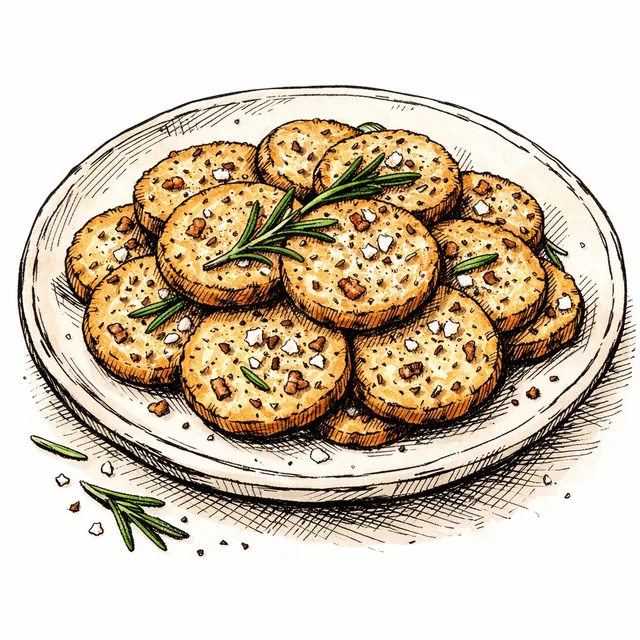
Rosemary–Pecan Apéro Sablés: Café-Level Crunch, Zero Drama
February makes me crave apéro food that’s crisp, salty, and quietly fancy—without turning my kitchen into a project. These rosemary–pecan sablés are my answer: savory shortbread (sablés—“sandy” in French, for that tender crumble) with cultured-butter richness, deeply toasted pecans, and a black-pepper edge that wakes everything up.
The inspiration is half Paris, half Bay Area. In Paris, apéro was olives, nuts, maybe a biscuit salé, and nobody apologized for keeping it simple. In California, I learned the power of toasting—nuts, spices, even sugar—until they smell like something you’d follow down the street.
I started making these during a rainy February when friends kept “dropping by for a second.” I wanted something that felt planned even when it wasn’t. Slice-and-bake is the cheat code: the fridge does the work, and you bake only what you need.
Why it works: chill time firms the butter, so the rounds hold their edges and bake up crisp, not greasy.
Make it yours: swap pecans for walnuts, add lemon zest, or go harder on pepper. Finish with flaky salt. Butter is not a garnish.
Cami’s shortcut note: freeze the log; slice from frozen, add 2 minutes.
Don’t skip this: toast the pecans until glossy and fragrant—raw nuts taste tight like a bad alibi.
Featured Recipe
Rosemary–Pecan Apéro Sablés (Slice-and-Bake) with Black Pepper + Flaky Salt
These are my February apéro answer to “I want something crisp, salty, and a little fancy—without cooking all day.” Think buttery savory shortbread with piney rosemary, deeply toasted pecans, and a black-pepper snap, sliced straight from the fridge and baked to café-level crisp edges. Make the log now, bake a few whenever you need a plate that looks intentional.
Save a copy to your collection for editing
Ingredients
- 120 g Pecan halves(toast, then chop; about 1 cup)
- 2 tbsp Fresh rosemary(finely chopped (needles only))
- 10 g Granulated sugar(2 tsp; optional but helps browning without sweetness)
- 1 tsp Flaky salt(plus more for topping)
- 6 g Fine sea salt(1 tsp)
- 1 tsp Black pepper(freshly ground, plus more for topping)
- 170 g Unsalted cultured butter(very soft but not melted (about 3/4 cup))
- 10 g Dijon mustard(2 tsp; optional but great with rosemary (does not make it “mustardy”))
- 220 g All-purpose flour(about 1 3/4 cups, spooned and leveled)
- 30 g Rice flour(about 1/4 cup; for extra crisp (see note for swap))
- 2 g Baking powder(1/2 tsp; tiny lift to keep them from eating dense)
- 1 Egg white(for sealing the log + topping (optional but gives better edge crunch))
- 1 tbsp Sesame seeds(optional for the outside; subtle crunch)
Instructions
- 1
Spread 120 g Pecan halves on a small tray and toast 8–10 minutes until fragrant and slightly deeper in color. Cool completely, then chop into small pebble pieces (not dust).
12 min
Tip: Don’t rush the toast—raw pecans taste flat in shortbread. Cool fully so they don’t melt the butter later.
- 2
In a medium bowl, rub 2 tbsp Fresh rosemary into 6 g Fine sea salt with your fingertips for 10 seconds (this wakes up the oils). Add 170 g Unsalted cultured butter, 10 g Granulated sugar, 1 tsp Black pepper, and 10 g Dijon mustard. Stir with a spatula until smooth and cohesive.
5 min
Tip: Soft butter is the non-negotiable: if it’s cold, you’ll overwork the dough and get crumbly slices.
- 3
Sprinkle in 220 g All-purpose flour, 30 g Rice flour, and 2 g Baking powder. Mix until the flour just disappears. Fold in the chopped toasted pecans. The dough should look like a cohesive paste and hold together when pinched—no dry pockets, not greasy.
4 min
Tip: If it feels dry and crumbly, your butter was too cool—press and smear the dough against the bowl with the spatula until it comes together.
- 4
Dump dough onto parchment and form a tight log about 4–5 cm (1 1/2–2 in) in diameter. Roll firmly to eliminate air pockets, then wrap snugly in parchment and twist the ends like a candy wrapper.
6 min
Tip: Tight shaping = clean slices. Air pockets = broken coins.
- 5
Refrigerate at least 2 hours until very firm, or freeze 30–40 minutes. (You can also freeze the wrapped log up to 2 months.)
120 min
Tip: Cold dough is how you get sharp edges and controlled spread. Let time do the work.
- 6
Unwrap. Brush the log lightly with 1 Egg white, then roll in a mix of 1 tsp Flaky salt, extra 1 tsp Black pepper, and 1 tbsp Sesame seeds. Re-wrap and chill 15 minutes to re-firm.
20 min
Tip: This is the difference between “homemade cookies” and “apéro sablés that disappear first.”
- 7
Heat oven to 165°C / 330°F (convection/fan) or 175°C / 350°F (no fan). Line 2 sheet pans with parchment. Slice 8–10 mm (about 3/8 in) thick. Space 3 cm (1+ in) apart.
10 min
Tip: For perfect rounds, rotate the log a quarter-turn after every few slices so it doesn’t flatten on one side.
- 8
Bake 12 minutes, rotate pans, then bake 6–10 minutes more until the edges are clearly golden and the centers look set and matte (not glossy). Cool 10 minutes on the pan, then move to a rack to finish crisping.
20 min
Tip: Don’t pull them pale. Savory shortbread needs color for crunch. If your oven runs hot, drop 10°C / 25°F and add a couple minutes.
Chef's Notes
Why it works: rice flour lowers gluten and dries the bite just enough for that crisp, shattering edge without making the cookie fragile. Rosemary + pecan is the wintery, resin-and-nut combo I grew up nibbling beside a late-afternoon kir—except this version is weeknight-safe and freezer-friendly. Cami’s shortcut note: Keep a log in the freezer, pre-sliced if you want. Freeze slices flat, then bake from frozen—just add 2–3 minutes. Don’t skip this: bake until you see real golden edges. If they’re blond, they’ll go tight like a bad alibi instead of lacy-crisp. Swaps: No rice flour? Use all AP flour, but chill the log an extra 30 minutes and bake 1–2 minutes longer for crunch. No Dijon? Leave it out; add 1/2 tsp lemon zest if you want lift (not yuzu). Storage: airtight 5–7 days; they re-crisp 4 minutes in a 150°C / 300°F oven.

Camille Roux
Café-level bakes, weeknight methods, zero compromise.
Camille “Cami” Roux was born in Paris with flour in her hair and a healthy skepticism of culinary dogma. She grew up around neighborhood boulangeries that treated crust and crumb like religion—but what stuck with her wasn’t rigid tradition. It was the quiet precision: good butter that actually tastes like milk, patient fermentation that builds flavor for free, and desserts that know when to stop before they get cloying. After moving to the Bay Area, Cami trained in a bread-and-pastry scene obsessed with texture, naturally leavened doughs, and seasonal fruit—Tartine energy, minus the martyrdom. She became known for loaves that sing when they cool, jammy tarts with clean edges, and “how is this so good?” weeknight pastries made with a few smart shortcuts. Her motto is high impact, low fuss: splurge where it counts (butter, salt, time), streamline the rest (sheet pans, one bowl, cold-proofing). If it doesn’t improve flavor or structure, it doesn’t earn a step.