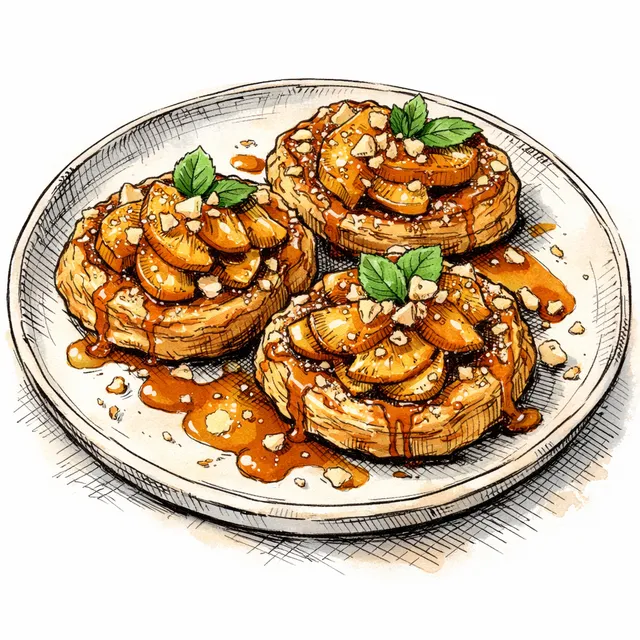
Salted Butter Caramel Apple Rough-Puff Tatinettes
I love a classic tarte Tatin, but standing over a hot stove caramelizing sugar in a copper pan at dawn is nobody's idea of a relaxing weekend. During my early days in Paris, I craved that deep, bitter-sweet apple magic without the heavy lifting. That is why I invented these Tatinettes. We are scaling the drama down into individual morning pastries using a lightning-fast rough-puff pastry. You get those lacy, shattering layers with practically zero morning stress. Butter is not a garnish here; we let it emulsify into the bubbling apple juices until it turns a deep amber. Honeycrisp apples hold their shape and give you that tart bite against the rich, salty caramel. The fridge is your friend—assemble these the night before and bake straight from cold. Remember, we are not suffering for brunch. Cami's shortcut note: store-bought European butter is non-negotiable for the lamination. Look for deep bubbles and a heavy gold wobble around the edges before you invert them.
Featured Recipe
Salted Butter Caramel Apple Rough-Puff Tatinettes
Imagine the blistering, caramelized drama of a classic tarte Tatin scaled down into flaky, single-serve morning pastries. With a quick five-minute rough-puff technique and crisp Honeycrisp apples baked directly over amber salted caramel, these give you deep bakery-counter shattering layers with practically zero morning stress. We are baking for maximum crust and zero fuss because we're not suffering for brunch.
Save a copy to your collection for editing
Timeline
Ingredients
- 240 g all-purpose flour(unbleached, plus extra for rolling)
- 1 tsp fine sea salt(divided)
- 225 g unsalted European-style cultured butter(cold, 82% butterfat minimum, cut into 1/2-inch cubes and chilled)
- 110 ml ice water(very cold)
- 130 g granulated sugar(divided)
- 3 Honeycrisp apples(medium (about 500g total), peeled, cored, and sliced into 1/2-inch thick wedges)
- 45 g salted cultured butter(for the pan caramel)
- 0.25 tsp ground cardamom(freshly cracked preferred)
- 1 tsp apple cider vinegar(to cut the sweetness)
- 0.5 tsp flaky sea salt(such as Maldon, for finishing)
- 120 g crème fraîche(for serving)
- 30 g granulated sugar(for tossing with apples)
- 0.25 tsp fine sea salt(for caramel)
Instructions
- 1
Toss 240 g all-purpose flour and 0.75 tsp fine sea salt into a wide chilled bowl. Drop in 225 g unsalted European-style cultured butter and use your thumb and forefingers to press each cube flat into thin shingle-like disks—do not rub it into meal; you want visible, distinct butter coins. Drizzle 110 ml ice water evenly over the flour mixture and toss with a fork or silicone spatula just until a ragged, shaggy dough forms with plenty of dry flour spots left.
5 min
Tip: Visible butter leaves equal blistered flakes later. If the butter softens at all, slide the whole bowl into the fridge for 5 minutes.
- 2
Tip the loose dough onto a lightly floured work surface. Press it firmly into a rough 6x10-inch rectangle, fold the top third down, and the bottom third up like a business letter (a 'tour simple' or single fold). Rotate the dough 90 degrees, roll it back out into an 8x12-inch rectangle, and repeat the letter fold. Wrap tightly in parchment and chill in the refrigerator for 25 minutes to firm up.
7 min
Tip: Why it works: folding butter ribbons between flour layers traps steam pockets during baking, giving you puff-pastry height without a 4-hour laminating ordeal.
- 3
While the dough rests in the cold, preheat your oven to 400°F (205°C) and arrange a standard 6-cup jumbo muffin tin or six 4-inch ovenproof ramekins on a parchment-lined rimmed baking sheet. In a medium skillet set over medium-high heat, combine 100 g granulated sugar and 2 tablespoons of water; swirl the pan gently without stirring until the sugar dissolves and turns into a deep, foaming copper caramel, about 5 to 6 minutes.
6 min
Tip: Do not leave the stove. Caramel turns from glorious hazelnut-amber to scorched acrid carbon in literally 15 seconds.
- 4
Pull the skillet off the heat immediately and whisk in 45 g salted cultured butter, 1 tsp apple cider vinegar, and 0.25 tsp fine sea salt until silky and glossy. Evenly divide the foaming caramel across the bottoms of the 6 jumbo muffin cups (about 1 generous tablespoon per well).
3 min
Tip: Butter is not a garnish—it creates the fat barrier that keeps the apples from sticking to the metal.
- 5
In a mixing bowl, toss 3 Honeycrisp apples with 30 g granulated sugar and 0.25 tsp ground cardamom. Arrange the apple wedges tightly in concentric circles or fan patterns over the warm caramel in each cup, packing them snugly; they will shrink noticeably as moisture evaporates during the bake.
6 min
Tip: Pack them tighter than feels polite. Tight apples equal a plump, jammy, unyielding base when flipped.
- 6
Retrieve the chilled rough puff from the fridge onto a lightly floured bench. Roll out into an even 1/8-inch-thick slab (roughly 9x14 inches). Using a 4.5-inch round cutter or a knife guided by a small bowl, cut 6 pastry disks. Dock each round 4 to 5 times with a fork to allow controlled steam escape.
6 min
Tip: Cut slightly larger than the mold top so the edges can tuck down into the pan around the fruit.
- 7
Lay one dough round atop the apples in each cup, gently tucking the pastry borders down inside the rim of the muffin well around the fruit like tucking in a bed sheet. Transfer the pan to the middle rack of the preheated oven.
3 min
Tip: Tucking the edges seals the steam and guarantees a protective pastry rim to catch all the bubbling juices.
- 8
Bake at 400°F (205°C) until the pastry tops are deep bronzed-gold, puffed with lacy flaky strata, and the caramel is vigorously bubbling up the sides, 26 to 28 minutes. If pastry puffs unevenly mid-bake, tap it gently with the back of a spatula.
28 min
Tip: Visual cue: look for deep chestnut edges on the pastry. If it looks pale, your crumb will be tight like a bad alibi. Give it the full bake.
- 9
Remove from the oven and let rest in the tin on a wire rack for exactly 4 minutes—long enough for the caramel to thicken slightly, but before it cements itself to the pan. Invert a large rimmed baking sheet or cutting board over the tin, brace both firmly with oven mitts, and flip cleanly in one swift, confident movement.
5 min
Tip: Why it works: at minute 4, the caramel is viscous enough to cling to the apples without running everywhere, but still hot enough to release effortlessly.
- 10
Lift the pan off; if any apple wedges stuck to the bottom of the cups, slide them back into place with an offset spatula. Sprinkle the warm, glistening tatinettes with 0.5 tsp flaky sea salt and serve warm alongside generous dollops of 120 g crème fraîche.
2 min
Tip: Serve immediately while the rough-puff base remains deafeningly crisp against the velvety, tart apples.
Chef's Notes
Cami's shortcut note: If your morning schedule is tight, build the rough puff the night before, roll your 6 disks onto a parchment-lined baking sheet, wrap them well, and keep them chilled in the fridge. In the morning, you just boil the quick stovetop caramel, drop the apples in the tins, slap on the chilled rounds, and bake. Don't skip this: You must unmold between minutes 3 and 5. Wait 10 minutes and the caramel welds the fruit to the metal tin; flip immediately and the boiling caramel will wash your apples right off the pastry.

Camille Roux
Café-level bakes, weeknight methods, zero compromise.
Camille “Cami” Roux was born in Paris with flour in her hair and a healthy skepticism of culinary dogma. She grew up around neighborhood boulangeries that treated crust and crumb like religion—but what stuck with her wasn’t rigid tradition. It was the quiet precision: good butter that actually tastes like milk, patient fermentation that builds flavor for free, and desserts that know when to stop before they get cloying. After moving to the Bay Area, Cami trained in a bread-and-pastry scene obsessed with texture, naturally leavened doughs, and seasonal fruit—Tartine energy, minus the martyrdom. She became known for loaves that sing when they cool, jammy tarts with clean edges, and “how is this so good?” weeknight pastries made with a few smart shortcuts. Her motto is high impact, low fuss: splurge where it counts (butter, salt, time), streamline the rest (sheet pans, one bowl, cold-proofing). If it doesn’t improve flavor or structure, it doesn’t earn a step.