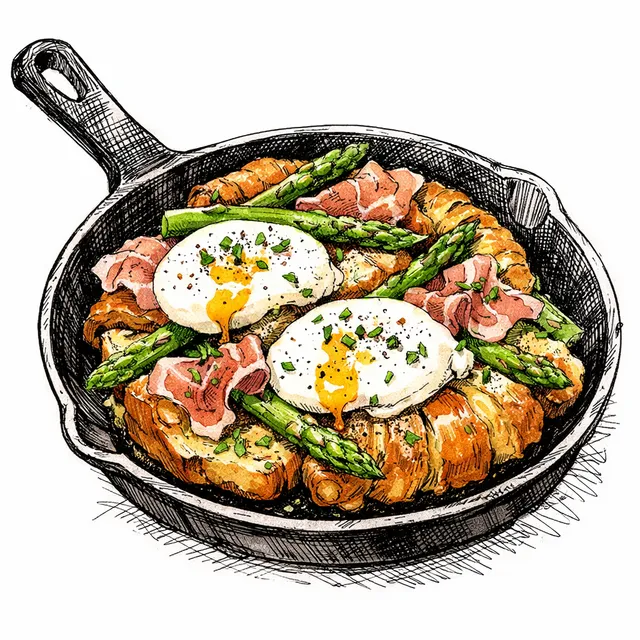
Savory Croissant Skillet Pain Perdu: We're Not Suffering for Brunch
Let’s get one thing straight: we are not suffering for brunch. I developed this Savory Croissant Skillet Pain Perdu (literally "lost bread," or French toast) after a marathon bake sale left me with a mountain of day-old croissants. Their crumb had gone tight like a bad alibi.\n\nInstead of tossing them, I tore them up and tossed them into a hot cast-iron skillet. The secret here is high impact, low fuss. You crisp those sad pastries in browned butter—because butter is not a garnish—and bind them with a sharp Dijon mustard custard. Throw in local Bay Area asparagus and drape prosciutto over the top. The oven does the heavy lifting, blistering the spears and rendering the pork into salty, shattered ribbons.\n\nThe result? Maximum crust-to-crumb ratio. A lacy, savory interior with a shattering top. Make it your own by swapping the asparagus for whatever is wilting in your crisper drawer—leeks or cherry tomatoes work beautifully.\n\nCami’s shortcut note: Whisk your custard the night before. The fridge is your friend.\n\nDon’t skip this: Watch for the wobble. Bake just until the center jiggles slightly; carryover heat will finish the job.
Featured Recipe
Savory Croissant Skillet Pain Perdu with Asparagus & Prosciutto
We are not suffering for brunch. This stovetop-to-oven pain perdu takes stale croissants, crisps them in browned butter, and binds them with a sharp mustard custard. The oven does the heavy lifting, blistering the asparagus and rendering the prosciutto into salty, shattered ribbons for maximum crust-to-crumb ratio.
Save a copy to your collection for editing
Timeline
Ingredients
- 4 large eggs(room temperature)
- 1 cup whole milk(full fat is non-negotiable)
- 1 tbsp Dijon mustard(smooth, not grainy)
- 1 cup Gruyère(grated, divided)
- 1/2 tsp kosher salt(Diamond Crystal)
- 1/4 tsp black pepper(freshly ground)
- 3 tbsp cultured butter(unsalted)
- 4 stale croissants(torn into large 2-inch chunks)
- 1 bunch asparagus(woody ends snapped, cut into 2-inch pieces)
- 3 oz prosciutto(torn into ribbons)
Instructions
- 1
Preheat your oven to 400F (200C). In a large mixing bowl, whisk together 4 large eggs, 1 cup whole milk, 1 tbsp Dijon mustard, and 1/2 cup grated Gruyère (we save the rest for the crust). Season the custard with 1/2 tsp kosher salt and 1/4 tsp black pepper. Do not overmix; we want a cohesive liquid, not a frothy foam.
5 min
Tip: Have your custard ready before you start cooking. The skillet moves fast once it's on the stove.
- 2
Place a 10-inch cast-iron skillet over medium heat. Drop in 3 tbsp cultured butter. Let it melt, foam, and smell slightly nutty. Immediately toss in the 4 stale croissants, torn into chunks. Toast them in the hot butter, tossing occasionally, until the edges catch and turn deeply golden. This builds the foundational crunch.
4 min
Tip: Butter is not a garnish. The browned milk solids will give the bread a savory, nutty depth.
- 3
Push the toasted croissants slightly to the edges of the pan to expose the hot iron. Drop in the 1 bunch asparagus, cut into 2-inch pieces. Let them sizzle against the metal for just a couple of minutes until they turn bright green and get a slight blister. Turn off the heat completely.
3 min
Tip: Don't overcook the asparagus here; it will finish tenderizing in the oven.
- 4
Pour your prepared egg mixture evenly over the entire skillet. Gently press the croissant pieces down so they absorb the liquid but leave their top edges exposed to crisp. Drape the 3 oz sliced prosciutto gracefully over the top—do not bury it, we want the fat to render in the oven. Scatter the remaining 1/2 cup grated Gruyère over the exposed bread.
2 min
Tip: Leaving the prosciutto exposed is the secret to a shatteringly crisp, salty finish.
- 5
Transfer the skillet immediately to the hot oven. Bake until the edges pull away from the pan, the prosciutto is crispy, and the center has a gentle, confident wobble. We want lacy edges and a tender crumb, tight like a bad alibi is not the goal here.
20 min
Tip: Watch for the wobble. An overbaked custard weeps and turns rubbery.
- 6
Remove the skillet from the oven. Let time do the work: allow it to rest in the hot cast-iron for exactly 5 minutes before serving. The residual heat will gently set the center while preserving the moisture.
5 min
Tip: Don't skip this. Slicing immediately will result in a messy, weeping custard.
Chef's Notes
Cami's shortcut note: Buy the croissants a day or two ahead and leave them out on the counter. Fresh, squishy pastry will turn to mush in the custard. You need stale, dry edges to absorb the liquid without losing structure. If you only have fresh croissants, tear them up and bake them at 300F for 10 minutes to dry them out before starting.

Camille Roux
Café-level bakes, weeknight methods, zero compromise.
Camille “Cami” Roux was born in Paris with flour in her hair and a healthy skepticism of culinary dogma. She grew up around neighborhood boulangeries that treated crust and crumb like religion—but what stuck with her wasn’t rigid tradition. It was the quiet precision: good butter that actually tastes like milk, patient fermentation that builds flavor for free, and desserts that know when to stop before they get cloying. After moving to the Bay Area, Cami trained in a bread-and-pastry scene obsessed with texture, naturally leavened doughs, and seasonal fruit—Tartine energy, minus the martyrdom. She became known for loaves that sing when they cool, jammy tarts with clean edges, and “how is this so good?” weeknight pastries made with a few smart shortcuts. Her motto is high impact, low fuss: splurge where it counts (butter, salt, time), streamline the rest (sheet pans, one bowl, cold-proofing). If it doesn’t improve flavor or structure, it doesn’t earn a step.