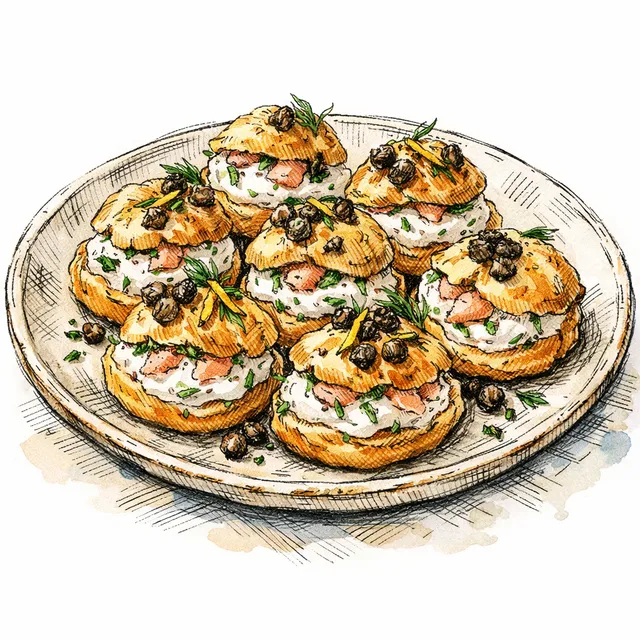
Smoked Trout Gougères with Lemon–Horseradish Crème Fraîche (and Crunchy Capers)
I built this recipe from two cravings: Paris apéro vibes and Bay Area “good enough to serve, easy enough to make on a Tuesday.” Gougères are that magic trick—choux pastry that bakes up airy and lacy, with cheese doing half the work. Butter is not a garnish.
My first real gougère memory is standing too close to a bakery tray as a kid, stealing one while it was still hot and smelling like toasted Comté. Fast-forward: tiny San Francisco kitchen, friends arriving early, me refusing to suffer for brunch—or drinks. So I made them slab-style-ish: spooned, not piped. Let time do the work in the oven.
What makes these special to me is the contrast: warm, savory puffs + cool smoked trout crème fraîche with lemon and horseradish (clean heat, not sinus punishment) + capers fried until they pop and go crunchy. That last bit is non-negotiable.
Make it yours: swap trout for smoked salmon or mackerel; add dill or chives; use Greek yogurt if you must, but crème fraîche stays silky. Don’t skip this: dry the capers well before frying—wet capers sputter and stay chewy.
Cami’s shortcut note: scoop the choux with a spoon and call it rustic. We’re not suffering for brunch.
Featured Recipe
Smoked Trout Gougères with Lemon–Horseradish Crème Fraîche (and Crunchy Capers)
These are café gougères (cheese choux puffs) made weeknight-friendly: one pot, one bowl, no piping bag drama unless you want it. I fill them with a fast smoked trout crème fraîche—bright lemon, a clean hit of horseradish—then finish with crunchy fried capers for that salty pop that makes wine taste better.
Save a copy to your collection for editing
Ingredients
- 120 g Water((1/2 cup))
- 120 g Whole milk((1/2 cup))
- 85 g Unsalted butter(cut into pieces (6 Tbsp))
- 4 g Fine salt(about 3/4 tsp, divided)
- 1/2 tsp Freshly ground black pepper(plus more to taste)
- 140 g All-purpose flour((1 cup plus 2 Tbsp), spooned/leveled)
- 4 Eggs(large, cold is fine)
- 100 g Gruyère or aged cheddar, finely grated(about 1 packed cup)
- 1 tsp Dijon mustard
- 1/8 tsp Cayenne(optional but good)
- 170 g Crème fraîche((about 3/4 cup); sour cream works in a pinch)
- 2 tsp Prepared horseradish(drained; add more to taste)
- 1 tsp Lemon zest(from 1 lemon)
- 1 tbsp Lemon juice(plus more to taste)
- 170 g Smoked trout(about 6 oz, flaked; remove skin/bones)
- 2 tbsp Chives or dill, finely chopped(optional but very on-theme)
- 2 tbsp Capers, drained and patted very dry(non-negotiable if you want the crunch)
- 2 tbsp Olive oil (or neutral oil)(for crisping capers)
- 1 pinch Flaky salt(to finish)
Instructions
- 1
Heat the oven to 425°F / 220°C. Line a sheet pan with parchment. Set out your 4 Eggs, 100 g Gruyère or aged cheddar, finely grated, and a mixing bowl with a wooden spoon or sturdy spatula.
5 min
Tip: Hot oven = fast steam = lift. Choux loves decisive heat.
- 2
Make the panade: In a medium saucepan, bring 120 g Water, 120 g Whole milk, 85 g Unsalted butter, 2.5 g Fine salt, and 1/2 tsp Freshly ground black pepper to a full boil. Take off the heat, dump in 140 g All-purpose flour all at once, and stir hard until no dry flour remains.
2 min
Tip: All the flour at once prevents lumps and keeps the dough smooth.
- 3
Dry the dough: Return the pan to medium heat and cook, stirring constantly, until a thin film forms on the bottom and the dough looks glossy and pulls into a ball.
2 min
Tip: You’re driving off moisture so the puffs rise instead of spreading. Look for a slightly nutty smell and a clean-ish pan.
- 4
Cool slightly, then add eggs: Scrape dough into a bowl. Stir for 1 minute to release heat. Add 4 Eggs one at a time, beating well after each, until the dough is smooth, thick, and falls from the spoon in a slow “V” shape. Stir in 1 tsp Dijon mustard, 1/8 tsp Cayenne, and the 100 g Gruyère or aged cheddar, finely grated.
6 min
Tip: If the dough feels stiff after 4 eggs, stop. If it’s too tight like a bad alibi, beat a 5th egg in a cup and add a tablespoon at a time until you get that slow V.
- 5
Portion: Scoop 18–22 mounds (about 1 1/2 Tbsp each) onto the sheet pan, spaced apart. Smooth peaks with a damp fingertip.
5 min
Tip: No piping bag needed. A cookie scoop makes this stupid-easy and evenly sized.
- 6
Bake: Bake 12 minutes at 425°F / 220°C. Without opening the door, reduce heat to 375°F / 190°C and bake until deeply golden and very light, 12–18 minutes more.
30 min
Tip: Don’t open the oven early. Steam is your lift; venting it too soon makes flat, sad puffs.
- 7
Dry the centers (quick but important): Turn off the oven. Pierce each gougère with the tip of a knife (a small slit) and return to the turned-off oven with the door cracked for 5 minutes.
5 min
Tip: This keeps them crisp instead of collapsing as they cool. Let time do the work.
- 8
Make the filling: In a bowl, mix 170 g Crème fraîche, 2 tsp Prepared horseradish, 1 tsp Lemon zest, 1 tbsp Lemon juice, 1.5 g Fine salt, and 2 tbsp Chives or dill, finely chopped if using. Fold in 170 g Smoked trout, keeping some larger flakes for texture. Taste and adjust lemon, pepper, and horseradish.
5 min
Tip: I want it bright enough to cut through the butter and cheese. If it tastes ‘nice’ but not ‘alive,’ add lemon.
- 9
Crunchy capers: Heat 2 tbsp Olive oil (or neutral oil) in a small skillet over medium-high. Add 2 tbsp Capers, drained and patted very dry and fry until they open like little flowers and crisp, 60–90 seconds. Drain on paper towel.
3 min
Tip: Capers must be very dry or they’ll spit. This is your salty crunch—don’t skip it.
- 10
Fill and finish: Split gougères. Spoon or pipe in the trout filling. Top with crunchy capers and 1 pinch Flaky salt. Serve warm-ish or at room temp with a cold glass of white wine.
7 min
Tip: If hosting, keep shells unfilled until the last second so they stay crisp.
Chef's Notes
This one’s personal: it tastes like my Paris café days collided with my Bay Area fridge habits. Choux feels fancy, but it’s basically steam management and courage. Cami’s shortcut note: Bake the gougères earlier in the day, cool completely, then re-crisp at 350°F / 175°C for 6–8 minutes. Fill right before serving. Don’t skip this: the “dry the centers” step (the little slit + door-cracked rest). That’s how you keep a lacy interior with a crisp shell, not a damp chew. Troubleshooting: - Flat puffs: oven wasn’t hot enough at the start or you opened the door too early. - Collapsed puffs: underbaked or skipped the drying step. - Cracked/rough tops: peaks weren’t smoothed or dough was a bit too dry—next time add a splash of beaten egg to hit the slow V texture.

Camille Roux
Café-level bakes, weeknight methods, zero compromise.
Camille “Cami” Roux was born in Paris with flour in her hair and a healthy skepticism of culinary dogma. She grew up around neighborhood boulangeries that treated crust and crumb like religion—but what stuck with her wasn’t rigid tradition. It was the quiet precision: good butter that actually tastes like milk, patient fermentation that builds flavor for free, and desserts that know when to stop before they get cloying. After moving to the Bay Area, Cami trained in a bread-and-pastry scene obsessed with texture, naturally leavened doughs, and seasonal fruit—Tartine energy, minus the martyrdom. She became known for loaves that sing when they cool, jammy tarts with clean edges, and “how is this so good?” weeknight pastries made with a few smart shortcuts. Her motto is high impact, low fuss: splurge where it counts (butter, salt, time), streamline the rest (sheet pans, one bowl, cold-proofing). If it doesn’t improve flavor or structure, it doesn’t earn a step.