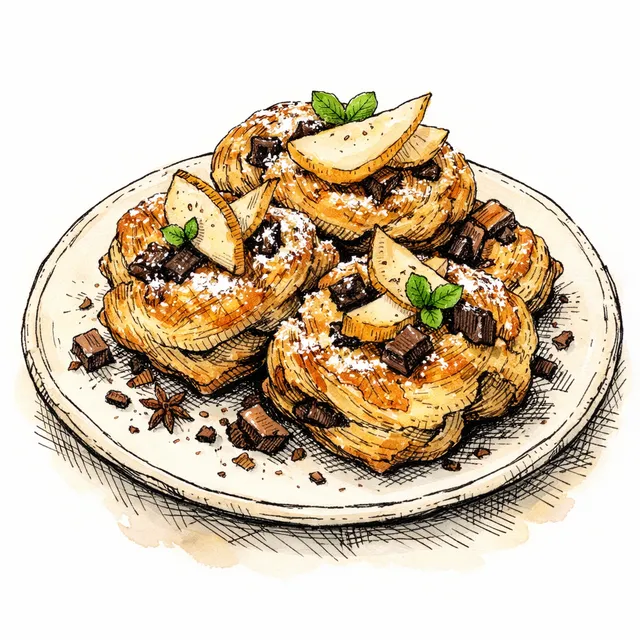
Spiced D'Anjou Pear and Dark Chocolate Rough-Puff Bichons
I first fell in love with bichons during my early kitchen days in Paris. Those classic little puff pastry turnovers were always too fussy for a weeknight, so I streamlined the process. We are using rough-puff lamination here--meaning we build flaky layers fast without folding for hours. Butter is not a garnish, so we use plenty of it, trapping pockets of steam that deliver a lacy, shatteringly crisp crumb rather than a tight, dense alibi. Inside, ripe D'Anjou pears meet bittersweet chocolate and warm autumn spices, caramelizing beneath a crunch of crystal sugar in the oven. My Bay Area training taught me to respect the fruit, while my Paris upbringing keeps the sweetness in check. Let the fridge do the heavy lifting overnight, and you will have bakery-level pastries with zero morning-of suffering. Don't skip the crystal sugar on top for that blistered crunch. Make it your own by swapping the pears for tart apples when the season shifts.
Featured Recipe
Spiced D'Anjou Pear & Dark Chocolate Rough-Puff Bichons
Blistered, shatteringly crisp French café turnovers filled with spiced D'Anjou pears and melting bittersweet chocolate. Caramelized under a crust of crystal sugar, these deliver maximum lacy lamination with a fraction of classic puff pastry fuss.
Save a copy to your collection for editing
Timeline
Ingredients
- 250 g all-purpose flour(unbleached, plus extra for rolling)
- 200 g unsalted cultured butter(very cold, cut into 1/2-inch cubes)
- 115 ml ice water(stirred with ice cubes, measured without ice)
- 1 tsp fine sea salt
- 3 medium firm D'Anjou pears(peeled, cored, and cut into 1/3-inch dice (about 400g prepared))
- 2 tbsp unsalted cultured butter(for sautéing pears)
- 3 tbsp light brown sugar(packed)
- 1 tsp fresh lemon zest(finely grated)
- 1/2 tsp ground green cardamom(freshly cracked preferred)
- 1 tsp pure vanilla bean paste
- 60 g 70% bittersweet dark chocolate(coarsely chopped)
- 1 large egg(beaten with 1 tbsp cold water for egg wash)
- 4 tbsp granulated sugar(for dredging and caramelizing tops)
- 1/4 tsp flaky sea salt(such as Maldon, for finishing)
Instructions
- 1
Toss 250 g all-purpose flour and 1 tsp fine sea salt together in a wide chilled bowl. Drop in 200 g unsalted cultured butter. Using your fingertips or a bench scraper, press the butter cubes flat into rough, walnut-sized shards—do not rub them down into fine meal. Pour in 115 ml ice water all at once and toss with a fork until large shaggy clumps form, then press the dough gently into a cohesive rectangular slab with your hands.
8 min
Tip: Butter is not a garnish, and it shouldn't be melted by warm hands. Keep those butter plates visible and cold; that steam is what lifts your layers.
- 2
Wrap the shaggy rough-puff slab tightly in parchment paper and transfer it to the refrigerator to chill and hydrate.
20 min
Tip: The fridge is your friend here. Giving the flour 20 minutes to absorb moisture without heat prevents gluten buildup and keeps your pastry tender.
- 3
While the dough rests, set a 10-inch skillet over medium heat and melt 2 tbsp unsalted cultured butter. Add 3 medium firm D'Anjou pears, 3 tbsp light brown sugar, 1 tsp fresh lemon zest, and 1/2 tsp ground green cardamom. Sauté for 6 to 8 minutes until the pear edges soften and turn translucent, but still hold their shape. Stir in 1 tsp pure vanilla bean paste during the last 30 seconds, then remove from heat.
9 min
Tip: Do not let the pears turn to mush. You want clean dice that yield without collapsing, or your turnovers will leak liquid.
- 4
Spread the warm pear compote across a shallow plate and pop it into the freezer or fridge to cool down to room temperature. Meanwhile, arrange your oven racks to the lower-middle position and preheat the oven to 400°F (200°C). Line a heavy rimmed baking sheet with parchment paper.
9 min
Tip: Never spoon warm fruit onto laminated dough; it instantly liquifies the butter layers and ruins your flake.
- 5
Unwrap the chilled dough onto a lightly floured counter. Roll into a 6x15-inch strip. Fold the bottom third up and top third down like a business letter. Rotate 90 degrees, roll out to 6x15 inches again, and repeat the letter fold. Repeat this rolling and folding one more time for a total of three turns. Roll the finished dough into a clean 10x15-inch rectangle, then trim edges and slice into 6 equal squares (roughly 4.5x5 inches each).
8 min
Tip: Dust off excess loose flour before each fold. If the butter feels sticky or soft at any turn, chill the slab for 5 minutes before pressing on.
- 6
Brush the perimeter edges of each dough square lightly with the beaten 1 large egg wash. Divide the cooled pear mixture evenly over one half of each square, leaving a 1/2-inch border. Scatter 60 g 70% bittersweet dark chocolate evenly on top of the pear mounds. Fold the empty half over the filling into rectangles or triangles, pressing the borders firmly with your fingertips to seal, then crimp lightly with fork tines.
7 min
Tip: Avoid letting egg wash drip down the cut pastry edges; dried egg glues the lamination shut and prevents vertical rise.
- 7
Transfer the sealed bichons to the parchment-lined baking sheet, spacing them 2 inches apart. Brush the tops generously with remaining 1 large egg wash, then press the damp surface of each turnover directly into 4 tbsp granulated sugar spread on a plate (or sprinkle heavily over the tops). Lightly score three diagonal vents across each turnover top with a sharp paring knife.
4 min
Tip: The thick sugar crust isn't decorative vanity—it bubbles and caramelizes into that glass-like bistro glaze classic to French bichons.
- 8
Bake at 400°F (200°C) for 23 to 26 minutes, until the pastries are puffed sky-high, deeply bronzed, and the sugar crust is crackled and caramelized. Check the undersides: they should be golden brown and dry, not pale.
25 min
Tip: Color equals flavor here. Pull them when they look like café display cases—rich amber, never pale beige.
- 9
Slide the bichons immediately onto a wire cooling rack to keep the bottoms crisp. Scatter 1/4 tsp flaky sea salt directly over the hot caramelized crusts. Allow them to settle for 10 minutes before serving warm.
10 min
Tip: Let them sit on wire; leaving them on the hot sheet pan will steam the base and soften your hard-won lacy layers.
Chef's Notes
A bichon is Lyon's best-kept pastry secret: a turnover crowned with caramelized sugar that crackles when you bite through. D'Anjou pears are essential here because they don't break down into watery baby food during the bake. Cami's shortcut note: 3 quick letter folds deliver 80% of classic puff's lamination in 15 minutes of work. Don't skip this: chill the pear filling completely before it meets the pastry, or your butter will melt on contact and leave your crumb tight like a bad alibi.

Camille Roux
Café-level bakes, weeknight methods, zero compromise.
Camille “Cami” Roux was born in Paris with flour in her hair and a healthy skepticism of culinary dogma. She grew up around neighborhood boulangeries that treated crust and crumb like religion—but what stuck with her wasn’t rigid tradition. It was the quiet precision: good butter that actually tastes like milk, patient fermentation that builds flavor for free, and desserts that know when to stop before they get cloying. After moving to the Bay Area, Cami trained in a bread-and-pastry scene obsessed with texture, naturally leavened doughs, and seasonal fruit—Tartine energy, minus the martyrdom. She became known for loaves that sing when they cool, jammy tarts with clean edges, and “how is this so good?” weeknight pastries made with a few smart shortcuts. Her motto is high impact, low fuss: splurge where it counts (butter, salt, time), streamline the rest (sheet pans, one bowl, cold-proofing). If it doesn’t improve flavor or structure, it doesn’t earn a step.