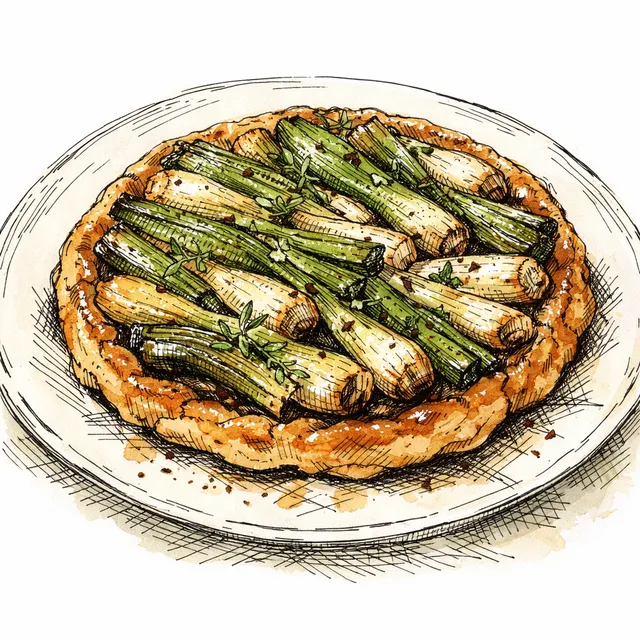
Spring Onion & Black Pepper Tarte Tatin
Growing up in Paris, a tarte tatin meant apples, full stop. But after years baking in the Bay Area, the bundles of spring onions flooding the April farmers markets changed my mind entirely.This Spring Onion and Black Pepper Tarte Tatin is what happens when you treat the humble allium like a café jewel. We braise them in sherry vinegar and cultured butter until deeply jammy. Butter is not a garnish here; it is the foundation. We then blanket the caramelized onions in a 15-minute black pepper rough-puff—lamination-lite for real weeknights—and bake it upside-down. Flipping this skillet is the easiest magic trick you will ever pull off on a Tuesday. The resulting crust bakes up lacy and shattering, never tight like a bad alibi.Make it your own: swap the spring onions for fat leeks or halved shallots, or fold a hard, salty pecorino into the pastry dough.Cami's shortcut note: Grate frozen butter directly into your flour if you hate cutting it in by hand. The fridge is your friend, so keep everything freezing cold.Don't skip this: Let the skillet sit for exactly three minutes out of the oven before flipping. Wobble the pan to check for release. Too soon, and the caramel splatters. Too late, and it turns to glue. We're not suffering for brunch, but we do respect the pan.
Featured Recipe
Spring Onion & Black Pepper Tarte Tatin
This is what happens when you treat the humble spring onion like a café jewel. We braise them in sherry vinegar and cultured butter until jammy, blanket them in a 15-minute black pepper rough-puff, and bake them upside-down. Flipping this skillet is the easiest magic trick you'll pull off on a Tuesday.
Save a copy to your collection for editing
Timeline
Ingredients
- 1 cup all-purpose flour(plus more for dusting)
- 1 tsp kosher salt(divided (1/2 tsp for pastry, 1/2 tsp for onions))
- 1 tsp freshly cracked black pepper(coarse grind preferred)
- 1/2 cup cold cultured butter(1 stick, cut into 1/2-inch cubes)
- 1/4 cup ice water(you may not need it all)
- 1.5 lbs spring onions(about 2 bunches, bulbs halved lengthwise, tough green tops removed)
- 2 tbsp unsalted butter(for the pan caramel)
- 1 tbsp olive oil(keeps the butter from burning)
- 2 tbsp sherry vinegar(apple cider vinegar works in a pinch)
- 1 tbsp honey(mild flavor)
- 4 sprigs fresh thyme sprigs(whole)
- 1 pinch flaky sea salt(for finishing)
- 1/2 tsp kosher salt(Used in step 1 and step 3, but only 1 tsp total is listed.)
- a dusting all-purpose flour(Used for rolling out dough in step 4.)
Instructions
- 1
In a mixing bowl, toss together 1 cup all-purpose flour, 1/2 tsp kosher salt, and 1 tsp freshly cracked black pepper. Drop in 1/2 cup cold cultured butter and use your fingers to smash each cube flat like a coin. Don't rub it into sand—we want visible butter shards for a lacy, shattered crust. Drizzle in 1/4 cup ice water, mixing gently until it just holds together. Shape into a rough block, wrap, and throw it in the fridge.
10 min
Tip: Cami's shortcut note: This is my lamination-lite rough puff. We skip the endless turns. Just smash, hydrate, and chill. Let time do the work in the fridge.
- 2
Preheat your oven to 400°F (200°C). Trim 1.5 lbs spring onions, leaving about an inch of the pale green stems attached to the bulbs. Cut the bulbs in half lengthwise so they lay flat.
5 min
Tip: Save those dark green tops for stock or a weekend frittata. We are not suffering for brunch, but we don't waste good alliums.
- 3
Place a 9 or 10-inch cast-iron skillet over medium heat. Add 2 tbsp unsalted butter and 1 tbsp olive oil. Once foaming, stir in 2 tbsp sherry vinegar, 1 tbsp honey, and the remaining 1/2 tsp kosher salt. Nestle the spring onions into the pan, cut-side down, in a tight concentric circle. Scatter 4 sprigs fresh thyme over the top. Cook undisturbed until the liquid reduces to a sticky, mahogany syrup and the onions are deeply charred on the bottom.
15 min
Tip: Visual cue: You want large, slow, bubbling pockets in the pan sauce. If it's watery, keep going. Butter is not a garnish—it's the foundation of your caramel.
- 4
Remove the skillet from the heat to cool slightly. Pull the dough from the fridge and roll it out on a lightly floured surface into a circle just slightly larger than your skillet, about a 1/4-inch thick. Drape the pastry directly over the warm onions. Use a spoon or blunt knife to quickly tuck the edges of the dough down the inside of the skillet, hugging the onions. Poke three small slits in the center to let steam escape.
5 min
Tip: Don't stress if the dough tears slightly. Pinch it back together. We want rustic, not factory-stamped.
- 5
Bake the skillet on the middle rack for 25 to 30 minutes. You are looking for a pastry that is puffed, dry to the touch, and deeply golden brown. The caramel should be bubbling up around the edges.
30 min
Tip: If the edges are pale, leave it in. Pale pastry tastes like regret. Bake until confident.
- 6
Remove from the oven and set a timer for exactly 5 minutes. Any less and the caramel is dangerously fluid; any more and the onions will cement to the iron. Place a large, flat serving plate over the skillet. Use oven mitts to grip the plate and skillet together, take a breath, and confidently flip them over in one swift motion. Lift the pan off. Finish with 1 pinch flaky sea salt.
5 min
Tip: Troubleshooting: If an onion sticks to the pan, just pluck it out with a fork and nudge it back into the tart. No one will ever know.
Chef's Notes
Serve this warm with a sharp, aggressively dressed mustard-greens salad. The acid cuts right through the buttery richness of the pastry. Leftovers can be revived in a 350°F oven for 10 minutes—never the microwave, which turns rough-puff into a damp sponge.

Camille Roux
Café-level bakes, weeknight methods, zero compromise.
Camille “Cami” Roux was born in Paris with flour in her hair and a healthy skepticism of culinary dogma. She grew up around neighborhood boulangeries that treated crust and crumb like religion—but what stuck with her wasn’t rigid tradition. It was the quiet precision: good butter that actually tastes like milk, patient fermentation that builds flavor for free, and desserts that know when to stop before they get cloying. After moving to the Bay Area, Cami trained in a bread-and-pastry scene obsessed with texture, naturally leavened doughs, and seasonal fruit—Tartine energy, minus the martyrdom. She became known for loaves that sing when they cool, jammy tarts with clean edges, and “how is this so good?” weeknight pastries made with a few smart shortcuts. Her motto is high impact, low fuss: splurge where it counts (butter, salt, time), streamline the rest (sheet pans, one bowl, cold-proofing). If it doesn’t improve flavor or structure, it doesn’t earn a step.