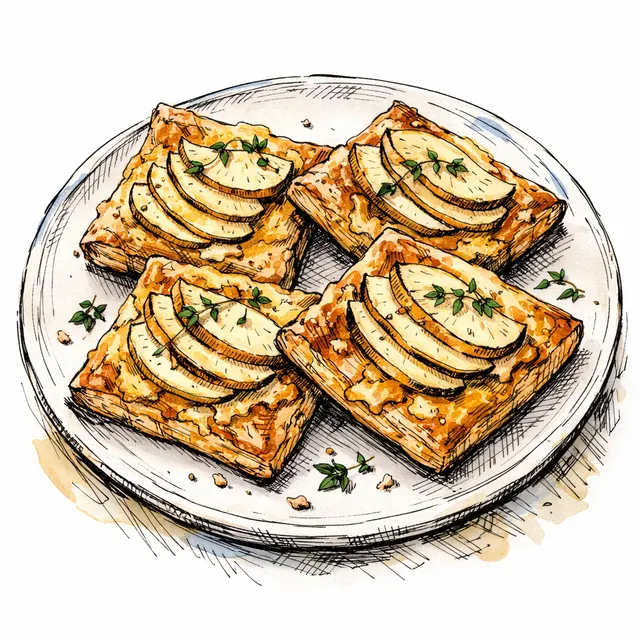
Tart Apple & Aged Cheddar Rough-Puff Carrés
When you want something that tastes like it took all day but actually respects your weeknight sanity, you make these carrés. The inspiration hit me during a crisp autumn afternoon in my Bay Area kitchen, watching leftover sharp farmhouse cheddar beg for a proper pairing. I wanted sweet, tart, and deeply savory all at once without suffering through a multi-hour laminated dough process. We are not suffering for brunch, people. By using a lamination-lite rough-puff method, you get blistering, flaky layers in a fraction of the time. Thinly sliced tart apples bring the brightness, fresh thyme adds an earthy punch, and the whole thing bakes into a bronzed, crispy cheese frico at the edges. Why does it work? Fat and acid play nice together, and high heat guarantees maximum crunch. Cut them into bite-sized squares and serve them warm with a glass of hard cider. Cami's shortcut note: Store-bought all-butter puff pastry works in a pinch, but my quick rough-puff gives you that true bakery-quality lacy crumb. Don't skip the flaky salt right as it comes out of the oven. Butter is not a garnish, and neither is salt.
Featured Recipe
Tart Apple & Aged Cheddar Rough-Puff Carrés
Buttery, shattering rough-puff pastry cut into bite-sized café snacking squares, layered with sharp farmhouse cheddar, paper-thin apples, and fresh thyme. The edges caramelize into deeply bronzed cheese frico while the pastry stays blistered, flaky, and outrageously crisp.
Save a copy to your collection for editing
Timeline
Ingredients
- 240 g all-purpose flour(unbleached, plus extra for rolling)
- 1 tsp fine sea salt
- 170 g cold unsalted European-style butter(82% fat, cut into 1/2-inch cubes and kept ice-cold)
- 100 ml ice water(mixed with 1 tsp apple cider vinegar)
- 2 tbsp Dijon mustard(sharp, whole-grain or smooth)
- 120 g sharp aged cheddar cheese(coarsely grated (aged white cheddar or Montgomery's style))
- 2 medium crisp tart apples (such as Pink Lady or Honeycrisp)(cored, unpeeled, and sliced 1/16-inch thin on a mandoline)
- 1 tbsp fresh thyme leaves(lightly bruised)
- 0.5 tsp freshly cracked black pepper
- 1 large egg(whisked with 1 tsp water for egg wash)
- 1 tbsp runny wildflower honey(warmed, for brushing)
- 0.5 tsp flaky sea salt(such as Maldon)
Instructions
- 1
In a wide mixing bowl, whisk 240 g all-purpose flour and 1 tsp fine sea salt. Toss in 170 g cold unsalted European-style butter cubes to coat. Using your thumbs and forefingers, press each butter cube flat into a rustic nickel-sized shingle. Do not rub down into meal; you want broad sheets of visible cold fat.
5 min
Tip: Visible butter shingles create the steam pockets that puff the pastry into lacy, delicate layers without a four-hour laminating ordeal.
- 2
Drizzle 100 ml ice water over the flour-butter mixture. Using a flexible bench scraper or fork, gently toss and fluff the mixture until loose, ragged clumps form. Tip the mass onto a clean counter and press it firmly into a rough 6x8-inch rectangle. It will look shaggy and slightly dry—that is exactly right.
4 min
Tip: Resist the urge to add extra water. Excess liquid activates too much gluten and yields a tough, tight crumb.
- 3
Dust the counter lightly with flour. Roll the rough dough into a 6x12-inch strip. Fold the bottom third up and the top third down like a business letter (turn one). Rotate 90 degrees, roll out to 6x12 inches again, and repeat the letter fold (turn two). Wrap tightly and chill in the refrigerator for 20 minutes to reset the fat.
6 min
Tip: Keep the edges neat and square by tapping the sides with your rolling pin before each roll.
- 4
While the dough chills, preheat your oven to 415°F (212°C) with a heavy baking sheet set on the center rack. Core and thinly slice 2 medium crisp tart apples on a mandoline. Toss slices gently in a bowl with 1 tbsp fresh thyme leaves and 0.5 tsp freshly cracked black pepper.
8 min
Tip: Preheating the baking sheet ensures immediate bottom-heat transfer, stopping butter leakage before the steam puffs the crust.
- 5
Remove the chilled rough puff from the fridge. Roll it on a lightly floured surface into a 10x15-inch rectangle, roughly 1/8-inch thick. Trim ragged edges flush with a chef's knife. Slice the dough into 12 even 3x3-inch squares (carrés). Transfer the cut squares to a sheet of parchment paper, leaving 1/2 inch between them.
6 min
Tip: Always cut with a sharp knife pressed straight down; never saw or drag, which pinches the delicate butter layers shut.
- 6
Brush the center of each pastry square with a thin film of 2 tbsp Dijon mustard, leaving a 1/4-inch clean border. Scatter 120 g sharp aged cheddar cheese evenly across the mustard. Fan 3 to 4 overlapping slices of 2 medium crisp tart apples diagonally over the cheese on each square. Brush the exposed pastry edges lightly with 1 large egg wash.
5 min
Tip: The mustard provides acidity that cuts the rich dairy, while cheese underneath anchors the apples without soggy pastry.
- 7
Slide the parchment with the assembled carrés onto the preheated baking sheet in the oven. Bake at 415°F (212°C) for 20 to 24 minutes, until the pastry borders are towering, deep mahogany-gold, and the cheddar edges have caramelized into crisp, lace-like fricos.
22 min
Tip: Look for deep chestnut color on the pastry rim; pale pastry means raw internal layers and zero flake.
- 8
Transfer the carrés to a wire rack. Immediately dab the warm apple slices with 1 tbsp runny wildflower honey and sprinkle with 0.5 tsp flaky sea salt. Let rest for 5 minutes so the bottom crust sets and crisps before serving warm.
5 min
Tip: That tiny brush of honey glazes the fruit and binds the salty, sharp cheese flavor together.
Chef's Notes
Cami's shortcut note: This rough-puff dough bypasses the tedious four-hour block-lamination method using shingled butter and two rapid letter turns. It delivers 80% of classic feuilletage flake for 20% of the effort. Don't skip chilling the dough after the turns—warm butter turns into grease on your board instead of flaky lifts in your oven. If you have extra dough, keep it frozen wrapped tightly for up to a month.

Camille Roux
Café-level bakes, weeknight methods, zero compromise.
Camille “Cami” Roux was born in Paris with flour in her hair and a healthy skepticism of culinary dogma. She grew up around neighborhood boulangeries that treated crust and crumb like religion—but what stuck with her wasn’t rigid tradition. It was the quiet precision: good butter that actually tastes like milk, patient fermentation that builds flavor for free, and desserts that know when to stop before they get cloying. After moving to the Bay Area, Cami trained in a bread-and-pastry scene obsessed with texture, naturally leavened doughs, and seasonal fruit—Tartine energy, minus the martyrdom. She became known for loaves that sing when they cool, jammy tarts with clean edges, and “how is this so good?” weeknight pastries made with a few smart shortcuts. Her motto is high impact, low fuss: splurge where it counts (butter, salt, time), streamline the rest (sheet pans, one bowl, cold-proofing). If it doesn’t improve flavor or structure, it doesn’t earn a step.