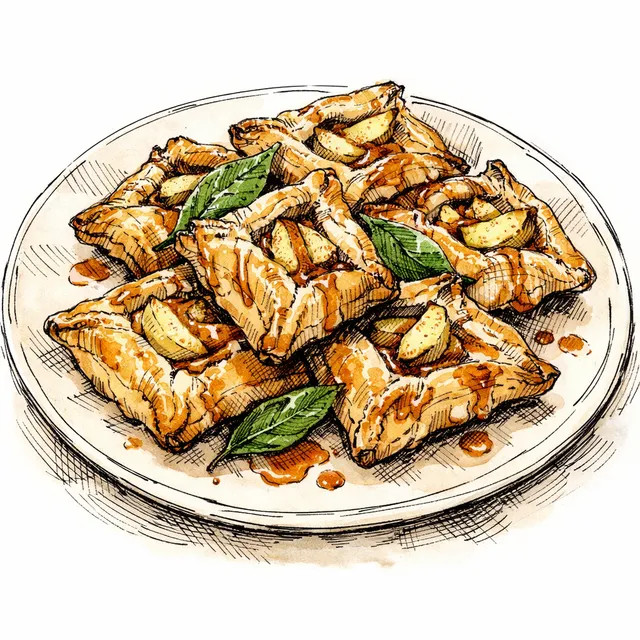
Tart Apple & Bay Leaf Caramel Rough-Puff Paniers
We are not suffering for brunch, and we certainly aren't spending three days on laminated pastry. When I want café-level bakery magic without canceling my Sunday, I make these paniers. The inspiration hit me during a crisp autumn afternoon in my kitchen when I had a surplus of sharp Granny Smith apples and a fresh branch of bay laurel. Bay leaves are criminally underused in sweets; steeped in a quick caramel, they lend a subtle, herbal depth that cuts right through the sugar. Butter is not a garnish here—our rough-puff pastry gives you those lacy, shatteringly crisp layers with minimal fuss. Fold the corners into open-faced baskets, let time do the work in a hot oven, and watch them disappear. Want to make it your own? Swap the apples for firm pears or tart plums depending on what's sitting on your counter. Don't skip the flaky salt on the finish; it anchors the whole bite.
Featured Recipe
Tart Apple & Bay Leaf Caramel Rough-Puff Paniers
Buttery, flaky rough-puff corners folded into open-faced café baskets, cradling tart Granny Smith apples and an intensely aromatic bay leaf quick-caramel. The contrast between lacy pastry layers and puckery, tender fruit is afternoon baking at its absolute best.
Save a copy to your collection for editing
Timeline
Ingredients
- 240 g all-purpose flour(plus extra for rolling)
- 225 g unsalted cultured butter(cold, cut into 1/2-inch cubes)
- 5 g fine sea salt(divided)
- 120 ml ice water(very cold)
- 2 medium Granny Smith apples(peeled, cored, and sliced into 1/8-inch half-moons)
- 65 g light brown sugar(packed)
- 2 fresh bay leaves(bruised with the back of a knife)
- 1 tbsp lemon juice(freshly squeezed)
- 1 large egg(beaten with 1 tsp water for egg wash)
- 2 tbsp demerara sugar(for crunchy exterior topping)
- 1/2 tsp flaky sea salt(such as Maldon, for finishing)
Instructions
- 1
Toss 240 g all-purpose flour and 4 g fine sea salt together in a wide bowl. Drop in 225 g unsalted cultured butter and press the cubes flat between your thumb and fingertips until they resemble large walnut shells—keep visible sheets of butter intact; do not rub into fine crumbs.
5 min
Tip: Visible butter flats equal soaring steam layers. If your kitchen is warm, chill the bowl for 5 minutes before adding water.
- 2
Drizzle 120 ml ice water over the flour mixture and use a flexible bench scraper or fork to gather the shaggy mass together into a rough brick. Wrap tightly in parchment and rest in the refrigerator to relax the gluten.
20 min
Tip: It will look dry and messy; moisture redistributes naturally while resting in the cold.
- 3
While the dough rests, combine 65 g light brown sugar, 1 tbsp lemon juice, 2 fresh bay leaves, and the remaining 1 g fine sea salt in a small saucepan over medium-low heat until the sugar dissolves into a bubbling syrup, about 3 minutes. Remove from heat, toss in 2 medium Granny Smith apples, and let the fruit soften slightly off the heat as the bay perfumes the juices.
10 min
Tip: Bay leaf imparts an herbal, tea-like resonance that cuts right through rich butter and sharp fruit acid.
- 4
Preheat your oven to 400°F (205°C) and line a heavy baking sheet with parchment paper.
15 min
Tip: Ensure the baking sheet is completely cold before loading pastries so the butter stays firm until oven heat hits.
- 5
Turn the chilled dough onto a lightly floured counter. Roll into a roughly 8x16-inch rectangle, then fold into thirds like a business letter (turn one). Rotate 90 degrees, roll out again to the same dimensions, and fold into thirds once more (turn two).
7 min
Tip: Square up your edges with the heel of your hand before each roll to keep the lamination clean and even.
- 6
Roll the pastry out to a 10x15-inch rectangle about 1/8-inch thick. Trim ragged edges, then slice cleanly into six 5-inch squares. Transfer the squares to the prepared baking sheet and chill for 10 minutes.
10 min
Tip: Press straight down with your wheel or knife without dragging to avoid pinching closed the delicate cut layers.
- 7
Discard the bay leaves from the apple mixture. Arrange the apple slices neatly in the center of each square, reserving the pan juices. Fold two opposite diagonal corners of pastry over the apples to meet in the middle, pressing firmly where they overlap to lock them in a basket (panier) shape.
6 min
Tip: A tiny dab of water where the two pastry points overlap acts as edible glue so the basket won't pop open during the bake.
- 8
Brush the pastry tops with 1 large egg wash, then sprinkle with 2 tbsp demerara sugar. Spoon a teaspoon of the reserved bay-caramel syrup directly over the exposed center apples of each pastry.
4 min
Tip: Avoid letting egg wash pool onto the parchment paper around the edges, which would glue down the rising puff.
- 9
Bake at 400°F (205°C) until the pastry rises dramatically, the edges turn deep golden brown, and the apple juices bubble furiously, 24 to 28 minutes.
26 min
Tip: Look for a crisp mahogany bottom crust; don't pull them pale or the inner layers will stay gummy.
- 10
Transfer the paniers to a wire cooling rack and immediately dust with 1/2 tsp flaky sea salt. Let cool for at least 15 minutes before biting in so the caramel sets and the crumb stays crisp.
15 min
Tip: Eating these piping hot softens the crust prematurely; warm-to-room-temperature yields maximum shatter.
Chef's Notes
Cami's shortcut note: Two simple envelope folds give you 90% of classic puff pastry's loft with zero lamination headache. Butter is not a garnish—use cultured European-style butter here for distinct layers that shatter instead of turning greasy. Don't skip this: Granny Smiths are non-negotiable because their pectin and bracing acidity stand up to hot caramel without collapsing into baby food.

Camille Roux
Café-level bakes, weeknight methods, zero compromise.
Camille “Cami” Roux was born in Paris with flour in her hair and a healthy skepticism of culinary dogma. She grew up around neighborhood boulangeries that treated crust and crumb like religion—but what stuck with her wasn’t rigid tradition. It was the quiet precision: good butter that actually tastes like milk, patient fermentation that builds flavor for free, and desserts that know when to stop before they get cloying. After moving to the Bay Area, Cami trained in a bread-and-pastry scene obsessed with texture, naturally leavened doughs, and seasonal fruit—Tartine energy, minus the martyrdom. She became known for loaves that sing when they cool, jammy tarts with clean edges, and “how is this so good?” weeknight pastries made with a few smart shortcuts. Her motto is high impact, low fuss: splurge where it counts (butter, salt, time), streamline the rest (sheet pans, one bowl, cold-proofing). If it doesn’t improve flavor or structure, it doesn’t earn a step.