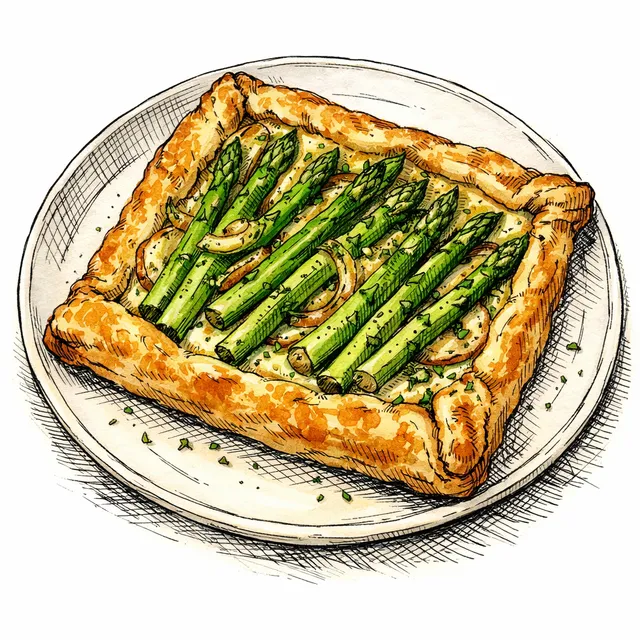
Weeknight Asparagus & Mustard-Cream Slab Galette
I grew up in Paris, where grabbing a beautiful, shattered savory tart from the corner boulangerie (bakery) was standard Tuesday behavior. In the Bay Area, finding that same effortless crunch meant either paying a premium or spending a weekend laminating dough. We're not suffering for weeknight dinner.
This Weeknight Asparagus & Mustard-Cream Slab Galette is the answer. The inspiration? Pure exhaustion meeting a fierce craving for butter. I developed a lamination-lite rough puff that builds right on the counter. You smash the butter into shards, fold it twice, and let time do the work in the fridge.
What makes this special is the slab format. Rolling it out into a large rectangle gives you maximum crust-to-crumb ratio. We swipe it with cultured cream spiked with sharp Dijon, then tile fat, local asparagus spears right on top.
Cami's shortcut note: Bake this directly on a preheated sheet pan. The blast of bottom heat hits the cold butter instantly, creating explosive steam. A soggy bottom is physically impossible, and your crust bakes up lacy, never tight like a bad alibi.
Make it yours: Swap asparagus for seasonal summer squash or add Gruyère. Just remember: butter is not a garnish.
Featured Recipe
Weeknight Asparagus & Mustard-Cream Slab Galette
This is how we do weeknight savory pastry without suffering. A lamination-lite rough puff built directly on the counter, swiped with sharp cultured cream, and tiled with fat asparagus spears. The crust bakes up lacy and shattered, the asparagus snaps, and baking directly on a preheated sheet pan means a soggy bottom is physically impossible.
Save a copy to your collection for editing
Timeline
Ingredients
- 1.5 cups All-purpose flour(Plus more for dusting)
- 1 tsp Flaky sea salt
- 10 tbsp Cold cultured butter(Cubed)
- 1 tbsp Apple cider vinegar(Acid inhibits gluten formation for a tender crust)
- 1/4 cup Ice water(Must be freezing cold)
- 1 lb Thick asparagus spears(Woody ends snapped off)
- 1 tbsp Olive oil
- 1/3 cup Crème fraîche(Or high-fat sour cream)
- 2 tbsp Whole grain Dijon mustard
- 1 tbsp Fresh tarragon(Finely chopped)
- 1/2 tsp Black pepper(Freshly cracked)
- 1 tbsp Heavy cream(For brushing the crust)
- 1 oz Pecorino Romano(Freshly grated)
- 1 tsp Lemon zest
Instructions
- 1
Toss 1.5 cups all-purpose flour and 1 tsp flaky sea salt in a large bowl. Smash in 10 tbsp cold cultured butter until you have walnut-sized, flat pieces. Drizzle in 1 tbsp apple cider vinegar and 1/4 cup ice water, tossing with your hands until it just holds together when squeezed. Butter is not a garnish here—leave the chunks big. They steam in the oven to create lacy, shattered layers. Overwork it, and the crumb goes tight like a bad alibi.
10 min
Tip: If the butter starts feeling greasy or soft, immediately put the bowl in the freezer for 5 minutes.
- 2
Dump the shaggy dough onto the counter. Pat it into a rough rectangle and fold it in thirds like a business letter. Turn it 90 degrees and fold in thirds one more time. Wrap tightly in parchment or plastic and stash it in the fridge. The fridge is your friend; cold dough equals flake.
30 min
Tip: This is lamination-lite. Two folds give you cafe-level layers with zero compromise.
- 3
Place a heavy, rimless baking sheet (or an inverted rimmed baking sheet) on the lowest oven rack. Preheat your oven to 400°F (200°C). Baking directly on screaming hot metal shocks the pastry, ensuring a crispy bottom crust.
30 min
Tip: Don't skip this. A preheated pan is the absolute key to avoiding a soggy bottom.
- 4
Trim your 1 lb thick asparagus spears by snapping off the woody ends—they will naturally break exactly where they need to. Toss them on a plate with 1 tbsp olive oil and a pinch of salt. The oil prevents the delicate tips from burning to a crisp before the pastry is done.
5 min
Tip: Always choose thick spears for roasting; pencil-thin asparagus will turn to string in a 400°F oven.
- 5
In a small bowl, whisk together 1/3 cup crème fraîche, 2 tbsp whole grain Dijon mustard, 1 tbsp fresh tarragon, and 1/2 tsp black pepper. This sharp, tangy base cuts through the butter crust and anchors the vegetables.
5 min
Tip: Crème fraîche (cultured cream) won't split under high heat the way regular cream might.
- 6
Pull the chilled dough from the fridge. On a large sheet of parchment paper, roll it into a 14x10-inch oval or rectangle, about 1/8-inch thick. If the dough fights you and springs back, walk away. Let time do the work. Give it 5 minutes to relax on the counter, then resume.
5 min
Tip: Roll out directly on the parchment so you don't have to awkwardly transfer the fragile dough later.
- 7
Spread the mustard cream evenly over the dough, leaving a generous 1.5-inch border. Tile the oiled asparagus straight across the cream in a single, tight layer. Fold the dough border up and over the ends of the asparagus, pleating the corners so they hold. Brush the exposed pastry edges with 1 tbsp heavy cream.
5 min
Tip: Keep the asparagus closely packed—they shrink slightly as they roast.
- 8
Using a peel or a flat cutting board, carefully slide the parchment with the galette directly onto the preheated baking sheet in the oven. Bake until the crust is deeply golden brown and the asparagus is tender and visibly blistered. Don't pull it early; pale pastry is a tragedy.
35 min
Tip: Look for the heavy cream wash to turn a rich, lacquered mahogany. That's flavor.
- 9
Remove the galette from the oven. While it's still piping hot, immediately shower it with 1 oz Pecorino Romano and 1 tsp lemon zest. The residual heat will melt the cheese into a savory lacing over the spears. Let it rest for 10 minutes to let the cream base set before slicing into squares.
10 min
Tip: Slicing too early causes the mustard cream to run. Patience pays out in neat, beautiful slices.
Chef's Notes
Cami's shortcut note: We're not suffering for a weeknight dinner. Make the dough on Sunday and let it live in the fridge. By Wednesday, it's practically begging to be rolled out. The slab format guarantees maximum crust-to-crumb ratio, meaning everybody gets a corner piece.

Camille Roux
Café-level bakes, weeknight methods, zero compromise.
Camille “Cami” Roux was born in Paris with flour in her hair and a healthy skepticism of culinary dogma. She grew up around neighborhood boulangeries that treated crust and crumb like religion—but what stuck with her wasn’t rigid tradition. It was the quiet precision: good butter that actually tastes like milk, patient fermentation that builds flavor for free, and desserts that know when to stop before they get cloying. After moving to the Bay Area, Cami trained in a bread-and-pastry scene obsessed with texture, naturally leavened doughs, and seasonal fruit—Tartine energy, minus the martyrdom. She became known for loaves that sing when they cool, jammy tarts with clean edges, and “how is this so good?” weeknight pastries made with a few smart shortcuts. Her motto is high impact, low fuss: splurge where it counts (butter, salt, time), streamline the rest (sheet pans, one bowl, cold-proofing). If it doesn’t improve flavor or structure, it doesn’t earn a step.