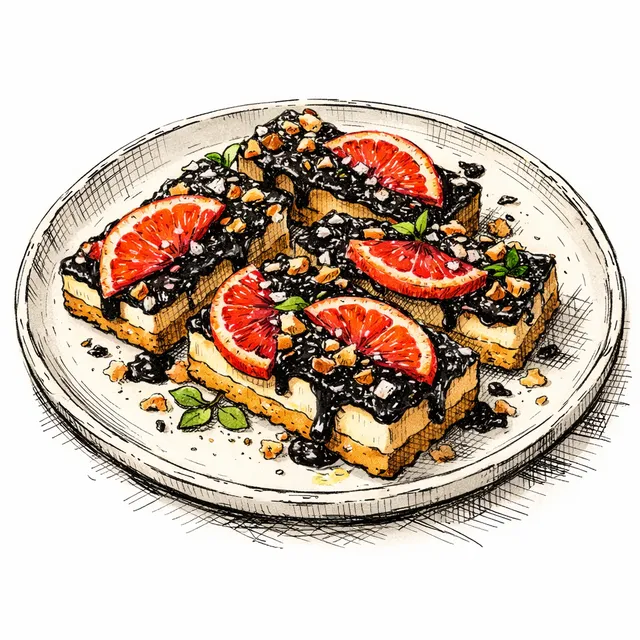
Winter Blood Orange–Tahini Sablé Bars with Black Sesame Praliné & Flaky Salt
I wrote these bars for that specific January feeling: gray sky, tired palate, craving something bright but not sugary. Think Paris sablés (butter shortbread) with a Bay Area twist—tahini for nuttiness, blood orange for bite, and a black sesame praliné that snaps like thin caramel and smells like toasted sunshine.
The inspiration is half marché, half memory. Growing up in Paris, winter citrus was the one cheerful thing in the kitchen—my mother would tuck orange slices beside butter cookies, like a little wink. Years later in California, I tasted tahini in a cookie and thought: that’s the grown-up cousin of my childhood sablé.
What makes this recipe special to me is the texture stack. The base is sandy-tender, the fruit layer goes jammy and sharp, and the sesame praliné gives you that crackle. Not too sweet. Clean finish. Butter is not a garnish.
Make it yours: swap blood orange for grapefruit + a spoon of honey, or fold toasted hazelnuts into the crust. Add a pinch of cardamom if you like perfume.
Cami’s shortcut note: press the dough straight into the pan—no fussy shaping.
Don’t skip this: flaky salt on top. Under-salted pastry is just sweet cardboard.
Featured Recipe
Winter Blood Orange–Tahini Sablé Bars with Black Sesame Praliné & Flaky Salt
These are Paris sablés (butter shortbread) rewritten for January: nutty tahini in the crust, a sharp-jammy blood orange layer, and a crackly black sesame praliné that tastes like toasted sunshine. They’re not too sweet, the edges go crisp, the center stays tender, and the whole thing slices like a dream. Weeknight-friendly, café-level—because we’re not suffering for brunch.
Save a copy to your collection for editing
Ingredients
- 170 g Unsalted cultured European-style butter, cold, cubed(Plus extra for pan)
- 90 g Granulated sugar(Keeps the crumb sandy, not cakey)
- 30 g Light brown sugar(Optional but nice for caramel depth)
- 6 g Fine sea salt(Under-salted pastry is just sweet cardboard)
- 70 g Tahini (well-stirred)(Choose a pourable, not-bitter brand)
- 1 Egg yolk(For richness and sliceability)
- 1 tsp Vanilla bean paste or extract(Judicious, not perfumey)
- 230 g All-purpose flour(Weigh it—sablé is a precision game)
- 20 g Rice flour or cornstarch(Rice flour gives extra snap; cornstarch is fine)
- 2 Blood oranges, zested(Zest only; avoid bitter pith)
- 180 g Blood orange juice (fresh)(From about 3–4 oranges)
- 15 g Lemon juice (fresh)(Brightens and stabilizes the citrus flavor)
- 80 g Granulated sugar (for curd layer)(Adjust +/− 10g depending on orange sweetness)
- 2 Eggs(Whole eggs for a clean-set curd)
- 8 g Cornstarch(Insurance for a neat slice)
- 30 g Unsalted butter (for curd), cubed(Silk without heaviness)
- 35 g Black sesame seeds(Toasted if yours are pale and raw)
- 15 g White sesame seeds(Optional—adds sweetness and crunch)
- 100 g Granulated sugar (for praliné)(Caramel for the sesame brittle)
- 25 g Water(Helps the caramel start evenly)
- 1 pinch Baking soda(Optional: a little aeration for a lighter crunch)
- 1 tsp Flaky sea salt(To finish—don’t be shy)
Instructions
- 1
Heat oven to 175°C / 350°F. Line an 20 cm / 8-inch square pan with parchment, leaving overhang for lifting. Butter the pan under the parchment so it doesn’t skate around.
8 min
Tip: Metal pan = cleaner edges. Glass runs hotter and can over-brown the crust.
- 2
Make the tahini sablé base: In a bowl, rub (or cut) 170 g Unsalted cultured European-style butter, cold, cubed into 90 g Granulated sugar, 30 g Light brown sugar, 6 g Fine sea salt, and 2 Blood oranges, zested until it looks like damp sand with a few pea-size bits. Stir in 70 g Tahini (well-stirred), 1 Egg yolk, and 1 tsp Vanilla bean paste or extract just to combine.
10 min
Tip: Why it works: keeping butter cold means a sandy, crisp sablé—not a dense cookie cake.
- 3
Add 230 g All-purpose flour and 20 g Rice flour or cornstarch. Mix with a spatula until no dry flour remains. It will look shaggy and a little dry—good. Press about 2/3 of the dough firmly into the lined pan in an even layer. Crumble the remaining 1/3 into the fridge (it’ll become the top ‘streusel’ later).
10 min
Tip: Non-negotiable: press hard. Loose packing = crumbly slices.
- 4
Par-bake the base until set and just turning pale gold at the edges, 16–18 minutes.
18 min
Tip: Your oven must be fully preheated. Timid heat makes greasy sablé.
- 5
While the base bakes, whisk 180 g Blood orange juice (fresh), 15 g Lemon juice (fresh), 80 g Granulated sugar (for curd layer), 2 Eggs, and 8 g Cornstarch in a small pot until smooth. Cook over medium heat, whisking constantly, until thick like warm pudding and the whisk leaves trails, 4–6 minutes. Off heat, whisk in 30 g Unsalted butter (for curd), cubed until glossy.
8 min
Tip: If you see little eggy bits, don’t panic—push through a fine sieve. Precision over pride.
- 6
Pour the hot blood orange curd over the hot par-baked base. Scatter the chilled crumbles of remaining dough evenly over the top (some curd showing is perfect). Return to the oven and bake until the center has a gentle wobble (not sloshy), 14–16 minutes.
16 min
Tip: Checkpoint: the curd should jiggle like set jam, not wave like soup.
- 7
Cool completely at room temp, then chill 2 hours (or overnight) before topping and slicing. Cold bars cut clean; warm bars cut like a bad alibi.
120 min
Tip: Fridge is your friend scheduling: bake tonight, slice tomorrow.
- 8
Make black sesame praliné: Line a small tray with parchment. In a small saucepan, combine 100 g Granulated sugar (for praliné) and 25 g Water. Cook without stirring until amber. Swirl, then add 35 g Black sesame seeds (and 1 pinch Baking soda if using). Stir quickly, pour onto parchment, and spread thin. Cool hard, 10 minutes.
20 min
Tip: Keep it thin for shattery crunch. Thick praliné turns tooth-breaking.
- 9
Crush the praliné into gravel: Use a rolling pin over a bag, or pulse briefly in a food processor. Sprinkle over chilled bars and finish with 1 tsp Flaky sea salt and 15 g White sesame seeds. Lift out, slice into 12–16 bars with a hot dry knife (wipe between cuts).
10 min
Tip: Don’t skip this: flaky salt on top. It snaps the sesame and makes the citrus taste louder.
Chef's Notes
This one’s personal: in Paris winters, the light is stingy and the cafés keep you alive—shortbread, citrus, and that little bitter edge that makes sweet taste grown-up. Tahini is my quiet shortcut here: it gives the sablé a nutty depth without hauling out almonds, and it plays beautifully with sesame praliné. Cami’s shortcut note: You can swap blood oranges for Cara Cara or navel if that’s what your market has—just keep the lemon juice for brightness. Don’t skip this: Chill before slicing. Warm curd is delicious, but it will not behave.

Camille Roux
Café-level bakes, weeknight methods, zero compromise.
Camille “Cami” Roux was born in Paris with flour in her hair and a healthy skepticism of culinary dogma. She grew up around neighborhood boulangeries that treated crust and crumb like religion—but what stuck with her wasn’t rigid tradition. It was the quiet precision: good butter that actually tastes like milk, patient fermentation that builds flavor for free, and desserts that know when to stop before they get cloying. After moving to the Bay Area, Cami trained in a bread-and-pastry scene obsessed with texture, naturally leavened doughs, and seasonal fruit—Tartine energy, minus the martyrdom. She became known for loaves that sing when they cool, jammy tarts with clean edges, and “how is this so good?” weeknight pastries made with a few smart shortcuts. Her motto is high impact, low fuss: splurge where it counts (butter, salt, time), streamline the rest (sheet pans, one bowl, cold-proofing). If it doesn’t improve flavor or structure, it doesn’t earn a step.