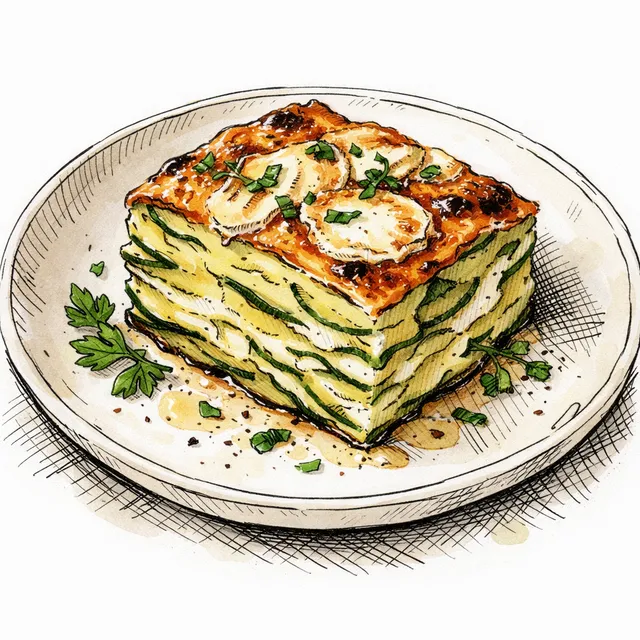
Zucchini & Chèvre Gâteau Invisible: High-Impact, Low-Fuss
Growing up in Paris, I'd stare at café windows showcasing these towering, stratified vegetable cakes. They looked like impossible feats of pastry architecture. Years later in a cramped Bay Area kitchen, I realized the secret wasn't technique. It was just a sharp blade.This gâteau invisible (invisible cake) relies on one trick: slicing zucchini paper-thin so it practically melts into a savory, browned-butter batter. The batter disappears into the vegetable, leaving a lacy slab suspended with bright, tangy pockets of chèvre (goat cheese). We're not suffering for brunch, and the mandoline is doing all the heavy lifting.I love this recipe because it scales perfectly for a slab format, maximizing those crispy, caramelized edges. Butter is not a garnish here—it is the foundation.Make it your own: Swap the chèvre for gruyère, or toss in some toasted pine nuts.Cami's shortcut note: Don't bother peeling the zucchini. The skin adds structure and color.Don't skip this: Let the browned butter cool slightly before mixing. Hot butter scrambles eggs, resulting in a crumb tight like a bad alibi. You want a glossy batter that bakes up with a firm, custard-like wobble.
Featured Recipe
Zucchini & Chèvre Gâteau Invisible
This 'invisible cake' is a Parisian café window staple that relies on a single trick: slicing zucchini paper-thin so it melts into a savory, browned-butter batter. The result is a lacy, stratified slab punctuated by bright pockets of goat cheese. It looks like high-level French pastry architecture, but the mandoline does all the heavy lifting.
Save a copy to your collection for editing
Timeline
Ingredients
- 4 tbsp unsalted butter(cultured if possible, plus more for greasing)
- 3 large eggs(room temperature)
- 1/2 cup whole milk
- 2/3 cup all-purpose flour
- 1.5 tsp baking powder
- 1.5 tsp kosher salt(Diamond Crystal)
- 2 cloves garlic(grated or minced to a paste)
- 1 tsp lemon zest(freshly grated)
- 1 tbsp fresh thyme(leaves only, chopped)
- 1.5 lbs zucchini(about 3-4 medium, ends trimmed)
- 5 oz fresh goat cheese(chèvre, crumbled)
- 2 tbsp Parmigiano-Reggiano(finely grated, for the crust)
Instructions
- 1
Place 4 tbsp unsalted butter in a small skillet over medium heat. Let it melt, foam, and eventually toast until the milk solids drop to the bottom and smell deeply nutty. Butter is not a garnish here; browning it provides the backbone to an otherwise delicate batter. Pour immediately into a large mixing bowl to cool slightly.
5 min
Tip: Watch it closely once it starts bubbling—the line between browned and burned is about 15 seconds.
- 2
Preheat your oven to 375°F (190°C). Grease an 8x4-inch loaf pan and line it with a parchment paper sling, leaving overhang on the long sides for easy removal later.
5 min
Tip: Using a metal pan rather than glass will give you better, crisper edges.
- 3
To the cooled butter, add the 3 large eggs and whisk vigorously until smooth. Whisk in the 1/2 cup whole milk, followed by the 2/3 cup all-purpose flour, 1.5 tsp baking powder, 1.5 tsp kosher salt, 2 cloves garlic, 1 tsp lemon zest, and 1 tbsp fresh thyme. Whisk until a smooth, thin batter forms.
5 min
Tip: It should look like very thin crepe batter. This is exactly what we want.
- 4
Using a mandoline on its thinnest setting (about 1/16-inch), slice the 1.5 lbs zucchini directly into the bowl of batter. Toss gently but thoroughly with your hands, separating the slices so every single piece is slicked with batter. Don't rush this—clumped, uncoated slices mean a tight crumb like a bad alibi.
5 min
Tip: If you don't have a mandoline, use a Y-peeler to create ribbons. Knife slicing is usually too thick and will yield a chunky frittata, not a lacy cake.
- 5
Layer about one-third of the coated zucchini into the prepared pan, laying the slices as flat as possible to build structure. Scatter half of the 5 oz fresh goat cheese evenly over the vegetables. Add another third of the zucchini, the remaining goat cheese, and finally top with the rest of the zucchini. Pour any residual batter from the bowl over the top.
5 min
Tip: Press down firmly with your hands after the final layer to compress out any air pockets.
- 6
Sprinkle the 2 tbsp Parmigiano-Reggiano evenly across the surface. Bake until the top is deeply golden, the cake is puffed, and a knife inserted into the center meets absolutely no resistance from the zucchini.
60 min
Tip: Look for a firm wobble. If the top gets too dark before the center is tender, tent it loosely with foil.
- 7
Remove from the oven and let it cool in the pan on a wire rack for at least 45 minutes. This is non-negotiable. If you try to slice it piping hot, you will trigger a structural collapse. Let time do the work.
45 min
Tip: Once cooled, use the parchment overhang to lift it cleanly out of the pan onto a cutting board.
Chef's Notes
Cami's shortcut note: The fridge is your absolute best friend here. This gâteau is actually vastly superior on day two. Bake it Sunday, chill it overnight in the pan. On Monday, pull it out, slice off a thick, beautifully defined slab, and sear it in a hot skillet with a little olive oil until the edges crisp up. Serve with a bitter greens salad dressed heavily in lemon. We're not suffering for lunch.

Camille Roux
Café-level bakes, weeknight methods, zero compromise.
Camille “Cami” Roux was born in Paris with flour in her hair and a healthy skepticism of culinary dogma. She grew up around neighborhood boulangeries that treated crust and crumb like religion—but what stuck with her wasn’t rigid tradition. It was the quiet precision: good butter that actually tastes like milk, patient fermentation that builds flavor for free, and desserts that know when to stop before they get cloying. After moving to the Bay Area, Cami trained in a bread-and-pastry scene obsessed with texture, naturally leavened doughs, and seasonal fruit—Tartine energy, minus the martyrdom. She became known for loaves that sing when they cool, jammy tarts with clean edges, and “how is this so good?” weeknight pastries made with a few smart shortcuts. Her motto is high impact, low fuss: splurge where it counts (butter, salt, time), streamline the rest (sheet pans, one bowl, cold-proofing). If it doesn’t improve flavor or structure, it doesn’t earn a step.