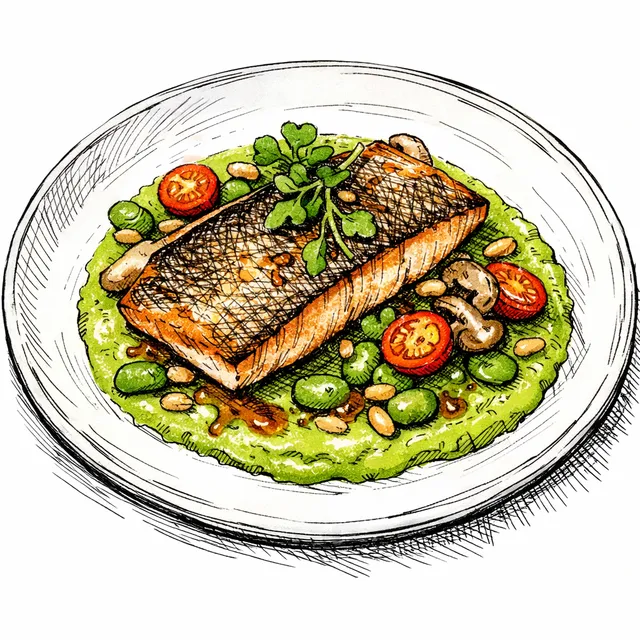
The Alpine Keystone: Pan-Seared Trout with a Fava Bean Emulsion
Architecture has taught me that the most breathtaking structures rely on a hidden, unyielding foundation. Growing up, my grandmother would spend hours near Lake Maggiore, coaxing flavor out of Alpine catches. As a busy designer in modern Milan, I simply do not have her luxury of time. This dish, The Alpine Keystone, is my modern blueprint for her nostalgic lake trout. The inspiration came to me while sketching a vaulted ceiling; I realized a great pan sauce behaves exactly like an architectural keystone. Here, the technique of emulsification binds vibrant, spring-green fava beans, a sharp splash of dry vermouth, and cold compound butter into a glossy, load-bearing mortar. This emulsion acts as the structural integrity of the dish, perfectly supporting the delicate, pan-seared trout. It is incredibly special to me because it beautifully bridges my Piedmontese roots with my fast-paced metropolitan reality. If you want to make it your own, consider swapping the fava beans for sweet peas, or add a decorative flourish of fried fresh sage on top. Remember, weeknight cooking should feel like an escape, not a chore. Let the ingredients do the heavy lifting.
Featured Recipe
The Alpine Keystone: Pan-Seared Trout with a Fava Bean Emulsion
Like a beautifully designed arch, a great pan sauce relies on a solid keystone. In this effortless weeknight dish, the technique of emulsification binds vibrant fava beans, dry vermouth, and cold butter into a glossy, load-bearing mortar for delicate, pan-seared trout. Let the ingredients do the heavy lifting, giving you an escape to the tranquil lakes of Northern Italy in under twenty minutes.
Save a copy to your collection for editing
Timeline
Ingredients
- 4 fillets Trout fillets(About 6 oz each, skin-on)
- 1.5 cups Double-peeled fava beans(Frozen and thawed. High-quality frozen favas are my favorite weeknight shortcut.)
- 1/3 cup Dry vermouth(Provides an architectural acidity)
- 1/2 cup Premium chicken brodo(Store-bought is perfectly fine if it's high quality)
- 4 tbsp Cold unsalted butter(Cubed, crucial for the emulsion)
- 6 leaves Fresh sage leaves(Roughly torn)
- 1 medium Shallot(Finely diced)
- 1 tbsp Olive oil(For searing)
- 1 tsp Kosher salt(Divided)
- 1/2 tsp Black pepper(Freshly ground)
- 1/2 tsp kosher salt(for seasoning)
- 1/4 tsp black pepper(for seasoning)
Instructions
- 1
Take half of your 1.5 cups double-peeled fava beans (about 3/4 cup double-peeled fava beans) and roughly mash them with a fork in a small bowl. This mashed portion will act as the structural aggregate for our emulsion, while the rest will be left whole for decorative texture.
3 min
Tip: Don't over-mash; you want a rustic, coarse texture to help thicken the pan sauce.
- 2
Pat the 4 trout fillets completely dry and season with 1/2 tsp kosher salt and 1/4 tsp black pepper. Heat the 1 tbsp olive oil in a large, heavy-bottomed skillet over medium-high heat. Place the trout skin-side down. Press gently so the skin makes full contact with the pan. Sear undisturbed until the skin is crisp and the fish is nearly cooked through, then flip for just 30 seconds. Remove to a plate.
6 min
Tip: Trout cooks remarkably fast. Think of the crispy skin as the cantilevered roof of the dish—it requires high heat and no interference.
- 3
Reduce the heat to medium. In the same skillet, utilizing the residual fish oils, add the 1 finely diced shallot and the 6 fresh sage leaves. Sauté until the shallots are softened and translucent, forming the foundation of your flavor profile.
2 min
Tip: If the pan is too dry, add a tiny splash of olive oil. The sage will instantly perfume your kitchen.
- 4
Pour in the 1/3 cup dry vermouth to deglaze the pan, scraping up any browned bits. Let it reduce by half. Then, pour in the 1/2 cup premium chicken brodo and add the mashed 3/4 cup double-peeled fava beans. Simmer gently to marry the flavors.
4 min
Tip: The starch from the mashed favas will begin to naturally thicken the brodo.
- 5
Here is the critical structural moment. Remove the pan completely from the heat. Add the 4 tbsp cold unsalted butter, cubed one cube at a time, swirling the pan or whisking vigorously. The temperature drop and rapid movement force the fat and liquid to bind, creating a glossy, perfectly emulsified mortar. Season with the remaining 1/2 tsp kosher salt and 1/4 tsp black pepper.
2 min
Tip: Never boil an emulsion once the butter is added, or the structure will break and separate.
- 6
Gently fold in the reserved whole 3/4 cup double-peeled fava beans just to warm them through. Plate the crispy-skinned trout and spoon this vibrant, structural green emulsion generously over the top.
2 min
Tip: Serve immediately. The glossy sauce should drape elegantly over the fish.
Chef's Notes
Emulsification is simply culinary architecture at its finest—binding two opposing forces (fat and liquid) into a unified, stable structure. By keeping the butter ice-cold and whisking it off the heat, you guarantee a velvety finish every time. And remember, sourcing high-quality frozen fava beans means you skip an hour of double-peeling. Let the ingredients do the heavy lifting!

Elena Rossi
Effortless Northern Italian elegance for busy modern weeknights.
Milan-born Elena Rossi, her true passion was always simmering on the stove. Raised on the rich, comforting flavors of her grandmother's Piedmontese kitchen, Elena found herself constantly reimagining those time-intensive classics for her own demanding, fast-paced lifestyle. Today, Elena is the voice behind a beloved culinary movement that proves authentic Italian food does not require spending eight hours stirring a pot. She beautifully merges the precision of her design background with the soul of Northern Italian cooking, offering busy home cooks a stylish, stress-free approach to dinner. Whether she is utilizing a pressure cooker for a Tuesday night osso buco or elevating a high-quality store-bought brodo with fresh herbs, Elena empowers her readers to cook with confidence. Her recipes are a testament to the idea that practicality and elegance can perfectly coexist on the modern dinner table.