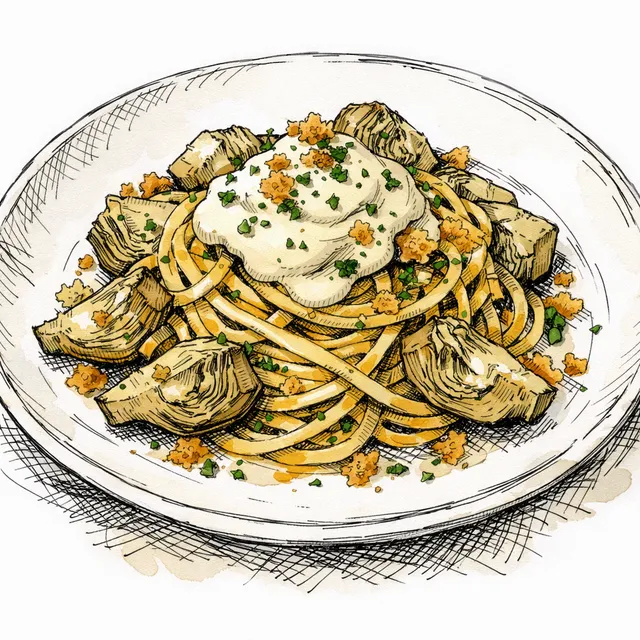
The Artichoke Keystone: Linguine with Vermouth-Braised Carciofini and a Structural Emulsion
Growing up, my grandmother's kitchen in Piedmont was a sanctuary of slow-simmered perfection. Today, navigating my fast-paced Milanese reality, I rarely have three hours to coax flavor from a thistle. I engineered this linguine out of sheer necessity after a grueling day at the drafting table. I craved Nonna's tender artichokes but required a twenty-minute timeline.\n\nIn this design, baby artichokes (carciofini) act as the keystone of our culinary arch. A generous splash of dry vermouth provides an instant, aged depth that traditionally takes hours to build. Meanwhile, starchy pasta water and cold butter form a flawless, load-bearing emulsion. It is an exercise in structural integrity—no unnecessary complexity, just a solid foundation.\n\nTo make this blueprint your own, treat the fresh herbs as your decorative facade. A visually measured shower of fresh sage works beautifully, provided your Parmigiano-Reggiano base remains robust. Simply let the ingredients do the heavy lifting. Weeknight cooking should always feel like an elegant escape, not a chore.
Featured Recipe
The Artichoke Keystone: Linguine with Vermouth-Braised Carciofini and a Structural Emulsion
On busy metropolitan weeknights, I turn to this dish as an exercise in elegant engineering. Baby artichokes act as the keystone, while starchy pasta water and cold butter form a flawless, load-bearing emulsion. Let the ingredients do the heavy lifting—this is Northern Italian simplicity at its finest.
Save a copy to your collection for editing
Timeline
Ingredients
- 1 lb baby artichokes(tough outer leaves removed)
- 1 lemon(halved, divided use)
- 4 quarts water(for boiling pasta)
- 1 tbsp kosher salt(for pasta water)
- 12 oz dried linguine(bronze-die extruded for maximum starch release)
- 4 oz pancetta(diced)
- 2 garlic cloves(smashed)
- 1/3 cup dry vermouth(essential for deglazing)
- 1/2 cup premium vegetable brodo(store-bought is perfectly fine)
- 3 tbsp cold unsalted butter(cubed, must be cold for the emulsion)
- 1/2 cup Parmigiano-Reggiano(finely grated)
- 1/4 cup fresh parsley(finely chopped)
- 1/2 lemon(for preventing artichoke oxidation)
- 1 cup pasta water(reserved before draining pasta)
- 1/2 lemon(for finishing the dish)
Instructions
- 1
Bring 4 quarts water to a rolling boil in a large pot. Meanwhile, execute the 'demolition phase' on 1 lb baby artichokes: peel away the tough, dark green outer leaves until the pale yellow structural core is exposed. Trim the top half off, halve them lengthwise, and immediately submerge them in a bowl of cold water squeezed with the juice of 1/2 lemon to prevent oxidation.
10 min
Tip: Be ruthless with your artichoke peeling. If the leaves are green, they are too tough. We only want the load-bearing tender hearts.
- 2
Add 1 tbsp kosher salt and 12 oz dried linguine to the boiling water. Cook until just shy of al dente, about 2 minutes less than the package directs. We will finish cooking the pasta in the sauce to build our foundation.
9 min
Tip: Bronze-die pasta is crucial here; its rough texture sheds the architectural starch we need to bind the sauce.
- 3
Concurrently, place 4 oz diced pancetta into a large, cold skillet over medium heat. Allowing the pancetta to render slowly from a cold start ensures maximum fat extraction and crispness without burning.
5 min
Tip: The rendered fat acts as the mortar for our flavor profile.
- 4
Use a slotted spoon to remove the crisped pancetta and set it aside, leaving the fat in the pan. Drain the artichokes and pat them completely dry. Add them to the hot pancetta fat along with 2 garlic cloves. Sauté until the artichokes develop a deep, golden-brown char.
5 min
Tip: Drying the artichokes thoroughly prevents sputtering and ensures a proper sear.
- 5
Carefully scoop out and reserve 1 cup pasta water before draining the pasta.
1 min
Tip: Never pour away your pasta water. It is liquid gold and the secret to structural integrity in Italian sauces.
- 6
Pour 1/3 cup dry vermouth into the artichoke skillet, scraping up the caramelized bits from the bottom. Once the alcohol smell dissipates, pour in 1/2 cup premium vegetable brodo and let the mixture rapidly bubble and reduce by half.
3 min
Tip: Vermouth brings a botanical complexity that beautifully mirrors the artichokes.
- 7
Transfer the drained linguine into the skillet. Add the reserved pancetta, 3 tbsp cold unsalted butter, 1/2 cup finely grated Parmigiano-Reggiano, and a splash of the reserved pasta water. Toss vigorously and continuously. The violent mechanical action forces the starchy water and the melting fat to bind into a flawless, glossy, load-bearing emulsion. Add more pasta water as needed until the sauce clings beautifully to the pasta.
3 min
Tip: The butter must be cold. Warm butter will split the sauce, ruining your emulsion's structural integrity.
- 8
Remove the pan from the heat. Fold in 1/4 cup fresh parsley and a finishing squeeze of juice from the remaining 1/2 lemon to brighten the architectural weight of the dish.
1 min
Chef's Notes
When I walk through the markets near the Duomo in early April, the baby artichokes—carciofini—are stacked like miniature pinecones. To modernize this traditional springtime ingredient, I skip the long braise my grandmother favored in Piedmont. Instead, we flash-sauté them and rely on the mechanical action of tossing hot pasta, starchy water, and cold butter to create a glossy, structural sauce in minutes. Let the ingredients do the heavy lifting.

Elena Rossi
Effortless Northern Italian elegance for busy modern weeknights.
Milan-born Elena Rossi, her true passion was always simmering on the stove. Raised on the rich, comforting flavors of her grandmother's Piedmontese kitchen, Elena found herself constantly reimagining those time-intensive classics for her own demanding, fast-paced lifestyle. Today, Elena is the voice behind a beloved culinary movement that proves authentic Italian food does not require spending eight hours stirring a pot. She beautifully merges the precision of her design background with the soul of Northern Italian cooking, offering busy home cooks a stylish, stress-free approach to dinner. Whether she is utilizing a pressure cooker for a Tuesday night osso buco or elevating a high-quality store-bought brodo with fresh herbs, Elena empowers her readers to cook with confidence. Her recipes are a testament to the idea that practicality and elegance can perfectly coexist on the modern dinner table.