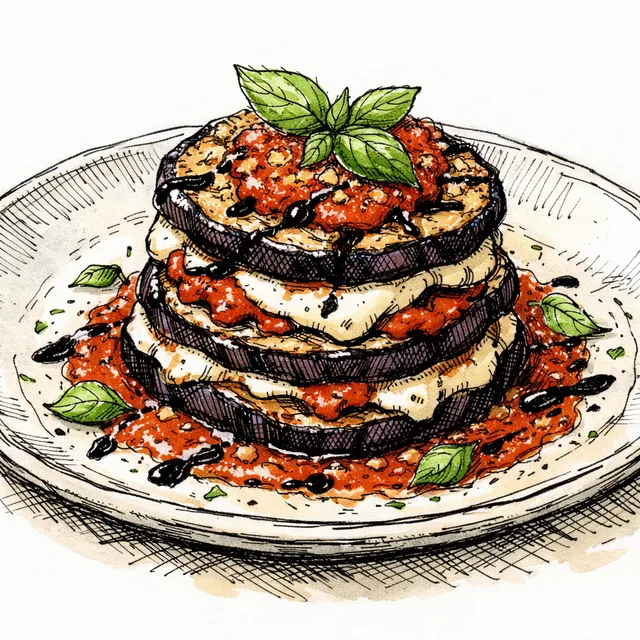
The Aubergine Millefoglie: A Structural Midday Stack
In Milan, lunch is rarely a rushed affair; it is a precisely engineered pause in the day. Growing up, my Piedmontese grandmother would spend hours tending to her Parmigiana, carefully constructing it like a sacred monument. I loved those long Sunday afternoons, but my fast-paced metropolitan reality demands a different blueprint. This Aubergine Millefoglie is my architectural homage to her, modernizing those nostalgic flavors into a structural midday meal. The inspiration came to me while drafting plans for a tiered Milanese courtyard. I realized that a recipe, much like a building, requires a solid foundation of a few high-quality components rather than unnecessary complexity. Here, we use high-heat roasting for our load-bearing eggplant slices, bypassing the tedious frying process. Our mortar is a rapid, dry vermouth-spiked cherry tomato reduction that binds the layers with deep, slow-simmered flavor in a fraction of the time. A generous dusting of robust Parmigiano-Reggiano serves as the decorative, yet necessary, facade. To make it your own, swap the cheese for smoked scamorza or add a layer of fresh sage compound butter for a richer foundation. Remember, weeknight cooking should feel like an escape, not a chore. Let the ingredients do the heavy lifting.
Featured Recipe
The Aubergine Millefoglie: A Structural Midday Stack
In Milan, lunch is rarely a rushed affair; it is a precisely engineered pause in the day. This elegant, layered eggplant stack takes the nostalgic flavors of a classic Parmigiana and modernizes them into a structural midday meal. By using high-heat roasting for our load-bearing eggplant and a rapid, vermouth-spiked cherry tomato reduction as our mortar, we build incredible depth in a fraction of the time.
Save a copy to your collection for editing
Timeline
Ingredients
- 1 large globe eggplant(Sliced into precisely 1/2-inch structural rounds)
- 3 tbsp extra virgin olive oil(Divided use)
- 1 tsp kosher salt(Divided use)
- 1/2 tsp black pepper(Freshly cracked, divided use)
- 2 cloves garlic(Smashed)
- 1 pint cherry tomatoes(Left whole)
- 1/4 cup dry vermouth(The secret to instant architectural depth)
- 8 oz fresh mozzarella(Sliced thinly)
- 1/2 cup Parmigiano-Reggiano(Freshly grated)
- 1/4 cup fresh basil leaves(Torn)
Instructions
- 1
Preheat your oven to 425 degrees Fahrenheit. Slice the 1 large globe eggplant into 1/2-inch rounds. This thickness is crucial; it ensures the eggplant acts as a solid, load-bearing foundation rather than collapsing. Brush the rounds on both sides with 2 tbsp extra virgin olive oil, then season with 1/2 tsp kosher salt and 1/4 tsp black pepper.
5 min
Tip: Do not skip brushing the oil evenly; it acts as a sealant to help the eggplant roast rather than steam.
- 2
Arrange the seasoned eggplant rounds on a parchment-lined baking sheet and place in the hot oven to roast until golden brown and tender, yet structurally intact.
15 min
Tip: Flip them halfway through the cooking time to ensure an even, caramelized cladding on both sides.
- 3
While the eggplant roasts, begin building your mortar. In a wide skillet, heat the remaining 1 tbsp extra virgin olive oil over medium-high heat. Add the 2 cloves garlic and the 1 pint cherry tomatoes. Let the tomatoes sit undisturbed for a moment to blister and char.
5 min
Tip: You want the tomatoes to burst, creating a rapid, rustic sauce that holds the layers together.
- 4
Once the tomatoes begin to collapse, pour in the 1/4 cup dry vermouth. It will aggressively sizzle and deglaze the pan. Add the remaining 1/2 tsp kosher salt and 1/4 tsp black pepper. Lower the heat and let the liquid reduce as you gently mash the tomatoes with the back of a wooden spoon.
6 min
Tip: The vermouth is the keystone here—it replaces hours of slow-simmering with instant, complex acidity.
- 5
Remove the roasted eggplant from the oven. Keep the oven on. Discard the smashed garlic cloves from your reduced tomato mortar.
2 min
Tip: The garlic has already imparted its foundational flavor; leaving it in disrupts the elegant texture of the stack.
- 6
Begin the assembly directly on the baking sheet. For each stack, start with a large roasted eggplant round. Top with a spoonful of the tomato mortar, a slice of 8 oz fresh mozzarella, and a pinch of the 1/2 cup Parmigiano-Reggiano. Repeat to create two to three distinct layers per stack, finishing with a cap of mozzarella and Parmigiano.
4 min
Tip: Think like an architect: place the widest, sturdiest slices at the bottom.
- 7
Return the baking sheet to the oven. Bake until the mozzarella has melted into a glorious, cohesive canopy that binds the layers together.
4 min
Tip: Watch closely. We want melted unity, not a collapsed structure.
- 8
Carefully transfer the stacks to plates using a wide spatula. Scatter the torn 1/4 cup fresh basil leaves over the top as a vibrant, decorative finish.
2 min
Tip: Serve immediately while the structural integrity is at its peak.
Chef's Notes
Let the ingredients do the heavy lifting here. By cutting the eggplant thickly and roasting it at a high temperature, we bypass the tedious breading and frying of a traditional Parmigiana. The resulting stack is lighter, incredibly flavorful, and perfectly engineered for an elegant midday escape.

Elena Rossi
Effortless Northern Italian elegance for busy modern weeknights.
Milan-born Elena Rossi, her true passion was always simmering on the stove. Raised on the rich, comforting flavors of her grandmother's Piedmontese kitchen, Elena found herself constantly reimagining those time-intensive classics for her own demanding, fast-paced lifestyle. Today, Elena is the voice behind a beloved culinary movement that proves authentic Italian food does not require spending eight hours stirring a pot. She beautifully merges the precision of her design background with the soul of Northern Italian cooking, offering busy home cooks a stylish, stress-free approach to dinner. Whether she is utilizing a pressure cooker for a Tuesday night osso buco or elevating a high-quality store-bought brodo with fresh herbs, Elena empowers her readers to cook with confidence. Her recipes are a testament to the idea that practicality and elegance can perfectly coexist on the modern dinner table.