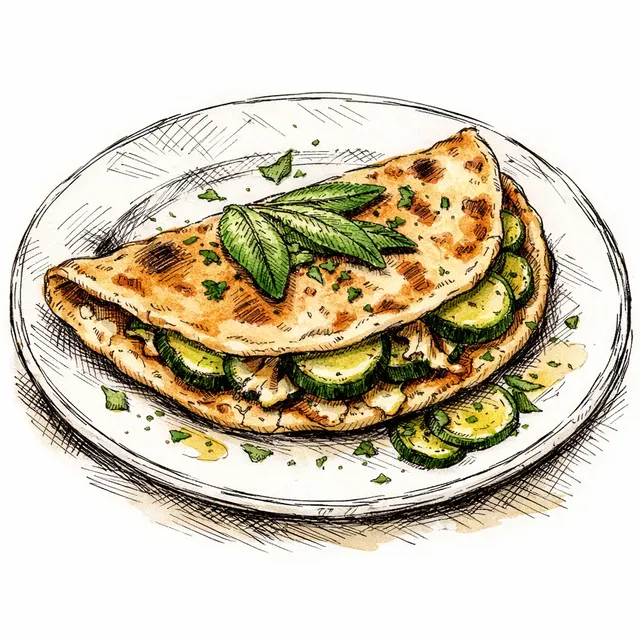
The Emilian Truss: Zucchini and Sage Folded Crescione
Milanese lunch breaks are a study in efficient, portable elegance. Wandering past the Duomo recently, I craved the structural perfection of a Romagnolo street food classic, but paired with the nostalgic flavors of my Piedmontese grandmother's kitchen. Enter The Emilian Truss: my Zucchini and Sage Folded Crescione. Think of this unleavened flatbread as a beautifully engineered cantilever. It requires absolutely no proofing, which is a crucial shortcut for our fast-paced modern reality. The sturdy olive oil dough acts as a flawless load-bearing shell, encasing a vibrant, savory mortar. To build this interior, we rely on deglazing zucchini, diced visually to the size of tiny mosaic tiles, with a sharp splash of dry vermouth, then binding it with creamy ricotta and fresh sage. What makes this recipe so special to me is its brilliant structural integrity; it perfectly marries old-world depth with the demanding timeline of a busy Tuesday night. To make it your own, consider the ricotta your base foundation. You can easily reinforce it with a handful of robust Parmigiano-Reggiano for a firmer bite or add decorative ribbons of prosciutto. Remember, you do not need a complicated blueprint for a beautiful dinner. Let the ingredients do the heavy lifting, and enjoy the escape.
Featured Recipe
The Emilian Truss: Zucchini and Sage Folded Crescione
Milanese lunch breaks are a study in efficient, portable elegance. Today, we look to the Romagna coast for a quick, structural street food: the crescione. This unleavened, folded flatbread requires no proofing, relying on a sturdy olive oil dough to encase a vibrant mortar of vermouth-deglazed zucchini, fresh sage, and creamy ricotta.
Save a copy to your collection for editing
Timeline
Ingredients
- 2 cups all-purpose flour(Plus extra for dusting)
- 1 tsp baking powder(Our modern shortcut to avoid proofing time)
- 1.5 tsp fine sea salt(Divided (1 tsp for dough, 1/2 tsp for zucchini))
- 4 tbsp extra-virgin olive oil(Divided (3 tbsp for dough, 1 tbsp for sautéing))
- 1/2 cup warm water(Approximately, to bind the dough)
- 2 medium zucchini(Grated on the large holes of a box grater)
- 1 clove garlic(Smashed, for flavoring the oil)
- 1 tbsp fresh sage leaves(Finely chopped)
- 2 tbsp dry vermouth(For deglazing)
- 1/2 cup whole milk ricotta(Strained if excessively watery)
- 1/3 cup Parmigiano-Reggiano(Freshly grated, acting as our load-bearing cheese)
- 1/2 tsp fine sea salt(used in step 1)
Instructions
- 1
Place the grated 2 medium zucchini in a colander and toss with 1/2 tsp fine sea salt. Water is the enemy of a sound foundation; let this sit to drain while we build the dough.
3 min
Tip: Place a bowl under the colander to catch the expelled water.
- 2
In a large mixing bowl, combine the 2 cups all-purpose flour, 1 tsp baking powder, and 1 tsp fine sea salt. Pour in 3 tbsp extra-virgin olive oil and 1/2 cup warm water. Knead vigorously for a few minutes until a smooth, elastic dough forms. Cover and let it rest.
5 min
Tip: Using baking powder instead of yeast is a brilliant architectural shortcut for weeknight flatbreads.
- 3
Take the resting zucchini in your hands and squeeze out as much moisture as structurally possible. Heat the remaining 1 tbsp extra-virgin olive oil in a skillet over medium heat. Add the 1 clove garlic and let it sizzle for a minute to perfume the oil, then add the squeezed zucchini and 1 tbsp fresh sage leaves. Sauté until slightly golden, then splash in the 2 tbsp dry vermouth, scraping up any bits until the pan is nearly dry. Remove from heat and discard the garlic clove.
5 min
Tip: The dry vermouth adds an instant depth of flavor, replicating a slow-simmered taste in just minutes.
- 4
Transfer the warm zucchini to a bowl. Fold in the 1/2 cup whole milk ricotta and 1/3 cup Parmigiano-Reggiano. This mixture serves as the mortar for our stuffed crescioni.
2 min
Tip: Ensure the ricotta is thick; we want a paste, not a soup.
- 5
Divide the rested dough into 4 equal pieces. On a lightly floured surface, roll each piece into a thin, 8-inch circle. This is your canvas.
5 min
Tip: Roll the dough as thinly as you can without tearing it; it should feel like sturdy parchment.
- 6
Spoon the zucchini mortar evenly onto one half of each dough circle, leaving a half-inch border. Fold the empty half over the filling to create a half-moon shape. Crimp the edges tightly with the tines of a fork to seal the vault and ensure zero structural failure during cooking.
5 min
Tip: Press down gently on the filling to remove any trapped air before sealing.
- 7
Heat a large, dry skillet or cast-iron griddle over medium-high heat. Place the crescioni in the dry pan (cook two at a time if they fit comfortably). Toast for 3 to 4 minutes per side, until the exterior is deeply golden with beautiful, blistered char marks and the internal cheese is melted. Let the ingredients do the heavy lifting as you serve immediately.
8 min
Tip: Do not oil the pan! A dry pan creates the authentic, blistered texture of regional Romagna street food.
Chef's Notes
The beauty of a crescione lies in its absolute portability and structural integrity. By forcefully expelling the water from the zucchini before building our filling, we prevent the dreaded soggy interior. This dish proves that with a little architectural foresight, you can enjoy authentic Northern Italian street food during a busy modern lunch hour.

Elena Rossi
Effortless Northern Italian elegance for busy modern weeknights.
Milan-born Elena Rossi, her true passion was always simmering on the stove. Raised on the rich, comforting flavors of her grandmother's Piedmontese kitchen, Elena found herself constantly reimagining those time-intensive classics for her own demanding, fast-paced lifestyle. Today, Elena is the voice behind a beloved culinary movement that proves authentic Italian food does not require spending eight hours stirring a pot. She beautifully merges the precision of her design background with the soul of Northern Italian cooking, offering busy home cooks a stylish, stress-free approach to dinner. Whether she is utilizing a pressure cooker for a Tuesday night osso buco or elevating a high-quality store-bought brodo with fresh herbs, Elena empowers her readers to cook with confidence. Her recipes are a testament to the idea that practicality and elegance can perfectly coexist on the modern dinner table.