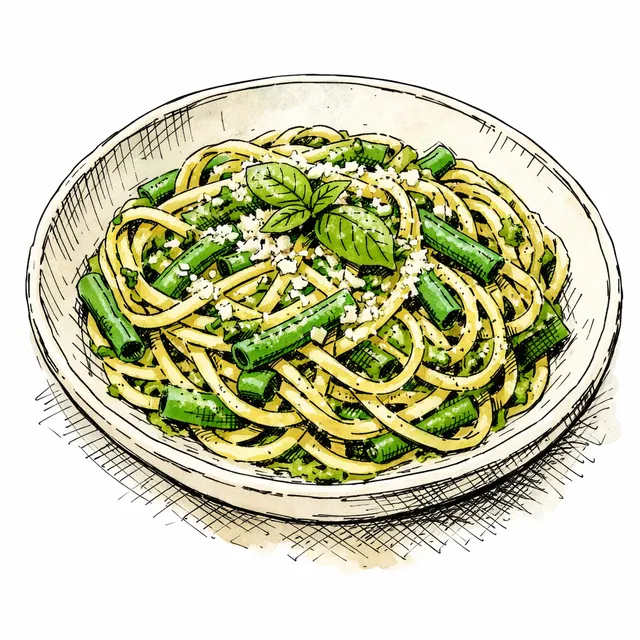
The Ligurian Mortar: Linguine with Crushed Basil and Green Beans
Whenever I need an escape from the fast-paced concrete and glass of modern Milan, I return to the structural brilliance of a true emulsion. This recipe, The Ligurian Mortar, is a tribute to my grandmother. While her roots were firmly planted in Piedmont, her heavy marble mortar and pestle traveled everywhere, acting as the solid foundation for our family's meals. I still remember the rhythmic grinding against stone—a sound that meant a beautifully constructed dinner was near. What makes this linguine so special to me is its architectural efficiency. By boiling crisp green beans alongside the pasta, we streamline the construction for busy modern weeknights without sacrificing integrity. The raw pesto is the literal mortar of this dish. The friction of the stone coaxes out the basil's essential oils, creating a vibrant emerald emulsion that binds everything together. The basil and robust Parmigiano-Reggiano act as the load-bearing elements, while the pasta provides the structural framework. To make this blueprint your own, you can swap traditional pine nuts for toasted walnuts, or add a splash of dry vermouth to the pasta water for subtle aromatic depth. Keep your foundation strong, pour a glass of wine, and let the ingredients do the heavy lifting.
Featured Recipe
The Ligurian Mortar: Linguine with Crushed Basil and Green Beans
A tribute to the structural brilliance of a true emulsion. By boiling crisp green beans alongside the pasta and building a raw pesto with a mortar and pestle, we create a dish of unparalleled vibrancy. The friction of the stone coaxes out the basil's essential oils, creating an emerald mortar that binds the entire dish together.
Save a copy to your collection for editing
Timeline
Ingredients
- 1 lb Linguine or Trenette(High-quality bronze-die extruded if possible)
- 8 oz Fresh green beans(Trimmed and halved crosswise)
- 3 cups Fresh basil leaves(Washed and thoroughly dried (about 2 large bunches))
- 1/4 cup Pine nuts(Lightly toasted)
- 1 clove Garlic(Peeled and green germ removed)
- 1/2 tsp Coarse sea salt(Plus extra for the pasta water)
- 1/2 cup Extra virgin olive oil(Preferably a delicate Ligurian oil)
- 1/2 cup Parmigiano-Reggiano(Finely grated)
- 1/4 cup Pecorino Romano(Finely grated)
Instructions
- 1
Bring a large pot of water to a rolling boil. Meanwhile, prep your workspace by trimming and halving 8 oz Fresh green beans. If you haven't already, lightly toast 1/4 cup Pine nuts in a dry skillet over medium heat until they are just golden, about 3 minutes. Set them aside to cool completely.
10 min
Tip: Cooling the pine nuts is crucial; warm nuts will heat the basil in the mortar and dull its bright color.
- 2
Begin the structural foundation of your pesto. In a heavy marble mortar, place 1 clove Garlic and the cooled 1/4 cup Pine nuts. Pound firmly with a wooden pestle until the mixture forms a rough, rustic paste. This is the base upon which we will build our emulsion.
3 min
Tip: Use an up-and-down pounding motion first to break the garlic and nuts, then transition to a grinding motion.
- 3
Add 3 cups Fresh basil leaves to the mortar along with 1/2 tsp Coarse sea salt. The coarse salt acts as a load-bearing abrasive, physically shearing the cell walls of the basil. Grind the pestle firmly against the sides of the mortar in a circular motion until the leaves surrender into a dark, highly aromatic green paste.
5 min
Tip: Work efficiently; the longer the basil is exposed to air and friction, the more it risks oxidizing.
- 4
Generously salt your boiling water. Drop in 1 lb Linguine and the prepared 8 oz Fresh green beans. Cooking them together in the same pot is a brilliant architectural shortcut of Northern Italian kitchens—it flavors the water and perfectly synchronizes their doneness. Boil until the pasta is al dente, about 10 to 11 minutes.
11 min
Tip: The green beans should still have a structural snap to them when the pasta is perfectly chewy.
- 5
While the pasta cooks, finish your pesto. Slowly stream 1/2 cup Extra virgin olive oil into the mortar, stirring continuously with the pestle to integrate it into the basil paste. Fold in 1/2 cup Parmigiano-Reggiano and 1/4 cup Pecorino Romano until you achieve a thick, cohesive mortar.
3 min
Tip: The cheese acts as a binder, thickening the oil and basil into a creamy, stable emulsion.
- 6
Just before the pasta is done, scoop out roughly a half cup of the starchy cooking water. Drain the pasta and green beans, then transfer them immediately to a large, room-temperature mixing bowl.
2 min
Tip: Never toss pesto in a hot pan over a flame! The heat will cook the delicate basil, turning it brown and bitter.
- 7
Scrape the finished pesto from the mortar into the mixing bowl over the pasta and beans. Add a small splash of the reserved pasta water. Toss vigorously with tongs until the starchy water and the pesto merge into a glossy, emerald veneer coating every strand. Serve immediately. Let the ingredients do the heavy lifting.
2 min
Tip: If the pasta seems dry, add another spoonful of the starchy water to loosen the structure.
Chef's Notes
When we build a dish, we look for structural synergies. Boiling the green beans and the linguine in the same salted water is one of my favorite old-world efficiencies—it saves a pot, harmonizes the flavors, and ensures everything finishes simultaneously. The mortar and pestle may seem antiquated to a busy modern cook, but it takes merely 10 minutes and produces a resilient emulsion a blade could never replicate.

Elena Rossi
Effortless Northern Italian elegance for busy modern weeknights.
Milan-born Elena Rossi, her true passion was always simmering on the stove. Raised on the rich, comforting flavors of her grandmother's Piedmontese kitchen, Elena found herself constantly reimagining those time-intensive classics for her own demanding, fast-paced lifestyle. Today, Elena is the voice behind a beloved culinary movement that proves authentic Italian food does not require spending eight hours stirring a pot. She beautifully merges the precision of her design background with the soul of Northern Italian cooking, offering busy home cooks a stylish, stress-free approach to dinner. Whether she is utilizing a pressure cooker for a Tuesday night osso buco or elevating a high-quality store-bought brodo with fresh herbs, Elena empowers her readers to cook with confidence. Her recipes are a testament to the idea that practicality and elegance can perfectly coexist on the modern dinner table.