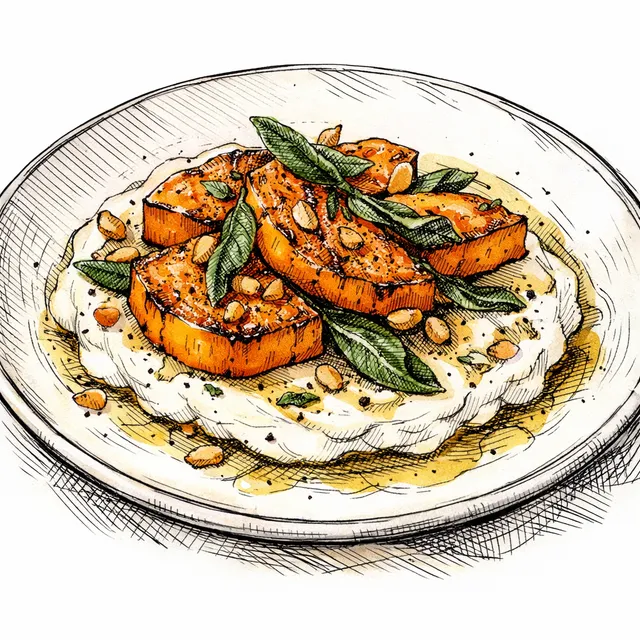
The Magenta Loggia: Gentle Pan-Seared Butternut Squash with Whipped Ricotta and Vermouth Sage Butter
There is a specific kind of autumn light that strikes the terracotta rooftops of Milan, casting a warm, rosy hue across the city s historic loggias. That exact palette inspired this dish: thick, amber-seared cutlets of butternut squash resting against a soft cloud of lemon-scented whipped ricotta. It always brings me back to my grandmother s Piedmontese kitchen, where the scent of bubbling butter and fresh sage meant the chaos of the city was finally melting away. Growing up, slow-roasting squash took hours, but modern life demands a bit of clever engineering. By using a hot pan and a splash of dry vermouth to deglace, we achieve that deep, caramelized slow-cooked flavor in a fraction of the time. The squash acts as our load-bearing element, while the toasted pumpkin seeds provide that much-needed architectural crunch. Let the ingredients do the heavy lifting here; a great Parmigiano-Reggiano and high-quality brodo make all the difference. If you want to make it your own, swap the sage for fresh thyme or add a drizzle of hot honey for an unexpected, modern twist. Weeknight cooking should always feel like an escape, never a chore.
Featured Recipe
The Magenta Loggia: Gentle Pan-Seared Butternut Squash with Whipped Ricotta and Vermouth Sage Butter
Thick cutlets of sweet butternut squash are gently pan-seared until amber and tender, then basted in an aromatic emulsion of dry vermouth, rich brodo, and crisp sage. Served over a cloud of lemon-scented whipped ricotta and finished with toasted pumpkin seeds, this light midday lunch captures effortless Milanese elegance in under thirty minutes.
Save a copy to your collection for editing
Timeline
Ingredients
- 1 lb butternut squash neck(peeled, seeded, and cut crosswise into 1/2-inch thick planks)
- 2 tbsp extra-virgin olive oil(divided)
- 3 tbsp unsalted butter(divided, European-style preferred)
- 10 fresh sage leaves(whole)
- 1 medium shallot(finely sliced into rings)
- 1/4 cup dry vermouth(such as Martini & Rossi Extra Dry)
- 1/3 cup rich vegetable brodo(high-quality store-bought or homemade)
- 1 cup whole-milk ricotta(drained of excess whey)
- 1/4 cup Parmigiano-Reggiano(finely grated, 24-month aged)
- 1 tsp lemon zest(freshly grated)
- 2 tbsp raw pumpkin seeds(pepitas)
- 1/2 tsp fine sea salt(divided)
- 1/4 tsp freshly cracked black pepper
Instructions
- 1
In a small dry pan set over medium-low heat, gently toast 2 tbsp raw pumpkin seeds for 2 to 3 minutes until puffed, fragrant, and slightly golden. Transfer to a small ramekin to stop the cooking and reserve for garnish.
3 min
Tip: Watch the seeds closely; like fine linens, they can burn if neglected for even thirty seconds.
- 2
In a small food processor or mixing bowl, combine 1 cup whole-milk ricotta, 1/4 cup finely grated Parmigiano-Reggiano, 1 tsp freshly grated lemon zest, and 1/4 tsp fine sea salt. Whip vigorously for about 2 minutes until silky, airy, and entirely smooth. Set aside at room temperature.
3 min
Tip: Whipping the ricotta breaks up the curd structure, transforming it from humble cheese into an architectural velvet base.
- 3
Set a wide, heavy stainless steel or cast-iron skillet over medium heat. Warm 1 tbsp extra-virgin olive oil and 1 tbsp unsalted butter until the foam gently subsides. Lay 1 lb butternut squash neck planks in a single uncrowded layer. Season with 1/4 tsp fine sea salt and 1/4 tsp freshly cracked black pepper. Sear gently without moving them for 4 minutes, then flip and cook 3 minutes on the reverse side until the edges turn amber and a knife pierces the center with slight resistance.
7 min
Tip: Gentle heat is everything here. We want caramelization from the squash's natural sugars, not aggressive scorching.
- 4
Push the seared squash slightly to the perimeter of the skillet. Drop the remaining 2 tbsp unsalted butter, 1 medium finely sliced shallot, and 10 whole fresh sage leaves into the center. Sauté for 1 minute until the butter foams hazelnut-brown and the sage crisps. Pour in 1/4 cup dry vermouth and 1/3 cup rich vegetable brodo, swirling the pan constantly as the liquid reduces by half into a glossy, fragrant pan emulsion that coats the squash.
3 min
Tip: The dry vermouth provides an herbal acid backbone that cuts through the rich squash and butter effortlessly.
- 5
Spoon the whipped ricotta across two shallow bowls, creating a broad, shallow well with the back of your spoon. Arrange the warm, glazed butternut squash planks over the center. Spoon the warm vermouth-sage pan sauce and crisp sage leaves over top. Drizzle with the remaining 1 tbsp extra-virgin olive oil and scatter the 2 tbsp raw pumpkin seeds over the plates.
2 min
Tip: Serve immediately while the temperature contrast between the warm basted squash and the cool, zesty ricotta is at its peak.
Chef's Notes
When autumn arrives in Milan, our midday breaks lean toward warm comfort that will not weigh down a busy afternoon. The solid cylinder neck of a butternut squash is a home cook's secret weapon—completely seedless, uniform to slice, and structurally sound. Here, gentle pan-searing coaxes out natural sweetness without needing an hour in the oven. Let the ingredients do the heavy lifting: aged Parmigiano in the whipped ricotta provides the load-bearing umami, while dry vermouth and fresh sage lift the butter into restaurant-quality elegance.

Elena Rossi
Effortless Northern Italian elegance for busy modern weeknights.
Milan-born Elena Rossi, her true passion was always simmering on the stove. Raised on the rich, comforting flavors of her grandmother's Piedmontese kitchen, Elena found herself constantly reimagining those time-intensive classics for her own demanding, fast-paced lifestyle. Today, Elena is the voice behind a beloved culinary movement that proves authentic Italian food does not require spending eight hours stirring a pot. She beautifully merges the precision of her design background with the soul of Northern Italian cooking, offering busy home cooks a stylish, stress-free approach to dinner. Whether she is utilizing a pressure cooker for a Tuesday night osso buco or elevating a high-quality store-bought brodo with fresh herbs, Elena empowers her readers to cook with confidence. Her recipes are a testament to the idea that practicality and elegance can perfectly coexist on the modern dinner table.