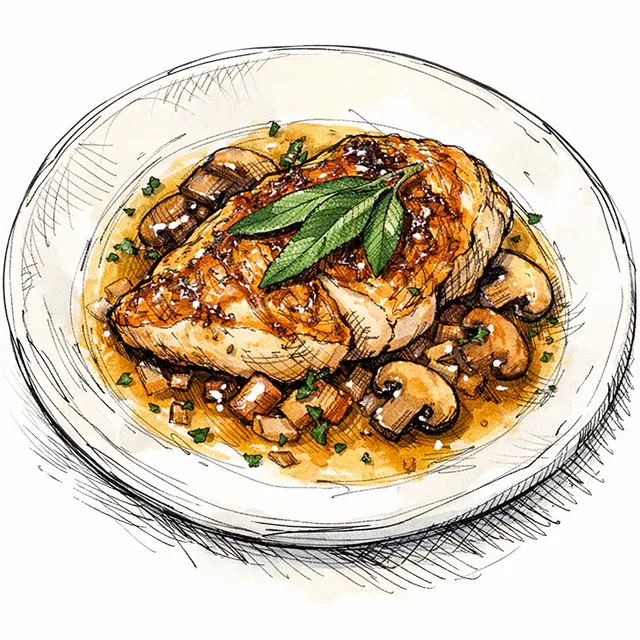
The Milanese Façade: Seared Chicken with Vermouth-Sage Pan Sauce
Growing up, my Piedmontese grandmother spent entire Sundays coaxing rich flavors from humble cuts of meat, filling the house with the scent of roasted sage and simmering stock. Today, my fast-paced Milanese reality simply does not afford me that luxury. Yet, craving that same architectural depth of flavor, I designed The Milanese Façade. This recipe is a masterclass in structural flavor, proving you do not need hours to build a masterpiece. We start with a golden, structural foundation on quick-seared chicken cutlets, creating a beautiful exterior facade. Then, the magic happens: a quick deglaze with dry vermouth and a splash of premium store-bought brodo. This acts as our binding mortar, reducing into a glossy pan sauce that holds the dish together perfectly. The fresh sage here is not merely decorative; it is entirely load-bearing, providing an aromatic pillar that supports the bright vermouth. To make this your own, consider swirling in a pat of compound butter at the end to reinforce the richness. Remember, a recipe is like a building—it requires a solid foundation of high-quality components, not unnecessary complexity. Pour yourself a glass of that vermouth, breathe, and let the ingredients do the heavy lifting.
Featured Recipe
The Milanese Façade: Seared Chicken with Vermouth-Sage Pan Sauce
A masterclass in structural flavor. We build a golden façade on quick-seared chicken cutlets, then deglaze with dry vermouth and premium brodo to create a glossy pan sauce that acts as the perfect binding mortar. Effortless Northern Italian elegance for a busy modern weeknight.
Save a copy to your collection for editing
Timeline
Ingredients
- 2 large boneless, skinless chicken breasts(halved horizontally into cutlets)
- 1 tsp tsp Kosher salt(measured visually)
- 1/2 tsp tsp black pepper(freshly cracked)
- 1/4 cup cup all-purpose flour(for a light primer coating)
- 2 tbsp tbsp olive oil(high quality)
- 3 tbsp tbsp unsalted butter(divided (1 tbsp for searing, 2 tbsp for sauce))
- 1 jar (14 oz) jar quartered artichoke hearts(drained and patted dry)
- 10 leaves fresh sage leaves(load-bearing aromatic)
- 1/3 cup cup dry vermouth(essential for deglazing)
- 1/2 cup cup premium chicken brodo(store-bought is fine, but choose the best)
- 1 tbsp tbsp lemon juice(freshly squeezed)
Instructions
- 1
To begin building our structural foundation, slice 2 large boneless, skinless chicken breasts horizontally to create four thin cutlets. Season both sides evenly with 1 tsp Kosher salt and 1/2 tsp black pepper. Lightly dredge them in 1/4 cup all-purpose flour, tapping off the excess so you are left with just a primer coat.
5 min
Tip: The flour coating should be nearly invisible. It is just there to help the sauce cling later.
- 2
Place a wide skillet over medium-high heat. Melt 1 tbsp unsalted butter into 2 tbsp olive oil. Once the butter foams, lay the chicken cutlets in the pan. We are building a golden façade here; sear undisturbed until beautifully browned.
8 min
Tip: Do not crowd the pan. If your skillet is small, work in batches to maintain structural heat.
- 3
While the chicken sears, take 1 jar (14 oz) quartered artichoke hearts and pat them completely dry. Excess moisture is the enemy of a good sear.
2 min
Tip: I like to press them lightly between paper towels.
- 4
Transfer the seared chicken to a resting plate. Into the residual fat, toss the dried artichokes and 10 fresh sage leaves. Sauté until the sage becomes crisp and the artichokes gain structural color.
3 min
Tip: The sage will infuse the residual fat with an incredible earthy aroma reminiscent of my grandmother's Piedmontese kitchen.
- 5
Now for the mortar. Pour in 1/3 cup dry vermouth to deglaze the pan. Scrape up every bit of fond from the bottom—this is pure, load-bearing flavor. Let it reduce by half.
2 min
Tip: Stand back slightly; the alcohol will release a robust cloud of steam.
- 6
Stir in 1/2 cup premium chicken brodo. Let the liquid bubble and simmer until it begins to tighten and thicken into a cohesive glaze.
3 min
Tip: Using a premium brodo here is the shortcut that saves us hours of traditional simmering.
- 7
Remove the pan from the heat. Vigorously swirl in the remaining 2 tbsp unsalted butter and 1 tbsp lemon juice. This emulsion creates a glossy, rich pan sauce without unnecessary complexity.
1 min
Tip: Let the ingredients do the heavy lifting—the butter and lemon will naturally bind the sauce into a perfect emulsion.
- 8
Nestle the chicken back into the skillet, turning the cutlets so they are completely coated in the vermouth-sage glaze. Serve immediately.
2 min
Tip: Spoon the extra sauce and artichokes over the top of each cutlet before serving.
Chef's Notes
As an architect, I appreciate a dish that requires a solid foundation of a few high-quality components rather than unnecessary complexity. As always, let the ingredients do the heavy lifting. The quality of your dry vermouth and chicken brodo will dictate the structural integrity of your sauce. A quick weeknight dinner shouldn't feel like a chore; it should feel like a brief escape to a chic Milanese courtyard.

Elena Rossi
Effortless Northern Italian elegance for busy modern weeknights.
Milan-born Elena Rossi, her true passion was always simmering on the stove. Raised on the rich, comforting flavors of her grandmother's Piedmontese kitchen, Elena found herself constantly reimagining those time-intensive classics for her own demanding, fast-paced lifestyle. Today, Elena is the voice behind a beloved culinary movement that proves authentic Italian food does not require spending eight hours stirring a pot. She beautifully merges the precision of her design background with the soul of Northern Italian cooking, offering busy home cooks a stylish, stress-free approach to dinner. Whether she is utilizing a pressure cooker for a Tuesday night osso buco or elevating a high-quality store-bought brodo with fresh herbs, Elena empowers her readers to cook with confidence. Her recipes are a testament to the idea that practicality and elegance can perfectly coexist on the modern dinner table.