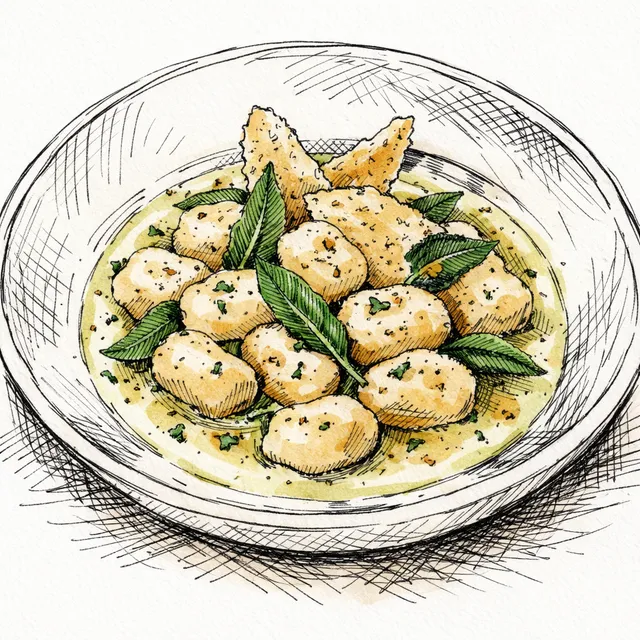
The Piedmontese Corbel: Gnocchi in a Structural Vermouth and Sage Emulsion
In architecture, a corbel is a solid piece of stone jutting from a wall to carry superincumbent weight. When designing my recipe for The Piedmontese Corbel, I wanted an emulsified pan sauce that served that exact load-bearing purpose. The inspiration struck me while sketching a modern restoration project near the Duomo, watching the golden evening light hit the ancient marble. I immediately thought of my grandmother in her Piedmontese kitchen, slowly building a rich, sage-infused sauce over several hours. Living a fast-paced metropolitan life, I rarely have hours to spare, but I firmly believe in maintaining structural integrity in flavor. This recipe is my modern shortcut. By relying on a tight emulsion of dry vermouth, premium store-bought brodo, and cold butter, we create a velvety mortar. It effortlessly supports high-quality store-bought potato gnocchi and crisp pancetta in mere minutes. What makes this dish so deeply special to me is how it perfectly bridges my grandmother's old-world roots with sleek, modern efficiency. To make it your own, consider the pancetta as a decorative facade; you might swap it for toasted walnuts if you prefer an earthier finish. Above all, let the ingredients do the heavy lifting, because weeknight dinner should always feel like a brief, beautiful escape to Milan, never a chore.
Featured Recipe
The Piedmontese Corbel: Gnocchi in a Structural Vermouth and Sage Emulsion
In architecture, a corbel is a structural piece of stone jutting from a wall to carry superincumbent weight. In this recipe, our emulsified pan sauce serves that exact load-bearing purpose. By relying on a tight emulsion of dry vermouth, rich brodo, and cold butter, we create a velvety mortar that effortlessly supports premium store-bought potato gnocchi and crispy pancetta. It is a masterclass in weeknight elegance—because when you let the ingredients do the heavy lifting, dinner becomes a brief, beautiful escape to Milan.
Save a copy to your collection for editing
Timeline
Ingredients
- 1 tbsp Kosher salt(For boiling water, plus extra for seasoning if needed)
- 4 tbsp unsalted butter(Must be ice cold and cubed)
- 4 oz pancetta(Diced)
- 10 fresh sage leaves(Roughly torn)
- 1/3 cup dry vermouth(A high-quality brand you would enjoy drinking)
- 1/2 cup premium chicken brodo(Store-bought is perfect here, but it must be high quality)
- 1 lb premium store-bought potato gnocchi(Look for vacuum-sealed or fresh varieties over dense boxed ones)
- 1/2 cup finely grated Parmigiano-Reggiano(Freshly grated for proper structural melting)
- 1 pinch cracked black pepper(Freshly cracked)
Instructions
- 1
Like laying a foundation, we begin with the basics. Bring a large pot of water to a rolling boil and season with 1 tbsp Kosher salt. This will serve as the brief cooking medium for our gnocchi and provide the vital starchy liquid needed for our sauce's structural integrity.
10 min
Tip: Do not skimp on the salt; the pasta water will season the final emulsion.
- 2
While the water heats, organize your mise en place. Cube 4 tbsp unsalted butter and place it in the freezer to ensure it is ice cold—this temperature differential is the secret to a stable emulsion. Dice 4 oz pancetta and tear 10 fresh sage leaves.
4 min
Tip: Keeping the butter ice-cold ensures it melts slowly into the liquid, forming a tight emulsion rather than breaking into a greasy pool.
- 3
Place the 4 oz pancetta into a cold, wide skillet over medium-low heat. Slowly rendering the fat creates our flavor base without burning the meat. Cook until crisp, then remove the pancetta with a slotted spoon, leaving the liquid gold fat in the pan.
6 min
Tip: Starting in a cold pan ensures maximum fat extraction, which is crucial for building the base of our sauce.
- 4
Increase the heat to medium-high. Pour in 1/3 cup dry vermouth to deglaze, scraping up any browned bits from the pancetta. Let it reduce by half, then pour in 1/2 cup premium chicken brodo. Allow this mixture to bubble and concentrate its flavors.
3 min
Tip: Letting the vermouth reduce burns off the raw alcohol, leaving behind only its complex botanicals.
- 5
Drop the 1 lb premium store-bought potato gnocchi into the boiling water. They are the brickwork of our dish. They will only take a few minutes; the moment they float to the surface, they are ready to be moved.
3 min
Tip: Do not walk away; fresh or premium gnocchi cook remarkably fast.
- 6
As the gnocchi cook, build your emulsion. Whisk the ice-cold 4 tbsp unsalted butter into the simmering vermouth and brodo reduction, one piece at a time. The vigorous whisking suspends the fat into the liquid, creating a glossy, thickened pan sauce.
2 min
Tip: If the sauce looks like it might separate, add a splash of the boiling starchy gnocchi water and whisk vigorously.
- 7
Using a spider strainer, transfer the floating gnocchi directly into the skillet, bringing a little starchy water with them. Toss vigorously. The starch acts as the final mortar, binding the sauce so it clings beautifully to each dumpling.
2 min
Tip: Tossing the pan rather than stirring protects the delicate structure of the gnocchi.
- 8
Off the heat, fold in the reserved pancetta, 10 fresh sage leaves, and 1/2 cup finely grated Parmigiano-Reggiano. Season with 1 pinch cracked black pepper. The residual heat will melt the cheese into the emulsion. Serve immediately, marveling at how a solid foundation yields such effortless elegance.
2 min
Tip: Always add Parmigiano-Reggiano off the heat to prevent it from seizing or clumping in the sauce.
Chef's Notes
Always use a dry vermouth that you would actually enjoy drinking over ice with a twist of lemon. The quality of your brodo and vermouth will directly dictate the architectural integrity of your final sauce.

Elena Rossi
Effortless Northern Italian elegance for busy modern weeknights.
Milan-born Elena Rossi, her true passion was always simmering on the stove. Raised on the rich, comforting flavors of her grandmother's Piedmontese kitchen, Elena found herself constantly reimagining those time-intensive classics for her own demanding, fast-paced lifestyle. Today, Elena is the voice behind a beloved culinary movement that proves authentic Italian food does not require spending eight hours stirring a pot. She beautifully merges the precision of her design background with the soul of Northern Italian cooking, offering busy home cooks a stylish, stress-free approach to dinner. Whether she is utilizing a pressure cooker for a Tuesday night osso buco or elevating a high-quality store-bought brodo with fresh herbs, Elena empowers her readers to cook with confidence. Her recipes are a testament to the idea that practicality and elegance can perfectly coexist on the modern dinner table.