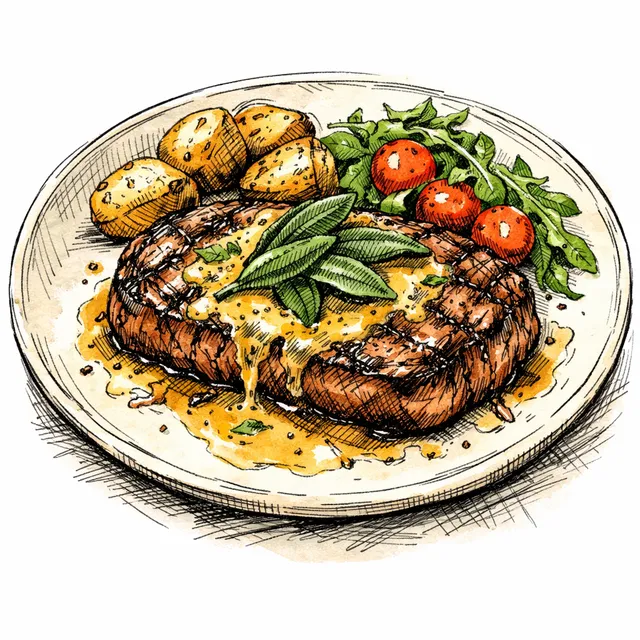
The Piedmontese Framework: Pan-Seared Sirloin with Melted Sage Butter
Growing up, I watched my grandmother labor over slow-braised Piedmontese beef, building flavor with the patience of a master mason laying bricks. Today, my fast-paced Milanese reality demands a much more modern blueprint. The inspiration for this recipe came from a desire to reconstruct her deep, old-world flavors within a twenty-minute weekday schedule. In architecture, a building is only as good as its foundation. Here, a beautifully seared prime sirloin acts as our load-bearing column. It requires high heat for structural integrity and a quiet, essential moment of rest. Rather than a complex reduction, we use a compound butter laced with fresh sage, dry vermouth, and robust Parmigiano-Reggiano. As this butter melts over the resting meat, it mimics hours of slow-simmering. I usually measure the sage visually—a handful roughly the size of a decorative rosette molding—to ensure it anchors the vermouth's brightness. You can easily make this blueprint your own by swapping the sage for rosemary or adding a pinch of cracked juniper. Remember, weeknight cooking should feel like an escape, not a chore. Just set your foundation, pour a glass of Barolo, and let the ingredients do the heavy lifting.
Featured Recipe
The Piedmontese Framework: Pan-Seared Sirloin with a Melted Sage Butter
A beautifully seared sirloin requires the same precision as a load-bearing column: a solid foundation, structural integrity under high heat, and a quiet moment of rest. In this effortless weeknight dish, we pan-sear prime beef and let a rich sage, vermouth, and Parmigiano compound butter do the heavy lifting as it melts over the resting meat. It is a masterclass in Northern Italian simplicity, delivering deep, slow-cooked flavors in a fraction of the time.
Save a copy to your collection for editing
Timeline
Ingredients
- 1.5 lbs sirloin steak(About 1.5 inches thick, patted completely dry)
- 2 tsp kosher salt
- 1 tsp black pepper(Freshly ground)
- 2 tbsp olive oil(Divided use)
- 3 tbsp unsalted butter(Room temperature)
- 1 tbsp fresh sage leaves(Finely chopped)
- 2 tbsp Parmigiano-Reggiano(Finely grated)
- 1/4 cup dry vermouth(Essential for deglazing)
- 1/2 cup premium beef brodo(Store-bought high quality broth)
- 2 cups arugula(For the decorative canopy)
- 1 tbsp lemon juice(Freshly squeezed)
Instructions
- 1
In a small bowl, mix together 3 tbsp unsalted butter, 1 tbsp fresh sage leaves, and 2 tbsp Parmigiano-Reggiano using a fork until it forms a cohesive paste. This compound butter will serve as our primary flavor architecture. Set aside at room temperature.
3 min
Tip: Ensure the butter is thoroughly softened to make mixing effortless.
- 2
Thoroughly pat 1.5 lbs sirloin steak dry with paper towels—moisture is the enemy of a structural crust. Season aggressively on all sides with 2 tsp kosher salt and 1 tsp black pepper.
2 min
Tip: Do this just before searing so the salt doesn't draw moisture back to the surface.
- 3
Place a heavy skillet (cast iron or stainless steel) over medium-high heat. Add 1 tbsp olive oil and heat until it just begins to smoke, signaling that our foundational layer is ready.
3 min
Tip: Patience is key; the pan must be hot enough to instantly sear the meat.
- 4
Carefully lay the sirloin into the hot skillet. Allow it to sear entirely undisturbed, building a strong, caramelized crust.
4 min
Tip: If it sticks when you try to lift it, the crust hasn't fully formed. Give it another 30 seconds.
- 5
Flip the steak and sear the other side until a meat thermometer registers 130°F for a perfect medium-rare.
4 min
Tip: Adjust timing based on the exact thickness of your steak.
- 6
Transfer the seared steak to a cutting board. Immediately spread the prepared sage-Parmigiano compound butter over the hot surface. Let the steak rest undisturbed; the residual heat will melt the butter into a luxurious glaze.
8 min
Tip: Never skip the resting phase; it allows the internal tensions of the meat to relax.
- 7
While the meat rests, return the skillet to medium heat. Pour in 1/4 cup dry vermouth to deglaze the pan, using a wooden spoon to scrape up the load-bearing browned bits. Add 1/2 cup premium beef brodo and let it simmer rapidly until reduced by half.
4 min
Tip: The vermouth lifts the rich beef flavors while adding an aromatic botanical note reminiscent of a Milanese aperitivo.
- 8
In a mixing bowl, toss 2 cups arugula with the remaining 1 tbsp olive oil and 1 tbsp lemon juice. This will act as a bright, peppery canopy for our rich beef.
2 min
Tip: Dress the greens right before serving so they maintain their structural integrity.
- 9
Slice the rested sirloin against the grain into half-inch strips. Arrange on a platter, spoon the warm pan reduction over the meat, and top with the dressed arugula. Serve immediately.
2 min
Tip: Any melted butter and juices on the cutting board should be poured right back over the sliced steak.
Chef's Notes
Just as concrete must cure to achieve its ultimate strength, a steak must rest to lock in its juices. Do not rush the resting phase (Step 6); it is the most critical step in this recipe. The melting compound butter will continually baste the meat as those internal tensions relax. Always remember my golden rule for busy nights: Let the ingredients do the heavy lifting.

Elena Rossi
Effortless Northern Italian elegance for busy modern weeknights.
Milan-born Elena Rossi, her true passion was always simmering on the stove. Raised on the rich, comforting flavors of her grandmother's Piedmontese kitchen, Elena found herself constantly reimagining those time-intensive classics for her own demanding, fast-paced lifestyle. Today, Elena is the voice behind a beloved culinary movement that proves authentic Italian food does not require spending eight hours stirring a pot. She beautifully merges the precision of her design background with the soul of Northern Italian cooking, offering busy home cooks a stylish, stress-free approach to dinner. Whether she is utilizing a pressure cooker for a Tuesday night osso buco or elevating a high-quality store-bought brodo with fresh herbs, Elena empowers her readers to cook with confidence. Her recipes are a testament to the idea that practicality and elegance can perfectly coexist on the modern dinner table.