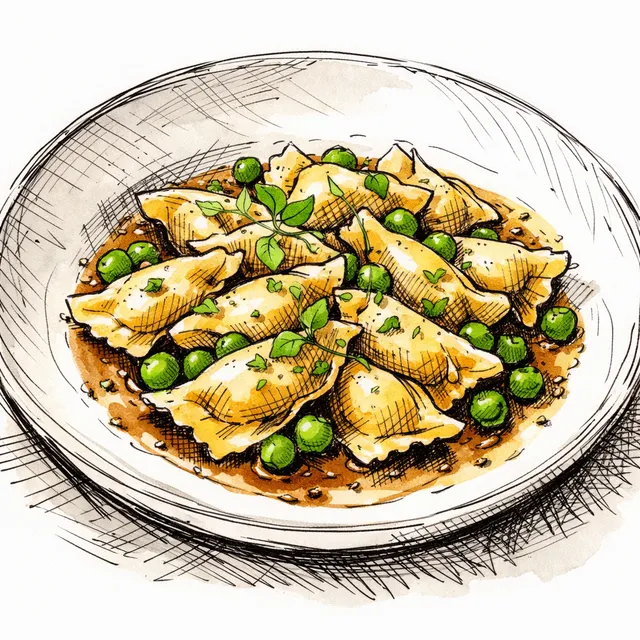
The Piedmontese Plin: Folded Spring Pea Agnolotti with Vermouth Glaze
Sunday family dinners in Milan are sacred, but they shouldn't require you to spend your entire weekend acting as a human pasta extruder. Growing up, I watched my grandmother meticulously pinch—or 'plin'—each delicate parcel in her Piedmontese kitchen, an exercise in culinary masonry that took hours. In my fast-paced metropolitan reality, I prefer to rely on high-quality, pre-fabricated fresh pasta sheets, skipping straight to the joyful architecture of folding. The true structural integrity of this dish lies in its load-bearing filling: a vibrant, sweet spring pea and rich mascarpone puree. It provides a solid foundation that stands up beautifully to a quick dry vermouth and brown butter glaze. What makes this recipe so special to me is how it preserves the soul of Nonna's slow-cooked Sundays while fitting perfectly into a modern weeknight. If you want to make it your own, consider the garnish as your decorative facade—a shower of robust Parmigiano-Reggiano or crispy fried sage leaves adds perfect textural contrast. Remember, just like in good design, we don't need unnecessary complexity. Let the ingredients do the heavy lifting, and allow your kitchen to be an escape, not a chore.
Featured Recipe
The Piedmontese Plin: Folded Spring Pea Agnolotti with Vermouth Glaze
Sunday family dinners in Milan are sacred, but they shouldn't require you to spend your entire weekend acting as a human pasta extruder. By utilizing high-quality, pre-fabricated fresh pasta sheets, we can skip straight to the joyful architecture of folding agnolotti dal plin together. A vibrant, load-bearing filling of sweet spring peas and rich mascarpone provides the perfect foundation for a quick vermouth and brown butter glaze.
Save a copy to your collection for editing
Timeline
Ingredients
- 1 lb fresh store-bought lasagna sheets(Look for high-quality, paper-thin fresh sheets in the refrigerated section)
- 2 cups spring peas(Fresh blanched or frozen and thawed)
- 1/2 cup mascarpone cheese(Brings structural creaminess without excess moisture)
- 1/2 cup grated Parmigiano-Reggiano(Plus extra for serving)
- 1/4 cup finely chopped prosciutto di Parma(About 2 oz; provides a salty, cured foundation)
- 1 whole egg(Lightly beaten, used as our structural mortar)
- 4 tbsp unsalted butter(For the glaze)
- 8 leaves fresh sage leaves(Essential for the Northern Italian aromatic profile)
- 1/4 cup dry vermouth(The secret to a complex, fast pan sauce)
- 1/2 tsp salt(To taste)
- 1/4 tsp black pepper(Freshly ground)
Instructions
- 1
Fill a large, heavy-bottomed pot with water, salt it generously like the Ligurian Sea, and set it over high heat to boil. This passive step gives us the timeline for our pasta construction.
15 min
Tip: Don't skimp on the salt; the pasta sheets need to absorb seasoning from the foundation up.
- 2
In a medium mixing bowl, roughly mash 2 cups spring peas with a fork. You want a textured, rubble-like aggregate, not a smooth purée. Fold in 1/2 cup mascarpone cheese, 1/2 cup grated Parmigiano-Reggiano, and 1/4 cup finely chopped prosciutto di Parma. Season this load-bearing filling with 1/2 tsp salt and 1/4 tsp black pepper.
5 min
Tip: If your peas are quite large or starchy, a quick pulse in a food processor works, but I prefer the tactile control of a fork.
- 3
Unroll your pre-tensioned slabs: lay out 1 lb fresh store-bought lasagna sheets on a clean work surface. Cut them lengthwise into long strips about 3 inches wide. Lightly beat 1 whole egg and use a pastry brush to paint a thin layer of this mortar along the top edge of each strip.
5 min
Tip: Keep a damp towel over any pasta sheets you aren't actively working on to prevent them from drying out and cracking.
- 4
Place half-teaspoon dollops of the pea filling along the center of each pasta strip, spacing them about 1 inch apart. Fold the bottom edge of the pasta up and over the filling to meet the egg-washed top edge. Use your fingers to pinch (the 'plin') the dough together firmly between each mound of filling, creating distinct little pockets. Use a fluted pasta wheel to cut along the top edge and separate the individual agnolotti.
15 min
Tip: Get the family involved here! An assembly line approach makes this architectural folding incredibly efficient.
- 5
Gently drop the folded agnolotti into the boiling water. Because the pasta is fresh, they will cook very quickly, rising to the surface when their structure is set.
3 min
Tip: Stir gently once immediately after dropping them in so they don't stick to the bottom of the pot.
- 6
Simultaneously, build your golden canopy. In a large skillet over medium heat, melt 4 tbsp unsalted butter. Once foaming, drop in 8 fresh sage leaves and fry until crisp. Pour in 1/4 cup dry vermouth to deglaze, letting the alcohol bubble off to leave behind a fragrant, botanical reduction.
3 min
Tip: The vermouth is crucial—it cuts the richness of the butter and mascarpone with bright, herbal acidity.
- 7
Using a spider strainer, transfer the cooked agnolotti directly from the water into the skillet. Toss gently, allowing the starchy pasta water clinging to the agnolotti to emulsify with the butter and vermouth into a glossy, unified sauce. Serve immediately, letting the ingredients do the heavy lifting.
2 min
Tip: If the sauce looks broken, add one more splash of pasta water and swirl vigorously.
Chef's Notes
As an architect, I appreciate a good shortcut that doesn't compromise structural integrity. Store-bought fresh pasta sheets are my absolute favorite 'pre-tensioned' material for relaxed Sunday family dinners. They allow you to focus entirely on the joy of folding and shaping the pasta together, rather than spending hours kneading and rolling dough. The mascarpone in the filling acts as an incredible mortar, keeping the sweet May peas perfectly suspended inside their little pasta vaults.

Elena Rossi
Effortless Northern Italian elegance for busy modern weeknights.
Milan-born Elena Rossi, her true passion was always simmering on the stove. Raised on the rich, comforting flavors of her grandmother's Piedmontese kitchen, Elena found herself constantly reimagining those time-intensive classics for her own demanding, fast-paced lifestyle. Today, Elena is the voice behind a beloved culinary movement that proves authentic Italian food does not require spending eight hours stirring a pot. She beautifully merges the precision of her design background with the soul of Northern Italian cooking, offering busy home cooks a stylish, stress-free approach to dinner. Whether she is utilizing a pressure cooker for a Tuesday night osso buco or elevating a high-quality store-bought brodo with fresh herbs, Elena empowers her readers to cook with confidence. Her recipes are a testament to the idea that practicality and elegance can perfectly coexist on the modern dinner table.